












A computer modelling study of the uptake and segregation of fluoride ions at the hydrated hydroxyapatite (0001) surface: introducing a Ca10(PO4)6(OH)2 potential model
文献情報
出版日
2003-12-19
DOI
10.1039/B313242K
インパクトファクター
3.676
著者
原文を見る
要旨
A combination of electronic structure calculations and interatomic potential-based methods are employed to study the uptake and segregation of fluoride ions from solution into the hydroxyapatite lattice. The hydroxyapatite potential model derived for this work accurately reproduces experimental properties and relative enthalpies of formation and is further validated by Density Functiontional Theory calculations of fluoride defects in bulk hydroxyapatite. Calculations of solid solutions of fluor- and hydroxy-apatite show that hydroxy groups are easily replaced by fluoride ions on thermodynamic grounds (ΔEx = −0.4 to −6.4 kJ mol−1), forming sheets of fluoride in the a/b plane. Molecular Dynamics simulations of the incorporation of fluoride into hydroxyapatite show that fluoride ions are also easily incorporated from solution into the surface of hydroxyapatite (ΔE = −193 kJ mol−1), but they do not segregate into the bulk crystal beyond approximately 10 Å. The hydroxy-groups, which remain aligned in the c-direction in the bulk material, due to the formation of pairs of OH− groups, are found to reverse randomly in the surface region when a vacuum interface is introduced. This surface region shows considerable relaxation and reconstruction of the calcium and phosphate sub-lattices, leading to the disintegration of the OH− pairs and hence their re-orientation. However, when the vacuum is filled with water, the surface relaxation is less extensive and the hydroxy groups remain aligned, although surface OH− groups dissolve into the water. When surface OH− groups are replaced by fluoride ions, this fluoride remains in the crystal lattice and further anchors surface calcium ions. As such this surface fluoride prevents the onset of apatite dissolution, although the fluorapatite layer is only superficial.
関連文献
Voltammetry and in situscanning tunnelling spectroscopy of osmium, iron, and ruthenium complexes of 2,2′:6′,2′′-terpyridine covalently linked to Au(111)-electrodes
Princia Salvatore, Allan Glargaard Hansen, Thomas Bjørnholm, Richard John Nichols, Jens Ulstrup
2011-06-23
Paper
DOI: 10.1039/C1CP21197H
A theoretical study of pure and mixed caesium clusters and cluster ions, CslHmO 0/+n, l ≤ 5: geometry, energetics and photofragmentation
Sebastian Krapf, Maria Schill, Sebastian Krötz, Thorsten Koslowski
2011-07-14
Paper
DOI: 10.1039/C1CP21274E
Ionic liquids and oligomer electrolytes based on the B(CN)4− anion; ion association, physical and electrochemical properties
Johan Scheers, Jagath Pitawala, Frederic Thebault, Jae-Kwang Kim, Jou-Hyeon Ahn, Aleksandar Matic, Per Jacobsson
2011-07-21
Paper
DOI: 10.1039/C1CP21062A
Resonant dissociative electron attachments to cysteine and cystine
Yong-Feng Wang, Shan Xi Tian, Jinlong Yang
2011-07-25
Paper
DOI: 10.1039/C1CP21267B
Stabilization of organic field-effect transistors by tert-butyl groups in dibenzotetrathiafulvalene derivatives
Junki Nagakubo, Minoru Ashizawa, Tadashi Kawamoto, Akihiko Tanioka
2011-06-15
Paper
DOI: 10.1039/C1CP21507H
Bias-stress effects in organic field-effect transistors based on self-assembled monolayer nanodielectrics
Florian Colléaux, James M. Ball, Paul H. Wöbkenberg, Peter J. Hotchkiss, Seth R. Marder, Thomas D. Anthopoulos
2011-06-20
Paper
DOI: 10.1039/C1CP20769E
Broadening of the derivative discontinuity in density functional theory
P. Schmitteckert
2011-07-27
Paper
DOI: 10.1039/C1CP21247H
Covalent networks through on-surface chemistry in ultra-high vacuum: state-of-the-art and recent developments
2011-05-09
Perspective
DOI: 10.1039/C1CP20700H
Extraction of the surface trap level from photoluminescence: a case study of ZnO nanostructures
Haiping He, Yanjie Wang, Jingrui Wang, Zhizhen Ye
2011-07-11
Communication
DOI: 10.1039/C1CP21527B
Structural characterization and DFT study of VIVO(acac)2 in imidazolium ionic liquids
Andreia Mota, Jason P. Hallett, Maxim L. Kuznetsov, Isabel Correia
2011-07-25
Paper
DOI: 10.1039/C1CP20800D
こちらもおすすめ
化合物よくある質問
2-ヒドロキシ-5-ニトロベンジンブロモイドの代替品はありますか?
2-ヒドロキシ-5-ニトロベンジンブロモイドは特定の化学反応に適しているため、代替品は限られています。しかし、同様の構造を持つ2-ヒドロキシ-4-ニトロベンジン...
772-33-82-(Bromomethyl)-4-ni...
化合物よくある質問
N-(2-ブロモフェニル)-1-チロール-3-オキソ-3-(ピペリジニル)プロペン-2-イル)ベンゼンアミドを取り扱う際の実験室安全事項は何ですか?
N-(2-ブロモフェニル)-1-チロール-3-オキソ-3-(ピペリジニル)プロペン-2-イル)ベンゼンアミドは有毒で、皮膚や粘膜に刺激を与える可能性があります。...
1800044-77-2N-[(1Z)-1-(2-Bromoph...
化合物よくある質問
1,3プロパンジオール,2-[2-(2アミノ-6クロロ-9Hピリミジン-9-イル)エチル-1,1,2,2-D4]-2,3-ジアセタートの市場動向や研究トレンドはどうですか?
この化合物は、新規治療薬の開発に注目されています。市場では、その有効性と安全性が評価され、研究分野では、分子生物学と医薬化学の新たな発見が期待されています。
1020718-81-31,3-Propanediol, 2-[...
579-44-2Ethanone, 2-hydroxy-...
化合物よくある質問
Succinimidyl-alanyl-phenylalanyl-prolyl-phenylalanine 4-nitroanilide はどの業界で使用されていますか?
Succinimidyl-alanyl-phenylalanyl-prolyl-phenylalanine 4-nitroanilide は主に医薬品開発やポ...
128802-73-3succinimidyl-alanyl-...
化合物よくある質問
メチル6-アミノ-5-クロロピリジン-2-カーボイル酸について、適用される法規ガイドラインは何ですか?
メチル6-アミノ-5-クロロピリジン-2-カーボイル酸(CAS番号: 1256794-05-4)の使用には、GHS( Globally Harmonized S...
1256794-05-4Methyl 6-amino-5-chl...
化合物よくある質問
エチル4-(シクロ Pentagonyl)アミノ-2-メチル硫化基ピリミジン-5-カルボキシレートを取り扱う際の実験室安全事項は何ですか?
取り扱いには、耐薬品性の容器を使用し、通気性の良い場所で操作することを推奨します。漏れ時は、SDS(安全データシート)を参照して適切な措置を取ること。手洗いと洗...
211245-62-4ethyl 4-(cyclopentyl...
化合物よくある質問
(S)-3-ベンZYルピペリジン塩酸塩とは何ですか?
(S)-3-ベンZYルピペリジン塩酸塩は、CAS番号1258940-00-9で表される化合物です。これは、(S)-3-苯基哌啶的盐酸盐であり、主に医薬品の原料と...
1258940-00-9(S)-3-Phenylpiperidi...
化合物よくある質問
3,5-二甲基金剛胺の主な用途は何ですか?
3,5-二甲基金剛胺は、主に医薬品の原料として使用され、また抗うつ薬や抗アルツハイマー薬の開発に利用されます。さらに、化粧品や食品添加物の製造でも重要な役割を果...
19988-45-52-(2,3-Dihydroxyphen...
化合物よくある質問
ビス(4-メチル-2-ペンチル)フェニルカルボン酸エステルの代替品はありますか?
ビス(4-メチル-2-ペンチル)フェニルカルボン酸エステル (CAS番号: 1398066-13-1) の代替品には、ビス(2-エチルヘキシル)フェノールカルボ...
1398066-13-1Bis(4-methyl-2-penty...
掲載誌
Physical Chemistry Chemical Physics

CiteScore:
5.5
自己引用率:
10.3%
年間論文数:
3036
Physical Chemistry Chemical Physics (PCCP) is an international journal co-owned by 19 physical chemistry and physics societies from around the world. This journal publishes original, cutting-edge research in physical chemistry, chemical physics and biophysical chemistry. To be suitable for publication in PCCP, articles must include significant innovation and/or insight into physical chemistry; this is the most important criterion that reviewers and Editors will judge against when evaluating submissions. The journal has a broad scope and welcomes contributions spanning experiment, theory, computation and data science. Topical coverage includes spectroscopy, dynamics, kinetics, statistical mechanics, thermodynamics, electrochemistry, catalysis, surface science, quantum mechanics, quantum computing and machine learning. Interdisciplinary research areas such as polymers and soft matter, materials, nanoscience, energy, surfaces/interfaces, and biophysical chemistry are welcomed if they demonstrate significant innovation and/or insight into physical chemistry. Joined experimental/theoretical studies are particularly appreciated when complementary and based on up-to-date approaches.
おすすめ化合物
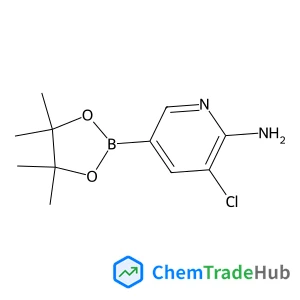
3-Chloro-5-(4,4,5,5-tetramethyl-1,3,2-dioxaborolan-2-yl)-2-pyridinamine
CAS番号:
1032758-99-8
分子式:
C11H16BClN2O2
![6-Benzyl-4,5,6,7-tetrahydro-1H-pyrazolo[3,4-c]pyridin-3(2H)-one structure](https://static.chemtradehub.com/structs/909/909187-64-0-f54f.webp "6-Benzyl-4,5,6,7-tetrahydro-1H-pyrazolo[3,4-c]pyridin-3(2H)-one structure")

![Pyrazolo[1,5-a]pyridine-3-carbothioamide structure](https://static.chemtradehub.com/structs/885/885275-44-5-aae0.webp "Pyrazolo[1,5-a]pyridine-3-carbothioamide structure")
おすすめサプライヤー




免責事項
このページに表示される学術雑誌情報は、参考および研究目的のみを目的としています。当社は雑誌出版社とは提携しておらず、投稿の取り扱いも行っておりません。出版に関するお問い合わせは、各雑誌出版社に直接ご連絡ください。
表示されている情報に誤りがある場合は、support@chemtradehub.com までご連絡ください。迅速に確認し、対応いたします。