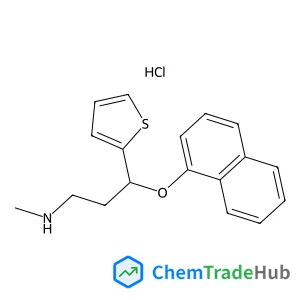
N-Methyl-3-(1-naphthyloxy)-3-(2-thienyl)-1-propanamine hydrochloride (1:1)
CAS番号:
1188266-11-6
分子式:
C18H20ClNOS
Olivier J. Dautel, Jean-Pierre Lère-Porte, Joël J. E. Moreau, Michel Wong Chi Man
A new method of hydrolysis–polycondensation of silsesquioxanes, the OG–HG (Organo Gel–Hybrid Gel or Organised Gel–Hydrolysed Gel) process allows the transcription of the supramolecular architecture of organogels to corresponding hybrid silsesquioxanes.
Alain Desbois, Julien Valton, Yohann Moreau, Stéphane Torelli, Vincent Nivière
DOI: 10.1039/D0CP03898A
Robert Medel, Martin A. Suhm
DOI: 10.1039/D1CP00342A
Bo-Hua Zhang, Jun-An Li, Min Wang, Ai-Min Ren, Teng-Fei He, Pan-Pan Lin, Yun-Li Zhang, Xiao-Yue Xi, Lu-Yi Zou
DOI: 10.1039/D0CP06269C
Taesoon Hwang, Rye-Gyeong Oh, Woosuk Cho, Maenghyo Cho, Kyeongjae Cho
DOI: 10.1039/D0CP06483A
Md. Habibur Rahman, Emdadul Haque Chowdhury, Didarul Ahasan Redwan, Shailee Mitra, Sungwook Hong
DOI: 10.1039/D0CP06426B
Brian K. Kendrick, Hui Li, Ming Li, Svetlana Kotochigova, Naduvalath Balakrishnan
DOI: 10.1039/D0CP05499B
Isabel Abril, Rafael Garcia-Molina
DOI: 10.1039/D0CP04951D
Chuan Liu, Shuaishuai Wang, Xuchun Wang, Xiangju Ye, Zirong Li, Jumeng Wei, Ping Cheng, Yingjie Li
DOI: 10.1039/D0CP06504H
Dipak Mazumdar, I. Das
DOI: 10.1039/D0CP06447E
Jie Sun, Yanyan Chen, Qian Wang
DOI: 10.1039/D0CP06390H
3-イチチルビフェニルは、ビフェニルとイチプロピオニトリルを回収率約90%で反応させて合成されます。触媒は通常、亜リチウムホウ素を用います。
8-溴-5-三氟甲基喹啉は、5-トリフルオロメチル-2-メチル-1,3-ベンゼンジオールをブロモエタノールと反応させて生成します。この反応は塩基性条件下で行われ...
ジメチル4-(4,4,5,5-テトラメチル-1,3,2-ドioxaborolan-2-基)-2,6-ピリジンジカルボイル酸フェニルアミニドの代替品としては、4-...
N-(3,5-ヘキサクロロ-4-ピリドインイル)-8-メチオキシ-5-キノリンカーボン酸の市場動向は、主に産業用途での需要により影響を受けます。研究トレンドとし...
イソステアロイルグリセリルは一般的に安全性が高いとされていますが、過度な使用や個人差により皮�owsん炎などの反応が起こる可能性があります。使用前に医師に相談す...
1-(二苯甲基)-3,3-二氟-氮杂环丁烷の市場動向は、医薬品や合成化学の研究分野で注目を集めています。新興研究は、該当化合物の合成改良と生体内での作用メカニズ...
3-チオフェンスチオールのCAS番号は7774-73-4です。結晶性の白色粉末で、分子量は122.17です。この化合物は水に微溶解し、エタノールやジクロロメタン...
2-Methyl-2-propanyl (2S)-2-(aminomethyl)-1-piperidinecarboxylateは一定の安全性基準を満たしていま...
CAS番号1316822-90-8の化合物は安全性に関しては評価が不足していますが、一般的には生物学的に活性な物質であり、取り扱いには適切な安全防護措置が必要で...
Tert-butyl 2-(2-羟基乙基)哌嗪-1-羧酸は、冷暗所で保存し、直射日光から遠ざけてください。容器は密閉し、高湿度や高温を避けて保管してください。

ChemComm publishes urgent research which is of outstanding significance and interest to experts in the field, while also appealing to the journal’s broad chemistry readership. Our communication format is ideally suited to short, urgent studies that are of such importance that they require accelerated publication. Our scope covers all topics in chemistry, and research at the interface of chemistry and other disciplines (such as materials science, nanoscience, physics, engineering and biology) where there is a significant novelty in the chemistry aspects. Major topic areas covered include: Analytical Chemistry Catalysis Chemical Biology and medicinal chemistry Computational Chemistry and Machine Learning Energy and sustainable chemistry Environmental Chemistry Green Chemistry Inorganic Chemistry Materials Chemistry Nanoscience Organic Chemistry Physical Chemistry Polymer Chemistry Supramolecular Chemistry

![N-{[(2-Methyl-2-propanyl)oxy]carbonyl}-L-methionylglycine structure](https://static.chemtradehub.com/structs/234/23446-03-9-e1e5.webp "N-{[(2-Methyl-2-propanyl)oxy]carbonyl}-L-methionylglycine structure")