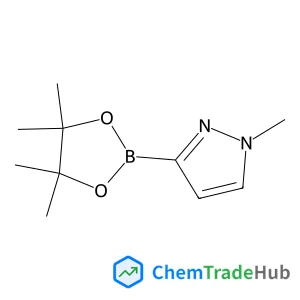
1-Methyl-3-(4,4,5,5-tetramethyl-1,3,2-dioxaborolan-2-yl)-1H-pyrazole
CAS番号:
1020174-04-2
分子式:
C10H17BN2O2
A. Fuerte, M. D. Hernández-Alonso, A. Iglesias-Juez, A. Martínez-Arias, J. C. Conesa, J. Soria, M. Fernández-García
Thermal and hydrothermal treatments were applied to two amorphous Ti–W mixed oxide precursors with varying W ∶ Ti atomic ratio to obtain nanostructured particles having different properties. The photocatalytic behavior of these Ti–W mixed oxides has been tested in the photoelimination of toluene using sunlight-type excitation. These materials were prepared by a microemulsion method and their physico-chemical properties were characterized by a multitechnique approach using X-ray diffraction and photoelectron spectroscopy, as well as Raman and UV-vis spectroscopies. All samples contain substitutionally disordered Ti–W mixed oxides with anatase-type structure. The hydrothermal treatment allows introduction of a larger quantity of W into the anatase structure and produces particles with lower particle size and a moderate surface W enrichment (dependent upon treatment conditions). A Fourier transform infrared (FTIR) investigation of the catalysts under conditions prevailing during the test photoreaction together with EPR experiments of oxygen activation and DMPO spin trapping were carried out in an attempt to clarify the different photoactivities of the samples. W insertion into the anatase structure appears to potentially affect photoactivity using sunlight-type excitation by three different factors, namely the increasing absorption power in the visible region, the presence of surface W centers enhancing oxygen activation and, finally, the creation of new surface centers with modified interaction with toluene. The dependence of these factors on the preparation method and conditions and their influence on the photocatalytic activity of Ti–W systems are analyzed.
Weizhao Cai, Rong Zhang, Shanti Deemyad
DOI: 10.1039/C6CP08171A
Carlie M. Novak, Ryan C. Fortenberry
DOI: 10.1039/C6CP08140A
Vladimir I. Novoderezhkin, Elisabet Romero, Javier Prior, Rienk van Grondelle
DOI: 10.1039/C6CP07308E
Xiaoli Sun
DOI: 10.1039/C6CP07690D
Katharine Moore Tibbetts, Xiao-Jiang Feng, Herschel Rabitz
DOI: 10.1039/C6CP06187G
Wook Lee, Spiridoula Matsika
DOI: 10.1039/C6CP05604K
L. A. Ferreira, V. N. Uversky, B. Y. Zaslavsky
DOI: 10.1039/C6CP08214A
Guohai Deng, Xuelin Dong, Qifan Liu, Dingqing Li, Hongmin Li, Qiao Sun, Xiaoqing Zeng
DOI: 10.1039/C6CP08125H
Ignacio Fdez. Galván, Daniel Roca-Sanjuán, Erick L. Bastos, Wilhelm J. Baader, Roland Lindh
DOI: 10.1039/C6CP08154A
2-溴-9,9-二苯基芴は、医薬品、工業材料、有機合成の研究分野で応用されます。特に、レーザー材料や機能性ポリマーの合成に使用されることがあります。また、蛍光色...
四氯化铱の市場は研究開発分野で注目されており、特にナノ技術や金属有機框架(MOFs)の分野での需要が増加傾向にあります。価格は安定しており、中国や韓国での生産が...
1-(4-溴-3-氟苯基)-2-氯乙酮 (CAS番号: 1260857-14-4) の廃棄物は専門的な廃棄処理が必要です。まず、廃棄物は密閉された容器に収集し、...
苦参酚Kは、CAS番号101236-49-1を持つ化合物で、主に天然由来の生薬から抽出されます。この化合物は、抗炎症作用や抗癌作用を持つことが報告されています。
POTASSIUM (1-(TERTBUTOXYCARBONYL)AZETIDIN-3-YL)TRIFLUOROBORATE を含む廃棄物は、まず安全なエント...
4-庚基-4’-聯苯羧酸は、特殊化学品や合成化学の分野で用いられる化学物質ですが、市場動向としては、研究開発の進展とともに需要が増加しています。また、環境配慮型...
6-ブロモ-3-メトキシ-1-フェニル-1H-インドゾールを含む廃棄物は、適切な化学廃棄処理が必要です。通常、廃棄物は密閉容器に収集され、専門の廃棄処理業者に引...
4,4-二甲基-2-吡咯烷酮は医薬、ポリマー、センサー、半導体などの業界で広く使用されています。特に溶媒としての性能が高く評価されています。

Physical Chemistry Chemical Physics (PCCP) is an international journal co-owned by 19 physical chemistry and physics societies from around the world. This journal publishes original, cutting-edge research in physical chemistry, chemical physics and biophysical chemistry. To be suitable for publication in PCCP, articles must include significant innovation and/or insight into physical chemistry; this is the most important criterion that reviewers and Editors will judge against when evaluating submissions. The journal has a broad scope and welcomes contributions spanning experiment, theory, computation and data science. Topical coverage includes spectroscopy, dynamics, kinetics, statistical mechanics, thermodynamics, electrochemistry, catalysis, surface science, quantum mechanics, quantum computing and machine learning. Interdisciplinary research areas such as polymers and soft matter, materials, nanoscience, energy, surfaces/interfaces, and biophysical chemistry are welcomed if they demonstrate significant innovation and/or insight into physical chemistry. Joined experimental/theoretical studies are particularly appreciated when complementary and based on up-to-date approaches.