












![N-{3-[Benzyl(methyl)amino]propyl}-9-chloro-5,6,7,8-tetrahydro-2-acridinecarboxamide structure](https://static.chemtradehub.com/structs/142/1426944-49-1-1e4c.webp "N-{3-[Benzyl(methyl)amino]propyl}-9-chloro-5,6,7,8-tetrahydro-2-acridinecarboxamide structure")
The effect of gravity on the rate of a simple neutralisation reaction in a small, open cylindrical vessel
文献情報
出版日
2002-03-19
DOI
10.1039/B110795J
インパクトファクター
3.676
著者
David F. Fletcher
原文を見る
要旨
We have examined the local and global evolution of the extent of neutralisation in an upright cylindrical flow reactor with a rigid adiabatic base and sidewall but with an open top. The cylinder is initially filled with a dilute aqueous solution of a strong base or a strong acid. A dilute solution of strong acid or strong base is injected as a steady Poiseuille flow towards the centre of the base of the reactor through a large capillary tube coaxial with the cylindrical reactor. Computational fluid dynamics modelling, using the finite-volume method, indicates that each neutralisation reaction progresses at a significantly different rate under conditions of normal terrestrial gravity and microgravity. The gravitational dependence of the conversion of acid or base to salt and water is attributed to secondary flows due, largely, to buoyancy forces associated with the dependence of the local liquid density on the local chemical composition. The influence of these secondary flows on the spatial distribution of the salty product is illustrated. For the rather dilute solutions examined here we find excellent agreement between results from our weakly compressible hydrodynamic treatment and those from a more standard analysis employing the Boussinesq approximation.
関連文献
N-terminal PEGylated cellulase: a high stability enzyme in 1-butyl-3-methylimidazolium chloride
Lu Li, Juan Xie, Shitao Yu, Zhongliang Su, Shiwei Liu, Fusheng Liu, Congxia Xie, Baoquan Zhang, Chenggang Zhang
2013-03-22
Paper
DOI: 10.1039/C3GC40104A
Cellulose-derived superparamagnetic carbonaceous solid acid catalyst for cellulose hydrolysis in an ionic liquid or aqueous reaction system
Haixin Guo, Youfen Lian, Lulu Yan, Xinhua Qi, Richard Lee Smith, Jr.
2013-05-14
Paper
DOI: 10.1039/C3GC40433A
Organic solvent-free and efficient manufacture of functionalized cellulose nanocrystalsvia one-pot tandem reactions
Lirong Tang, Biao Huang, Nating Yang, Tao Li, Qilin Lu, Wenyi Lin, Xuerong Chen
2013-06-26
Communication
DOI: 10.1039/C3GC40965A
Photoassisted synthesis of manganese oxide nanostructures using visible light at room temperature
Lavinia Balan, Loïc Vidal
2013-06-11
Paper
DOI: 10.1039/C3GC40487K
Reactions of hydrophobic organic nanoparticle mixtures in water: nanoparticle-on-nanoparticle oxidative dye bleaching
Marco Giardiello, Tom O. McDonald, Jet-Sing Lee, Aled D. Roberts, Andrew Owen, Steve P. Rannard
2013-04-12
Paper
DOI: 10.1039/C3GC40573G
Comparative performance evaluation and systematic screening of solvents in a range of Grignard reactions
Asha Kadam, Mylinh Nguyen, Michael Kopach, Paul Richardson, Fabrice Gallou, Zhao-Kui Wan, Wei Zhang
2013-05-03
Paper
DOI: 10.1039/C3GC40702K
Photocatalysis on supported gold and silver nanoparticles under ultraviolet and visible light irradiation
Sarina Sarina, Eric R. Waclawik, Huaiyong Zhu
2013-05-10
Tutorial Review
DOI: 10.1039/C3GC40450A
Catalytic conversion of biomass-derived levulinic acid to valerate esters as oxygenated fuels using supported ruthenium catalysts
Tao Pan, Jin Deng, Qing Xu, Yang Xu, Qing-Xiang Guo, Yao Fu
2013-08-13
Paper
DOI: 10.1039/C3GC40927A
Atom-economical in situ synthesis of BaSO4 as imaging contrast agents within poly(N-isopropylacrylamide) microgels using one-step droplet microfluidics
Qin Wang, Di Zhang, Xiangliang Yang, Huibi Xu, Amy Q. Shen, Yajiang Yang
2013-06-03
Paper
DOI: 10.1039/C3GC40728D
こちらもおすすめ
化合物よくある質問
4-アミノフェノール酸ナトリウム水和物とは何ですか?
4-アミノフェノール酸ナトリウム水和物は、CAS番号206557-08-6の化合物で、4-アミノフェノールとナトリウムが結合した塩と水和物です。この化合物は、白...
206557-08-64-Aminobenzoic acid ...
化合物よくある質問
Methyl 3-methyl-N-{[(2-methyl-2-propanyl)oxy]carbonyl}-L-histidinateの代替品はありますか?
この化合物は特定の合成プロセスに使用される可能性がありますが、代替品として、他の类似的な化合物、例えばMethyl 3-methyl-N-{[(2-methyl...
72212-51-2Methyl 3-methyl-N-{[...
化合物よくある質問
4-Boc-2-哌嗪甲酸の市場動向や研究トレンドはどうですか?
4-Boc-2-哌嗪甲酸は、薬品開発や合成化学分野で広く使用されており、その需要は継続的に推移しています。特に、新薬開発における合成化学分野での需要が高まってい...
192330-11-3(2R)-4-[(tert-butoxy...
化合物よくある質問
4,4'-二羟甲基联苯の物理化学的性質は何ですか?
4,4'-二羟甲基联苯のCAS番号は1667-12-5です。この化合物は白色の結晶粉末で、分子量は154.20です。水にわずかに溶けますが、アルコールや有機溶媒...
1667-12-54,4'-Biphenyldiyldim...
化合物よくある質問
5-甲硫基戊腈はどの業界で使用されていますか?
5-甲硫基戊腈は医薬品産業で使用される可能性があります。また、ポリマー合成の触媒として、センサー製造の一部として、半導体製造のプロセス改善に使用される可能性があ...
59121-25-45-(Methylsulfanyl)pe...
化合物よくある質問
CAS番号1311961-50-8の化合物はどのように合成されますか?
この化合物は、1-abieta-8,11,13-trien-19-イルと6'-メトキシシンコナナン-9-基を含有する窒素含有化合物から合成されます。一般的な合成...
1311961-50-81-Abieta-8,11,13-tri...
化合物よくある質問
6-ブロモベンジジミダゾール-2-カルビルデオキシドはどのように保存すればよいですか?
6-ブロモベンジジミダゾール-2-カルビルデオキシドは、避光・乾燥した容器(密閉容器)で-20℃~4℃の低温で保存してください。高温や直射日光、湿気は避けてくだ...
885280-26-25-Bromo-1H-benzimida...
化合物よくある質問
Boc-N-甲基氨甲环酸とは何ですか?
621-65-8のCAS番号を持つBoc-N-甲基氨甲环酸は、化学式C7H13NO5を有する化合物です。この化合物は白色の結晶性粉末で、吸湿性があります。
621-65-83-Hydroxy-1,2-propan...
化合物よくある質問
乙基三氟硼酸钾はどのように合成されますか?
乙基三氟硼酸钾は、トリフLUオール酸カリウムとエチルブロミドを反応させて合成されます。この反応は高い選択性と収率を持ち、触媒を用いることで効率的に進行します。
882871-21-8Potassium ethyltrifl...
化合物よくある質問
2-フロウロ-5-クロロ-4-アミノフェノールはどのように保存すればよいですか?
2-フロウロ-5-クロロ-4-アミノフェノールは、直射日光を避けて冷却された暗所で保存し、密閉容器に保管してください。温度は常温か低温が適しています。
847872-10-04-Amino-5-chloro-2-f...
掲載誌
Physical Chemistry Chemical Physics

CiteScore:
5.5
自己引用率:
10.3%
年間論文数:
3036
Physical Chemistry Chemical Physics (PCCP) is an international journal co-owned by 19 physical chemistry and physics societies from around the world. This journal publishes original, cutting-edge research in physical chemistry, chemical physics and biophysical chemistry. To be suitable for publication in PCCP, articles must include significant innovation and/or insight into physical chemistry; this is the most important criterion that reviewers and Editors will judge against when evaluating submissions. The journal has a broad scope and welcomes contributions spanning experiment, theory, computation and data science. Topical coverage includes spectroscopy, dynamics, kinetics, statistical mechanics, thermodynamics, electrochemistry, catalysis, surface science, quantum mechanics, quantum computing and machine learning. Interdisciplinary research areas such as polymers and soft matter, materials, nanoscience, energy, surfaces/interfaces, and biophysical chemistry are welcomed if they demonstrate significant innovation and/or insight into physical chemistry. Joined experimental/theoretical studies are particularly appreciated when complementary and based on up-to-date approaches.
おすすめ化合物
![(4aR,5S,6R,8aS)-5-[2-(3-Furyl)ethyl]-8a-(hydroxymethyl)-5,6-dimethyl-3,4,4a,5,6,7,8,8a-octahydro-1-naphthalenecarboxylic acid structure](https://static.chemtradehub.com/structs/184/18411-75-1-d4cd.webp "(4aR,5S,6R,8aS)-5-[2-(3-Furyl)ethyl]-8a-(hydroxymethyl)-5,6-dimethyl-3,4,4a,5,6,7,8,8a-octahydro-1-naphthalenecarboxylic acid structure")
![[3-(2,6-Dichlorophenyl)-5-isopropyl-1,2-oxazol-4-yl]methanol structure](https://static.chemtradehub.com/structs/278/278597-30-1-5c79.webp "[3-(2,6-Dichlorophenyl)-5-isopropyl-1,2-oxazol-4-yl]methanol structure")
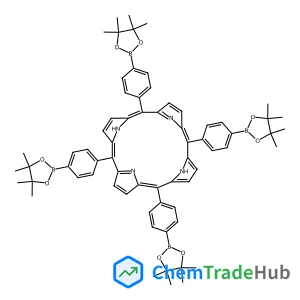
5,10,15,20-tetrakis(4-boronic acid pinacol ester phenyl) porphyrin
CAS番号:
1332748-00-1
分子式:
C68H74B4N4O8
おすすめサプライヤー





免責事項
このページに表示される学術雑誌情報は、参考および研究目的のみを目的としています。当社は雑誌出版社とは提携しておらず、投稿の取り扱いも行っておりません。出版に関するお問い合わせは、各雑誌出版社に直接ご連絡ください。
表示されている情報に誤りがある場合は、support@chemtradehub.com までご連絡ください。迅速に確認し、対応いたします。