












C–H stretching vibrations of benzene and toluene in their S1 states observed by double resonance vibrational spectroscopy in supersonic jets
文献情報
出版日
2002-03-19
DOI
10.1039/B108039C
インパクトファクター
3.676
著者
Chika Minejima, Takayuki Ebata, Naohiko Mikami
原文を見る
要旨
An investigation of CH stretching vibrations in benzene and toluene in their S1 states has been carried out using UV–IR and stimulated Raman–UV double resonance spectroscopic methods. In benzene two CH stretching vibrations, namely ν′20 and ν′2, were observed, and in the case of toluene both aromatic CH and methyl CH stretching vibrations were observed. The ν′20 of benzene is strongly coupled with ν′8 + ν′14via anharmonic resonance. The aromatic CH stretching vibrations in toluene also exhibit strong anharmonic resonance, leading to the appearance of a large number of bands in the 3000–3100 cm−1 region. The observed frequencies of CH stretching vibrations in the S1 state in both benzene and toluene are higher than the corresponding values in the S0 state. On the other hand, methyl CH stretching vibrations in the S1 state of toluene occur at a lower frequency than those in the S0 state.
関連文献
A palladium complex with functionalized β-cyclodextrin: a promising catalyst featuring recognition abilities for Suzuki–Miyaura coupling reactions in water
Guofu Zhang, Yuxin Luan, Xingwang Han, Yong Wang, Xin Wen, Chengrong Ding, Jianrong Gao
2013-06-04
Communication
DOI: 10.1039/C3GC40645H
In situ coating of diatom frustules with silver nanoparticles
Jeremiah Toster, Qin Lin Zhou, Nicole M. Smith, K. Swaminathan Iyer, Federico Rosei, Colin L. Raston
2013-06-11
Communication
DOI: 10.1039/C3GC40660A
Lewis-base-promoted copper-based catalyst for highly efficient hydrogenation of dimethyl 1,4-cyclohexane dicarboxylate
Shaoyan Zhang, Guoli Fan, Feng Li
2013-07-16
Communication
DOI: 10.1039/C3GC40658J
Methods for the regeneration of nicotinamidecoenzymes
Hong Wu, Chunyong Tian, Xiaokai Song, Chuang Liu, Dong Yang, Zhongyi Jiang
2013-04-03
Critical Review
DOI: 10.1039/C3GC37129H
Aerobic oxidation of primary aliphatic alcohols over bismuth oxide supported platinum catalysts in water
Zhongtian Du, Hong Ma, Jie Xu
2013-05-17
Paper
DOI: 10.1039/C3GC40730F
Eliminating ammonia emissions during rare earth separation through control of equilibrium acidity in a HEH(EHP)-Cl system
2013-04-23
Paper
DOI: 10.1039/C3GC40470F
An efficient electrochemical method for the atom economical synthesis of some benzoxazole derivatives
Hamid Salehzadeh, Davood Nematollahi, Hooman Hesari
2013-06-20
Paper
DOI: 10.1039/C3GC40954F
Selective aqueous phase oxidation of 5-hydroxymethylfurfural to 2,5-furandicarboxylic acid over Pt/C catalysts: influence of the base and effect of bismuth promotion
Hicham Ait Rass, Nadine Essayem, Michèle Besson
2013-06-10
Paper
DOI: 10.1039/C3GC40727F
Development of GSK's reagent guides – embedding sustainability into reagent selection
Joseph P. Adams, Catherine M. Alder, Ian Andrews, Ann M. Bullion, Matthew Campbell-Crawford, Michael G. Darcy, John D. Hayler, Richard K. Henderson, Catriona A. Oare, Israil Pendrak, Anikó M. Redman, Leanna E. Shuster, Helen F. Sneddon, Matthew D. Walker
2013-04-22
Paper
DOI: 10.1039/C3GC40225H
こちらもおすすめ
化合物よくある質問
4-アミノフェノール酸ナトリウム水和物とは何ですか?
4-アミノフェノール酸ナトリウム水和物は、CAS番号206557-08-6の化合物で、4-アミノフェノールとナトリウムが結合した塩と水和物です。この化合物は、白...
206557-08-64-Aminobenzoic acid ...
化合物よくある質問
Methyl 3-methyl-N-{[(2-methyl-2-propanyl)oxy]carbonyl}-L-histidinateの代替品はありますか?
この化合物は特定の合成プロセスに使用される可能性がありますが、代替品として、他の类似的な化合物、例えばMethyl 3-methyl-N-{[(2-methyl...
72212-51-2Methyl 3-methyl-N-{[...
化合物よくある質問
4-Boc-2-哌嗪甲酸の市場動向や研究トレンドはどうですか?
4-Boc-2-哌嗪甲酸は、薬品開発や合成化学分野で広く使用されており、その需要は継続的に推移しています。特に、新薬開発における合成化学分野での需要が高まってい...
192330-11-3(2R)-4-[(tert-butoxy...
化合物よくある質問
4,4'-二羟甲基联苯の物理化学的性質は何ですか?
4,4'-二羟甲基联苯のCAS番号は1667-12-5です。この化合物は白色の結晶粉末で、分子量は154.20です。水にわずかに溶けますが、アルコールや有機溶媒...
1667-12-54,4'-Biphenyldiyldim...
化合物よくある質問
5-甲硫基戊腈はどの業界で使用されていますか?
5-甲硫基戊腈は医薬品産業で使用される可能性があります。また、ポリマー合成の触媒として、センサー製造の一部として、半導体製造のプロセス改善に使用される可能性があ...
59121-25-45-(Methylsulfanyl)pe...
化合物よくある質問
CAS番号1311961-50-8の化合物はどのように合成されますか?
この化合物は、1-abieta-8,11,13-trien-19-イルと6'-メトキシシンコナナン-9-基を含有する窒素含有化合物から合成されます。一般的な合成...
1311961-50-81-Abieta-8,11,13-tri...
化合物よくある質問
6-ブロモベンジジミダゾール-2-カルビルデオキシドはどのように保存すればよいですか?
6-ブロモベンジジミダゾール-2-カルビルデオキシドは、避光・乾燥した容器(密閉容器)で-20℃~4℃の低温で保存してください。高温や直射日光、湿気は避けてくだ...
885280-26-25-Bromo-1H-benzimida...
化合物よくある質問
Boc-N-甲基氨甲环酸とは何ですか?
621-65-8のCAS番号を持つBoc-N-甲基氨甲环酸は、化学式C7H13NO5を有する化合物です。この化合物は白色の結晶性粉末で、吸湿性があります。
621-65-83-Hydroxy-1,2-propan...
化合物よくある質問
乙基三氟硼酸钾はどのように合成されますか?
乙基三氟硼酸钾は、トリフLUオール酸カリウムとエチルブロミドを反応させて合成されます。この反応は高い選択性と収率を持ち、触媒を用いることで効率的に進行します。
882871-21-8Potassium ethyltrifl...
化合物よくある質問
2-フロウロ-5-クロロ-4-アミノフェノールはどのように保存すればよいですか?
2-フロウロ-5-クロロ-4-アミノフェノールは、直射日光を避けて冷却された暗所で保存し、密閉容器に保管してください。温度は常温か低温が適しています。
847872-10-04-Amino-5-chloro-2-f...
掲載誌
Physical Chemistry Chemical Physics

CiteScore:
5.5
自己引用率:
10.3%
年間論文数:
3036
Physical Chemistry Chemical Physics (PCCP) is an international journal co-owned by 19 physical chemistry and physics societies from around the world. This journal publishes original, cutting-edge research in physical chemistry, chemical physics and biophysical chemistry. To be suitable for publication in PCCP, articles must include significant innovation and/or insight into physical chemistry; this is the most important criterion that reviewers and Editors will judge against when evaluating submissions. The journal has a broad scope and welcomes contributions spanning experiment, theory, computation and data science. Topical coverage includes spectroscopy, dynamics, kinetics, statistical mechanics, thermodynamics, electrochemistry, catalysis, surface science, quantum mechanics, quantum computing and machine learning. Interdisciplinary research areas such as polymers and soft matter, materials, nanoscience, energy, surfaces/interfaces, and biophysical chemistry are welcomed if they demonstrate significant innovation and/or insight into physical chemistry. Joined experimental/theoretical studies are particularly appreciated when complementary and based on up-to-date approaches.
おすすめ化合物
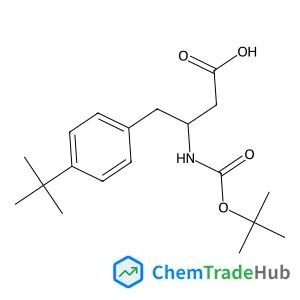
(S)-3-((tert-Butoxycarbonyl)amino)-4-(4-(tert-butyl)phenyl)butanoic acid
CAS番号:
403661-85-8
分子式:
C19H29NO4
おすすめサプライヤー





免責事項
このページに表示される学術雑誌情報は、参考および研究目的のみを目的としています。当社は雑誌出版社とは提携しておらず、投稿の取り扱いも行っておりません。出版に関するお問い合わせは、各雑誌出版社に直接ご連絡ください。
表示されている情報に誤りがある場合は、support@chemtradehub.com までご連絡ください。迅速に確認し、対応いたします。