












Solid-state NMR study of mesoporous phosphoro-vanado-aluminas
文献情報
出版日
2000-10-30
DOI
10.1039/B005598K
インパクトファクター
3.676
著者
Régis D. Gougeon, Philippe R. Bodart, Robin K. Harris, Dina M. Kolonia, Dimitris E. Petrakis, Philippos J. Pomonis
原文を見る
要旨
The structures of mesoporous solids of abbreviated formula Al100PxVy where x, y = 0, 5, 10 have been characterised by multinuclear magnetic resonance techniques. 31P MAS spectra indicate that two phosphorus environments (threefold or fourfold O–Al coordination) are incorporated within the aluminium network. 51V magic-angle spinning (MAS) spectra suggest that vanadium species are not (or only weakly) incorporated into the alumina network, forming V2O5-like and tetrahedral species at the surface of the pores. 27Al MAS spectra show that amorphous AlPO4 species are formed upon addition of phosphorus, already occurring for the lower phosphorus input. However, 27Al triple-quantum (3Q)-MAS cannot detect this amorphous AlPO4 phase, therefore indicating distorted environments close to the surface. For the Al100P10V10 sample, crystalline AlPO4 is detected. 31P–{27Al} and 31P–{51V} TRAPDOR experiments confirm that all the phosphorus atoms are surrounded by at least three aluminium atoms in the second coordination sphere, and suggest the heterogeneous location of vanadium species at the surface of the mesopores.
関連文献
A simple and efficient method for synthesis of 5-substituted 2′-deoxyuridine nucleosides using metal–halogen exchange reaction of 5-iodo-2′-deoxyuridine sodium salt
Mariko Aso, Toshiyuki Kaneko, Morihide Nakamura, Noboru Koga, Hiroshi Suemune
2003-04-02
Communication
DOI: 10.1039/B301425H
Control of Al distribution in ZSM-5 by conditions of zeolite synthesis
2003-04-23
Communication
DOI: 10.1039/B301634J
Zn-Proline catalyzed direct aldol reaction in aqueous media
Tamis Darbre, Miguel Machuqueiro
2003-03-31
Communication
DOI: 10.1039/B301117H
TEM stereo-imaging of mesoporous zeolite single crystals
Iver Schmidt, Anna Carlsson, Søren Dahl, Michael Brorson, Claus J. H. Jacobsen
2003-03-14
Communication
DOI: 10.1039/B212646J
Halogen-induced selectivity in heterogeneous epoxidation is an electronic effect—fluorine, chlorine, bromine and iodine in the Ag-catalysed selective oxidation of ethene
Richard M. Lambert, Rachael L. Cropley, Alifiya Husain, Mintcho S. Tikhov
2003-04-16
Communication
DOI: 10.1039/B302620E
Non-covalent switch for intramolecular energy transfer
Joe Otsuki, Akane Yasuda, Toshio Takido
2003-02-05
Communication
DOI: 10.1039/B212912D
Synthesis of a η2-2,3-diphosphabutadiene complex of zerovalent platinum from the corresponding η2-phosphaalkyne complex
Maria Helena Araujo, Peter B. Hitchcock, John F. Nixon, Uwe Kuehner, Othmar Stelzer
2003-04-02
Communication
DOI: 10.1039/B301335A
Remarkable effects of counter ions on scandium ion-promoted electron transfer reactions
Junpei Yuasa, Tomoyoshi Suenobu, Kei Ohkubo, Shunichi Fukuzumi
2003-04-02
Communication
DOI: 10.1039/B300543G
Pyridine–sugar conjugates as potent inhibitors of enzyme-catalysed glycosidehydrolysis
Peter A. Nkansah, Alan H. Haines, N. Patrick J. Stamford
2003-02-20
Communication
DOI: 10.1039/B211399F
Highly regio- and stereoselective four-component iodoamination of Se-substituted allenes. an efficient synthesis of N-(3-organoseleno-2-iodo-2(Z)-propenyl) acetamides
Xueshi Hao, Xian Huang
2003-04-02
Communication
DOI: 10.1039/B300879G
こちらもおすすめ
化合物よくある質問
2-ブロモ-9,9-ジフェニル-9H-フルオレンの主な用途は何ですか?
2-溴-9,9-二苯基芴は、医薬品、工業材料、有機合成の研究分野で応用されます。特に、レーザー材料や機能性ポリマーの合成に使用されることがあります。また、蛍光色...
474918-32-62-Bromo-9,9-diphenyl...
化合物よくある質問
四氯化铱の市場動向や研究トレンドはどうですか?
四氯化铱の市場は研究開発分野で注目されており、特にナノ技術や金属有機框架(MOFs)の分野での需要が増加傾向にあります。価格は安定しており、中国や韓国での生産が...
207399-11-9Tetrachloroiridium h...
882-06-44-Nitrocinnamic acid
化合物よくある質問
1-(4-溴-3-氟苯基)-2-氯乙酮を含む廃棄物はどのように処理すべきですか?
1-(4-溴-3-氟苯基)-2-氯乙酮 (CAS番号: 1260857-14-4) の廃棄物は専門的な廃棄処理が必要です。まず、廃棄物は密閉された容器に収集し、...
1260857-14-41-(4-Bromo-3-fluorop...
化合物よくある質問
苦参酚Kとは何ですか?
苦参酚Kは、CAS番号101236-49-1を持つ化合物で、主に天然由来の生薬から抽出されます。この化合物は、抗炎症作用や抗癌作用を持つことが報告されています。
101236-49-1Kushenol K
化合物よくある質問
POTASSIUM (1-(TERTBUTOXYCARBONYL)AZETIDIN-3-YL)TRIFLUOROBORATE を含む廃棄物はどのように処理すべきですか?
POTASSIUM (1-(TERTBUTOXYCARBONYL)AZETIDIN-3-YL)TRIFLUOROBORATE を含む廃棄物は、まず安全なエント...
1430219-73-0Potassium (1-(tert-b...
化合物よくある質問
4-庚基-4’-联苯羧酸の市場動向や研究トレンドはどうですか?
4-庚基-4’-聯苯羧酸は、特殊化学品や合成化学の分野で用いられる化学物質ですが、市場動向としては、研究開発の進展とともに需要が増加しています。また、環境配慮型...
58573-94-74'-Heptyl-4-biphenyl...
化合物よくある質問
6-ブロモ-3-メトキシ-1-フェニル-1H-インドゾールを含む廃棄物はどのように処理すべきですか?
6-ブロモ-3-メトキシ-1-フェニル-1H-インドゾールを含む廃棄物は、適切な化学廃棄処理が必要です。通常、廃棄物は密閉容器に収集され、専門の廃棄処理業者に引...
1332527-03-36-Bromo-3-methoxy-1-...
化合物よくある質問
4,4-二甲基-2-吡咯烷酮はどの業界で使用されていますか?
4,4-二甲基-2-吡咯烷酮は医薬、ポリマー、センサー、半導体などの業界で広く使用されています。特に溶媒としての性能が高く評価されています。
66899-02-34,4-dimethylpyrrolid...
51312-42-6Sodium Phosphotungst...
掲載誌
Physical Chemistry Chemical Physics

CiteScore:
5.5
自己引用率:
10.3%
年間論文数:
3036
Physical Chemistry Chemical Physics (PCCP) is an international journal co-owned by 19 physical chemistry and physics societies from around the world. This journal publishes original, cutting-edge research in physical chemistry, chemical physics and biophysical chemistry. To be suitable for publication in PCCP, articles must include significant innovation and/or insight into physical chemistry; this is the most important criterion that reviewers and Editors will judge against when evaluating submissions. The journal has a broad scope and welcomes contributions spanning experiment, theory, computation and data science. Topical coverage includes spectroscopy, dynamics, kinetics, statistical mechanics, thermodynamics, electrochemistry, catalysis, surface science, quantum mechanics, quantum computing and machine learning. Interdisciplinary research areas such as polymers and soft matter, materials, nanoscience, energy, surfaces/interfaces, and biophysical chemistry are welcomed if they demonstrate significant innovation and/or insight into physical chemistry. Joined experimental/theoretical studies are particularly appreciated when complementary and based on up-to-date approaches.
おすすめ化合物
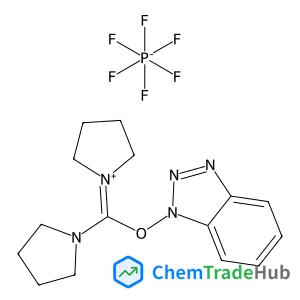
(1H-Benzotriazol-1-yloxy)(di-1-pyrrolidinyl)methylium hexafluorophosphate
CAS番号:
105379-24-6
分子式:
C15H21F6N5OP

おすすめサプライヤー






免責事項
このページに表示される学術雑誌情報は、参考および研究目的のみを目的としています。当社は雑誌出版社とは提携しておらず、投稿の取り扱いも行っておりません。出版に関するお問い合わせは、各雑誌出版社に直接ご連絡ください。
表示されている情報に誤りがある場合は、support@chemtradehub.com までご連絡ください。迅速に確認し、対応いたします。