












Structures and phase transitions in aqueous dispersions of branched-chain glycerophosphoethanolamines
文献情報
出版日
2000-09-18
DOI
10.1039/B003516P
インパクトファクター
3.676
著者
Frank Bringezu, Gert Rapp, Bodo Dobner, Peter Nuhn, Gerald Brezesinski
原文を見る
要旨
Glycerophosphoethanolamines with α-branched fatty acids were synthesized, varying the side-chain length. Differential scanning calorimetry and X-ray diffraction were applied to investigate the influence of the chemical alteration on the physico-chemical parameters and the structures formed in lipid–water dispersions. The results show that the introduction and stepwise elongation of side-chains decrease the transition temperature from gel to liquid-crystalline phases. The Tm values pass through a minimum and increase slightly on going to the triple-chain lipid. The change in the transition parameters is connected with a modified polymorphism. Short side-chains induce a tilt in the gel state and the elongation of the branch leads to interdigitated gel phases. With increasing side-chain length, non-lamellar liquid-crystalline phases are stabilized. For the long-branched derivative, an interdigitation of head-groups from adjacent bilayers is proposed.
関連文献
Opal gel templated synthesis of oblate titania opal materials
Lijun Ji, Jianhua Rong, Zhenzhong Yang
2003-04-02
Communication
DOI: 10.1039/B300825H
A miniature biofuel cell operating at 0.78 V
Nicolas Mano, Fei Mao, Ting Chen, Adam Heller
2003-01-21
Communication
DOI: 10.1039/B211796G
Regiocontrolled Ru-catalyzed addition of carboxylic acids to alkynes: practical protocols for the synthesis of vinyl esters
2003-02-17
Communication
DOI: 10.1039/B211277A
Control of Al distribution in ZSM-5 by conditions of zeolite synthesis
2003-04-23
Communication
DOI: 10.1039/B301634J
Synthesis and characterization of highly ordered functional mesoporous silica thin films with positively chargeable –NH2 groups
Nanguo Liu, Roger A. Assink, Bernd Smarsly
2003-04-16
Communication
DOI: 10.1039/B301910A
A ruthenium catalyst that does not require an N–H ligand to achieve high enantioselectivity for hydrogenation of an alkyl-aryl ketone
Carolyn G. Leong, Okwado M. Akotsi, Michael J. Ferguson, Steven H. Bergens
2003-02-25
Communication
DOI: 10.1039/B212544G
Novel and efficient chiral sulfideoxathiane ligands for palladium-catalyzed asymmetric allylic alkylation
Yuko Okuyama, Hiroto Nakano, Kouichi Takahashi, Hiroshi Hongo, Chizuko Kabuto
2003-01-17
Communication
DOI: 10.1039/B211031H
Cationic benzyl zirconium heteroscorpionates: synthesis and characterization of a novel ethylene polymerisation catalyst showing an unusual temperature dependent polymerisation mechanism
Stefano Milione, Cosimo Montefusco, Tomas Cuenca, Alfonso Grassi
2003-04-16
Communication
DOI: 10.1039/B301997G
A new dark quencher for use in genetic analysis
Jonathan P. May, Lynda J. Brown, Ivo Rudloff, Tom Brown
2003-03-18
Communication
DOI: 10.1039/B300934C
こちらもおすすめ
化合物よくある質問
2-ブロモ-9,9-ジフェニル-9H-フルオレンの主な用途は何ですか?
2-溴-9,9-二苯基芴は、医薬品、工業材料、有機合成の研究分野で応用されます。特に、レーザー材料や機能性ポリマーの合成に使用されることがあります。また、蛍光色...
474918-32-62-Bromo-9,9-diphenyl...
化合物よくある質問
四氯化铱の市場動向や研究トレンドはどうですか?
四氯化铱の市場は研究開発分野で注目されており、特にナノ技術や金属有機框架(MOFs)の分野での需要が増加傾向にあります。価格は安定しており、中国や韓国での生産が...
207399-11-9Tetrachloroiridium h...
882-06-44-Nitrocinnamic acid
化合物よくある質問
1-(4-溴-3-氟苯基)-2-氯乙酮を含む廃棄物はどのように処理すべきですか?
1-(4-溴-3-氟苯基)-2-氯乙酮 (CAS番号: 1260857-14-4) の廃棄物は専門的な廃棄処理が必要です。まず、廃棄物は密閉された容器に収集し、...
1260857-14-41-(4-Bromo-3-fluorop...
化合物よくある質問
苦参酚Kとは何ですか?
苦参酚Kは、CAS番号101236-49-1を持つ化合物で、主に天然由来の生薬から抽出されます。この化合物は、抗炎症作用や抗癌作用を持つことが報告されています。
101236-49-1Kushenol K
化合物よくある質問
POTASSIUM (1-(TERTBUTOXYCARBONYL)AZETIDIN-3-YL)TRIFLUOROBORATE を含む廃棄物はどのように処理すべきですか?
POTASSIUM (1-(TERTBUTOXYCARBONYL)AZETIDIN-3-YL)TRIFLUOROBORATE を含む廃棄物は、まず安全なエント...
1430219-73-0Potassium (1-(tert-b...
化合物よくある質問
4-庚基-4’-联苯羧酸の市場動向や研究トレンドはどうですか?
4-庚基-4’-聯苯羧酸は、特殊化学品や合成化学の分野で用いられる化学物質ですが、市場動向としては、研究開発の進展とともに需要が増加しています。また、環境配慮型...
58573-94-74'-Heptyl-4-biphenyl...
化合物よくある質問
6-ブロモ-3-メトキシ-1-フェニル-1H-インドゾールを含む廃棄物はどのように処理すべきですか?
6-ブロモ-3-メトキシ-1-フェニル-1H-インドゾールを含む廃棄物は、適切な化学廃棄処理が必要です。通常、廃棄物は密閉容器に収集され、専門の廃棄処理業者に引...
1332527-03-36-Bromo-3-methoxy-1-...
化合物よくある質問
4,4-二甲基-2-吡咯烷酮はどの業界で使用されていますか?
4,4-二甲基-2-吡咯烷酮は医薬、ポリマー、センサー、半導体などの業界で広く使用されています。特に溶媒としての性能が高く評価されています。
66899-02-34,4-dimethylpyrrolid...
51312-42-6Sodium Phosphotungst...
掲載誌
Physical Chemistry Chemical Physics

CiteScore:
5.5
自己引用率:
10.3%
年間論文数:
3036
Physical Chemistry Chemical Physics (PCCP) is an international journal co-owned by 19 physical chemistry and physics societies from around the world. This journal publishes original, cutting-edge research in physical chemistry, chemical physics and biophysical chemistry. To be suitable for publication in PCCP, articles must include significant innovation and/or insight into physical chemistry; this is the most important criterion that reviewers and Editors will judge against when evaluating submissions. The journal has a broad scope and welcomes contributions spanning experiment, theory, computation and data science. Topical coverage includes spectroscopy, dynamics, kinetics, statistical mechanics, thermodynamics, electrochemistry, catalysis, surface science, quantum mechanics, quantum computing and machine learning. Interdisciplinary research areas such as polymers and soft matter, materials, nanoscience, energy, surfaces/interfaces, and biophysical chemistry are welcomed if they demonstrate significant innovation and/or insight into physical chemistry. Joined experimental/theoretical studies are particularly appreciated when complementary and based on up-to-date approaches.
おすすめ化合物
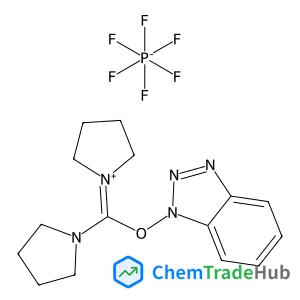
(1H-Benzotriazol-1-yloxy)(di-1-pyrrolidinyl)methylium hexafluorophosphate
CAS番号:
105379-24-6
分子式:
C15H21F6N5OP
おすすめサプライヤー







免責事項
このページに表示される学術雑誌情報は、参考および研究目的のみを目的としています。当社は雑誌出版社とは提携しておらず、投稿の取り扱いも行っておりません。出版に関するお問い合わせは、各雑誌出版社に直接ご連絡ください。
表示されている情報に誤りがある場合は、support@chemtradehub.com までご連絡ください。迅速に確認し、対応いたします。