












Application of a new light scattering technique to avoid the influence of dilution in light scattering experiments with milk
文献情報
出版日
DOI
10.1039/A903906F
インパクトファクター
3.676
著者
原文を見る
要旨
Colloidal systems are a subject of great interest in soft condensed matter research as well as in industry. But the ability to characterize colloidal systems with dynamic light scattering (DLS) is in general limited to systems with negligible contributions from multiple scattering of light. Therefore a variety of systems is excluded from investigations with DLS at high concentration and therefore increased turbidity. Often these samples were investigated under high dilution with, at least for some systems, a high probability of measuring artefacts. A promising solution to this problem consists of suppressing multiple scattering in a DLS experiment with a cross-correlation technique. Therefore we developed a so-called 3d cross-correlation instrument which enables us to characterize extremely turbid suspensions. After having found that the instrument works very well with model systems, we now demonstrate that complex ‘real world’ systems can successfully be characterized using this technique. An investigation of milk shows a strong dependence of the measured particle size distribution upon dilution. With the 3d instrument, however, the undiluted milk can be measured and artificial changes of the sample properties can be excluded.
関連文献
Advances in biological conversion technologies: new opportunities for reaction engineering
2020-02-24
Perspective
DOI: 10.1039/C9RE00422J
Continuous flow synthesis of ordered porous materials: from zeolites to metal–organic frameworks and mesoporous silica
Zhendong Liu, Jie Zhu, Ce Peng, Toru Wakihara, Tatsuya Okubo
2019-06-17
Review Article
DOI: 10.1039/C9RE00142E
Nucleophilic construction of sulfate bonds: simplified access to polysulfates and polysulfonates
Weiwei Zhu, Fuchong Li, Jikun Liu, Xingyu Ma, Xianxing Jiang
2019-08-07
Paper
DOI: 10.1039/C9RE00227H
Development of semi-continuous chemo-enzymatic terpene epoxidation: combination of anthraquinone autooxidation and the lipase-mediated epoxidation process
Sumanth Ranganathan
2017-10-03
Paper
DOI: 10.1039/C7RE00112F
Scale-up of N-alkylation reaction using phase-transfer catalysis with integrated separation in flow
María José Nieves-Remacha, Myriam Torres, María Ruiz-Abad, Juan A. Rincón, Graham R. Cumming, Pablo Garcia-Losada
2018-11-15
Paper
DOI: 10.1039/C8RE00203G
Mercury-free nitrogen-doped activated carbon catalyst: an efficient catalyst for the catalytic coupling reaction of acetylene and ethylene dichloride to synthesize the vinyl chloride monomer
Zhaobing Shen, Hong Zhao, Yue Liu, Zeyuan Kan, Ping Xing, Jinguang Zhong
2018-01-11
Paper
DOI: 10.1039/C7RE00201G
Estimating speciation of aqueous ammonia solutions of ammonium bicarbonate: application of least squares methods to infrared spectra
Federico Milella, Marco Mazzotti
2019-05-14
Paper
DOI: 10.1039/C9RE00137A
こちらもおすすめ
化合物よくある質問
間溴苯甲酰腈の市場動向や研究トレンドはどうですか?
間 brom 苯甲酰腈は、合成化学や薬物化学において重要な Intermediate として使用されています。市場動向としては、その合成性と機能性により、研究開...
24999-51-7(3-Bromophenyl)(oxo)...
287966-62-5Desulfo Glucoraphani...
化合物よくある質問
Methyl 2-amino-5-(trifluoromethyl)benzoateに適用される法規ガイドラインは何ですか?
CAS番号117324-58-0の塩酸メチル2アミノ-5-トリフルオロメチルベンゼートは、GHS分類により腐食性物質と判定されます。REACH規則では、製造、販...
117324-58-0Methyl 2-amino-5-(tr...
化合物よくある質問
3-ブロモ-1,3,4,5-四水化-2H-1-ベンザアゼピン-2-オンは安全ですか?
毒性があるため、適切な安全対策が必須です。皮膚や粘膜への刺激性が強く、吸入や誤飲により健康被害を引き起こす可能性があります。取扱時にはガスマスクや手袋、眼鏡を使...
86499-96-93-Bromo-1,3,4,5-tetr...
化合物よくある質問
三氟甲基ピリジン-2-甲アミン塩酸塩は安全ですか?
三氟甲基ピリジン-2-甲アミン塩酸塩は安全性に注意が必要です。毒性は低レベルですが、直接的接触や吸入は避けるべきです。適切な手袋や防塵マスクを着用し、密閉された...
871826-12-9(5-(Trifluoromethyl)...
化合物よくある質問
1-エチル-4-(4-硝基フェニル)ピペリジンは安全ですか?
1-エチル-4-(4-硝基フェニル)ピペリジンは有毒であり、取扱には注意が必要です。保管や作業中に手袋を着用し、目や皮膚に接触しないように注意する必要があります...
115619-00-61-Ethyl-4-(4-nitroph...
化合物よくある質問
1,1-ジメトキシプロパン-2-オンは安全ですか?
1,1-ジメトキシプロパン-2-オンは一般的に低毒性ですが、皮膚や目への刺激性があるため、取扱いには注意が必要です。蒸気や液体の吸入には有害な可能性があり、適切...
6342-56-91,1-dimethoxypropan-...
化合物よくある質問
コバルト(II) 3,3'-{[(1S,2S)-1,2-ジメチルフENCYCLICALE-1,2-エチエンジイル]ビス[ニトロリルメチルイリデン]}ビス[4-オキソ-2-ペンテン-2-olate]について「に適用される法規ガイドラインは何ですか?
この化合物はCAS番号259259-80-8に対応しています。GHS分類では、毒性、燃焼性、反応性、炎症性を考慮に入れ、適切な危険性分類が行われます。REACH...
259259-80-8Cobalt(2+) (2E,2'E)-...
化合物よくある質問
「カーバミル酸, N-[8-[[2-[[2-(2,6-ジオキソ-3-ピペリジニル)-2,3-ジオキソ-1,3-ジヒドロ-1H-イソイソインドール-4-イルオキシ]アセチル]アミノ]オクチル]-1,1-ジメチレチルエステル」はどのように保存すればよいですか?
この化合物は、冷却庫で-20℃の温度、乾燥した容器に保管し、直日光から保護する必要があります。湿度の高い環境や高温は避けてください。
1950635-34-32-Methyl-2-propanyl ...
1433975-21-3FMoc-D-4-Aph(tBu-CbM...
掲載誌
Physical Chemistry Chemical Physics

CiteScore:
5.5
自己引用率:
10.3%
年間論文数:
3036
Physical Chemistry Chemical Physics (PCCP) is an international journal co-owned by 19 physical chemistry and physics societies from around the world. This journal publishes original, cutting-edge research in physical chemistry, chemical physics and biophysical chemistry. To be suitable for publication in PCCP, articles must include significant innovation and/or insight into physical chemistry; this is the most important criterion that reviewers and Editors will judge against when evaluating submissions. The journal has a broad scope and welcomes contributions spanning experiment, theory, computation and data science. Topical coverage includes spectroscopy, dynamics, kinetics, statistical mechanics, thermodynamics, electrochemistry, catalysis, surface science, quantum mechanics, quantum computing and machine learning. Interdisciplinary research areas such as polymers and soft matter, materials, nanoscience, energy, surfaces/interfaces, and biophysical chemistry are welcomed if they demonstrate significant innovation and/or insight into physical chemistry. Joined experimental/theoretical studies are particularly appreciated when complementary and based on up-to-date approaches.
おすすめ化合物
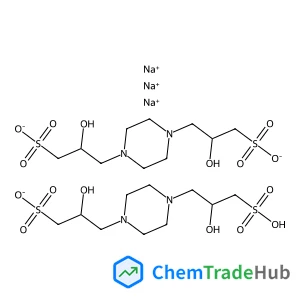
3,3'-(Piperazine-1,4-diyl)bis(2-hydroxypropane-1-sulfonic acid) Sodium Salt
CAS番号:
108321-08-0
分子式:
C20H41N4Na3O16S4
![O-Benzyl-N-[(9H-fluoren-9-ylmethoxy)carbonyl]-N-methyl-L-threonine structure](https://static.chemtradehub.com/structs/198/198561-81-8-a56e.webp "O-Benzyl-N-[(9H-fluoren-9-ylmethoxy)carbonyl]-N-methyl-L-threonine structure")
おすすめサプライヤー




免責事項
このページに表示される学術雑誌情報は、参考および研究目的のみを目的としています。当社は雑誌出版社とは提携しておらず、投稿の取り扱いも行っておりません。出版に関するお問い合わせは、各雑誌出版社に直接ご連絡ください。
表示されている情報に誤りがある場合は、support@chemtradehub.com までご連絡ください。迅速に確認し、対応いたします。