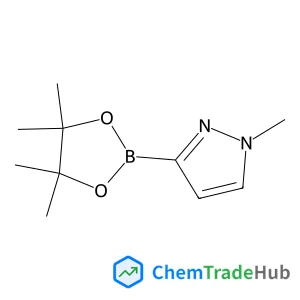
1-Methyl-3-(4,4,5,5-tetramethyl-1,3,2-dioxaborolan-2-yl)-1H-pyrazole
CAS番号:
1020174-04-2
分子式:
C10H17BN2O2
We experimentally determined complete falloff curves of the rate constant for the unimolecular decomposition of ethoxy radicals. Two different techniques, laser flash photolysis and fast flow reactor were used both coupled to a detection of C2H5O radicals by laser induced fluorescence. Experiments were performed at total pressures between 0.001 and 60 bar of helium and in the temperature range of 391–471 K. Under these conditions the β-C–C scission (1a) CH3CH2O+M→CH2O+CH3+M is the dominating decomposition channel. From a complete analysis of the experimental falloff curves the low and the high pressure limiting rate constants of k1a,0=[He] 3.3×10⁻⁸ exp(-58.5 kJ mol-1/RT) cm3 s-1 and k1a,∞=1.1×10¹³ exp(-70.3 kJ mol-1/RT) s-1 were extracted. We estimate an uncertainty for the absolute values of these rate constants of ±30%. Preexponential factor and activation energy are significantly lower than previous estimations. The rate constants are discussed in terms of statistical unimolecular rate theory. Excellent agreement between the experimental and the statistically calculated rate constants has been found. BAC-MP4, QCISD(T), or higher level of theory provide a reliable picture of the energy and the structure of the transition state of this radical bond dissociation reaction. On the same theoretical basis we predict the high pressure limiting rate constant for the β-C–H scission (1b) CH3CH2O+M→CH3CHO+H+M of k1b,∞=1.3×10¹³ exp(-84 kJ mol-1/RT) s-1. Atmospheric implications are discussed.
Stefano Milione, Cosimo Montefusco, Tomas Cuenca, Alfonso Grassi
DOI: 10.1039/B301997G
Hiroshi Mizoguchi, Nattamai S. P. Bhuvanesh, Patrick M. Woodward
DOI: 10.1039/B300635B
Joan Albert, J. Magali Cadena, Asensio González, Jaume Granell, Xavier Solans, Mercè Font-Bardia
DOI: 10.1039/B211808D
Ishtvan Boldog, Eduard B. Rusanov, Joachim Sieler, Steffen Blaurock, Konstantin V. Domasevitch
DOI: 10.1039/B212540D
Adi Dahan, Avi Weissberg, Moshe Portnoy
DOI: 10.1039/B302324A
Debasis Samanta, Nicolas Faure, Francis Rondelez, Amitabha Sarkar
DOI: 10.1039/B300833A
Artur Krężel, Jacek Wójcik, Maciej Maciejczyk, Wojciech Bal
DOI: 10.1039/B300632H
Begoña Bazán, José L. Mesa, José L. Pizarro, Andrés T. Aguayo, María I. Arriortua, Teófilo Rojo
DOI: 10.1039/B210998K
Lijun Ji, Jianhua Rong, Zhenzhong Yang
DOI: 10.1039/B300825H
Junpei Yuasa, Tomoyoshi Suenobu, Kei Ohkubo, Shunichi Fukuzumi
DOI: 10.1039/B300543G
2-溴-9,9-二苯基芴は、医薬品、工業材料、有機合成の研究分野で応用されます。特に、レーザー材料や機能性ポリマーの合成に使用されることがあります。また、蛍光色...
四氯化铱の市場は研究開発分野で注目されており、特にナノ技術や金属有機框架(MOFs)の分野での需要が増加傾向にあります。価格は安定しており、中国や韓国での生産が...
1-(4-溴-3-氟苯基)-2-氯乙酮 (CAS番号: 1260857-14-4) の廃棄物は専門的な廃棄処理が必要です。まず、廃棄物は密閉された容器に収集し、...
苦参酚Kは、CAS番号101236-49-1を持つ化合物で、主に天然由来の生薬から抽出されます。この化合物は、抗炎症作用や抗癌作用を持つことが報告されています。
POTASSIUM (1-(TERTBUTOXYCARBONYL)AZETIDIN-3-YL)TRIFLUOROBORATE を含む廃棄物は、まず安全なエント...
4-庚基-4’-聯苯羧酸は、特殊化学品や合成化学の分野で用いられる化学物質ですが、市場動向としては、研究開発の進展とともに需要が増加しています。また、環境配慮型...
6-ブロモ-3-メトキシ-1-フェニル-1H-インドゾールを含む廃棄物は、適切な化学廃棄処理が必要です。通常、廃棄物は密閉容器に収集され、専門の廃棄処理業者に引...
4,4-二甲基-2-吡咯烷酮は医薬、ポリマー、センサー、半導体などの業界で広く使用されています。特に溶媒としての性能が高く評価されています。

Physical Chemistry Chemical Physics (PCCP) is an international journal co-owned by 19 physical chemistry and physics societies from around the world. This journal publishes original, cutting-edge research in physical chemistry, chemical physics and biophysical chemistry. To be suitable for publication in PCCP, articles must include significant innovation and/or insight into physical chemistry; this is the most important criterion that reviewers and Editors will judge against when evaluating submissions. The journal has a broad scope and welcomes contributions spanning experiment, theory, computation and data science. Topical coverage includes spectroscopy, dynamics, kinetics, statistical mechanics, thermodynamics, electrochemistry, catalysis, surface science, quantum mechanics, quantum computing and machine learning. Interdisciplinary research areas such as polymers and soft matter, materials, nanoscience, energy, surfaces/interfaces, and biophysical chemistry are welcomed if they demonstrate significant innovation and/or insight into physical chemistry. Joined experimental/theoretical studies are particularly appreciated when complementary and based on up-to-date approaches.