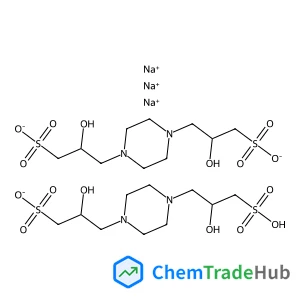
3,3'-(Piperazine-1,4-diyl)bis(2-hydroxypropane-1-sulfonic acid) Sodium Salt
CAS番号:
108321-08-0
分子式:
C20H41N4Na3O16S4
MgO nanoparticles obtained by chemical vapour deposition (CVD) were exposed to H2 and subsequently to UV irradiation and/or molecular oxygen at room temperature. A combined IR/EPR study reveals the role of low coordinated surface sites and anion vacancies in the diverse reaction steps. The hydride groups emerging from the initial H2 chemisorption processes (heterolytic splitting) play an active role in the consecutive reactions. They provide the electrons which are required for the UV induced formation of surface colour centres and for the production of superoxide anions (redox reaction). Both the colour centres and the superoxide anions are EPR active. The hydroxy groups resulting from H2 chemisorption do not actively participate in the consecutive reactions. Together with the OH groups formed in the course of colour centre formation they rather play the role of an observer. They undergo specific electronic interactions with both the colour centre and the superoxide anion which are IR inactive (or IR inaccessible) surface species. They may, however, be observed by IR spectroscopy via the specifically influenced OH stretching vibrations. This proves the intimate interplay between IR and EPR spectroscopy as applied to the surface processes under investigation. As a result, two paths were found for the three consecutive surface reaction steps: H2 chemisorption, colour centre formation and superoxide anion formation. In the first one a single, well defined surface area element is involved, namely a low coordinated ion pair, the cation of which is a constituent of an anion vacancy. In the second path a diffusion controlled intermediate step has to be adopted in which the electron required for the colour centre is transported by an H atom travelling from a hydride group to a remote anion vacancy. In either case there is clear experimental evidence that the finally resulting superoxide anions are complexed by the colour centre cations.
Jonathan Laurent, John Bozek, Marc Briant, Pierre Çarçabal, Denis Cubaynes, Aleksandar Milosavljević, Ralph Püttner, Niloufar Shafizadeh, Marc Simon, Benoît Soep, Gildas Goldsztejn
DOI: 10.1039/D1CP04845G
Ryota Sato, Hajime Okajima, Shinya Sugiura, Yohei Haketa, Yusuke Kinoshita, Hitoshi Tamiaki, Akira Sakamoto, Hiromitsu Maeda, Yoichi Kobayashi
DOI: 10.1039/D1CP04804J
Andrea Giustini, Massimiliano Aschi, Heejune Park
DOI: 10.1039/D1CP01724A
Nikita Levin, Jozef Lengyel, Martin Tschurl, Ulrich Heiz
DOI: 10.1039/D1CP04469A
Takumu Kosaka, Tomohiro Ando, Hiroshi Nishiyama, Yuanshu Zhou
DOI: 10.1039/D1CP03264J
Robin Van Echelpoel, Roy Aerts, Guillaume Acke, Patrick Bultinck, Wouter Herrebout
DOI: 10.1039/D1CP02428K
Aleksandra Deptuch, Małgorzata Jasiurkowska-Delaporte, Wojciech Zając, Ewa Juszyńska-Gałązka, Anna Drzewicz, Magdalena Urbańska
DOI: 10.1039/D1CP02297K
Nhu Pailes Nguyen, Tyler P. Farr, H. Evan Bush, Andrea Ambrosini, Peter G. Loutzenhiser
DOI: 10.1039/D1CP03303D
Manas Ranjan Dash, Mohamad Akbar Ali
DOI: 10.1039/D1CP03911C
間 brom 苯甲酰腈は、合成化学や薬物化学において重要な Intermediate として使用されています。市場動向としては、その合成性と機能性により、研究開...
CAS番号117324-58-0の塩酸メチル2アミノ-5-トリフルオロメチルベンゼートは、GHS分類により腐食性物質と判定されます。REACH規則では、製造、販...
毒性があるため、適切な安全対策が必須です。皮膚や粘膜への刺激性が強く、吸入や誤飲により健康被害を引き起こす可能性があります。取扱時にはガスマスクや手袋、眼鏡を使...
三氟甲基ピリジン-2-甲アミン塩酸塩は安全性に注意が必要です。毒性は低レベルですが、直接的接触や吸入は避けるべきです。適切な手袋や防塵マスクを着用し、密閉された...
1-エチル-4-(4-硝基フェニル)ピペリジンは有毒であり、取扱には注意が必要です。保管や作業中に手袋を着用し、目や皮膚に接触しないように注意する必要があります...
1,1-ジメトキシプロパン-2-オンは一般的に低毒性ですが、皮膚や目への刺激性があるため、取扱いには注意が必要です。蒸気や液体の吸入には有害な可能性があり、適切...
この化合物はCAS番号259259-80-8に対応しています。GHS分類では、毒性、燃焼性、反応性、炎症性を考慮に入れ、適切な危険性分類が行われます。REACH...
この化合物は、冷却庫で-20℃の温度、乾燥した容器に保管し、直日光から保護する必要があります。湿度の高い環境や高温は避けてください。

Physical Chemistry Chemical Physics (PCCP) is an international journal co-owned by 19 physical chemistry and physics societies from around the world. This journal publishes original, cutting-edge research in physical chemistry, chemical physics and biophysical chemistry. To be suitable for publication in PCCP, articles must include significant innovation and/or insight into physical chemistry; this is the most important criterion that reviewers and Editors will judge against when evaluating submissions. The journal has a broad scope and welcomes contributions spanning experiment, theory, computation and data science. Topical coverage includes spectroscopy, dynamics, kinetics, statistical mechanics, thermodynamics, electrochemistry, catalysis, surface science, quantum mechanics, quantum computing and machine learning. Interdisciplinary research areas such as polymers and soft matter, materials, nanoscience, energy, surfaces/interfaces, and biophysical chemistry are welcomed if they demonstrate significant innovation and/or insight into physical chemistry. Joined experimental/theoretical studies are particularly appreciated when complementary and based on up-to-date approaches.
![5-(2-Phenylpyrazolo[1,5-a]pyridin-3-yl)-2H-pyrazolo[3,4-c]pyridazin-3-amine structure](https://static.chemtradehub.com/structs/865/865362-74-9-0091.webp "5-(2-Phenylpyrazolo[1,5-a]pyridin-3-yl)-2H-pyrazolo[3,4-c]pyridazin-3-amine structure")
![(3R)-3-(3-Fluorophenyl)-3-({[(2-methyl-2-propanyl)oxy]carbonyl}amino)propanoic acid structure](https://static.chemtradehub.com/structs/500/500789-04-8-20dd.webp "(3R)-3-(3-Fluorophenyl)-3-({[(2-methyl-2-propanyl)oxy]carbonyl}amino)propanoic acid structure")