












Transition-state structural refinement with GRACE and CHARMM: Flexible QM/MM modelling for lactate dehydrogenase
文献情報
出版日
DOI
10.1039/A808364I
インパクトファクター
3.676
著者
原文を見る
要旨
Realistic simulations of chemical reactions require the use not only of methods capable of describing accurately the energy of molecules undergoing bonding changes within a particular chemical environment, but also of methods capable of exploring topographical features of significance on energy hypersurfaces spanning perhaps several thousand degrees of freedom. Hybrid quantum-mechanical/molecular-mechanical techniques show much promise for the first task, but existing computer codes are inadequate for the second. Application of these methods to real chemical problems demands new tools for location and characterisation of saddle-points, intrinsic reaction coordinates, hessians and vibrational frequencies for very large flexible systems. Algorithms capable of performing these tasks have been incorporated in a new software package, GRACE, which provides a non-invasive interface between popular codes for quantum chemistry and molecular dynamics and modelling. Transition structures (TSs) have been refined by this novel procedure, using a combined AM1/CHARMM24/TIP3P potential, involving full gradient relaxation of the positions of 1900–2000 atoms of a solvated enzyme–substrate complex (lactate dehydrogenase/NADH/pyruvate/water). Six different starting structures (arbitrarily selected from a molecular dynamics trajectory for the enzyme–substrate complex) lead to six different TSs. Although the essential features of these TSs are invariant, the relative dispositions of active-site residues differ quite significantly. The transition state for the enzymic reaction would represent an average of the properties of many, nearly degenerate TSs. This insight emerges only as a consequence of the flexible model of the active site employed in this study.
関連文献
Magnetically induced ring currents in metallocenothiaporphyrins
Theo Kurten, Lenara I. Valiulina, Sergey Yu. Ketkov, Viktor N. Cherepanov, Maria Dimitrova, Dage Sundholm
2021-12-20
Paper
DOI: 10.1039/D1CP04779E
Multiscale structural and rheological features of colloidal low-methoxyl pectin solutions and calcium-induced sol–gel transition
Ssu-Ting Huang, Cheng-Hao Yang, Peng-Ju Lin, Chien-You Su, Chi-Chung Hua
2021-08-10
Paper
DOI: 10.1039/D1CP02778F
Fabrication and application of composite adsorbents made by one-pot electrochemical exfoliation of graphite in surfactant ionic liquid/nanocellulose mixtures
Nur Amirah Jamaluddin, Suriani Abu Bakar, Tretya Ardyani, Masanobu Sagisaka, Haruka Saito, Mohamad Hafiz Mamat, Mohd Khairul Ahmad, H. P. S. Abdul Khalil, Stephen M. King, Sarah E. Rogers, Julian Eastoe
2021-08-12
Paper
DOI: 10.1039/D1CP02206G
Activation of CO2 and CH4 on MgO surfaces: mechanistic insights from first-principles theory
Meghna A. Manae, Lakshay Dheer, Sandhya Rai, Sharan Shetty, Umesh V. Waghmare
2021-12-21
Paper
DOI: 10.1039/D1CP04152E
Coexistence of intrinsic room-temperature ferromagnetism and piezoelectricity in monolayer BiCrX3 (X = S, Se, and Te)
Guang Song, Chengfeng Zhang, Zhengzhong Zhang, Guannan Li, Zhongwen Li, Juan Du, Bingwen Zhang, Xiaokun Huang, Benling Gao
2021-12-03
Paper
DOI: 10.1039/D1CP04900C
Photo-induced hydrophilicity at the ZnO(110) surface: an evolutionary algorithm-aided density functional theory study
Shen-Yuan Bao, Dong-Zhi Li, Xue-Qing Gong
2021-08-14
Paper
DOI: 10.1039/D1CP02542B
From fluorogens to fluorophores by elucidation and suppression of ultrafast excited state processes of a Schiff base
Souradip Dasgupta, Shrobona Banerjee, Sharmistha Das, Anindya Datta
2021-08-11
Paper
DOI: 10.1039/D1CP02540F
Reply to the ‘Comment on “High-temperature superconductivity in transition metallic hydrides MH11 (M = Mo, W, Nb, and Ta) under high pressure”’ by X. Zheng and J. Zheng, Phys. Chem. Chem. Phys., 2022, 24, DOI: 10.1039/D1CP01474A
Mingyang Du, Zihan Zhang, Hao Song, Hongyu Yu, Vladimir Z. Kresin, Defang Duan
2022-01-10
Comment
DOI: 10.1039/D1CP04384F
Local structuring of diketopyrrolopyrrole (DPP)-based oligomers from molecular dynamics simulations
2021-08-12
Paper
DOI: 10.1039/D1CP03257G
Development of an optical flow through detector for bubbles, crystals and particles in oils
Peter R. Birkin, Jack J. Youngs, Tadd T. Truscott, Silvana Martini
2021-12-23
Paper
DOI: 10.1039/D1CP03655F
こちらもおすすめ
化合物よくある質問
間溴苯甲酰腈の市場動向や研究トレンドはどうですか?
間 brom 苯甲酰腈は、合成化学や薬物化学において重要な Intermediate として使用されています。市場動向としては、その合成性と機能性により、研究開...
24999-51-7(3-Bromophenyl)(oxo)...
287966-62-5Desulfo Glucoraphani...
化合物よくある質問
Methyl 2-amino-5-(trifluoromethyl)benzoateに適用される法規ガイドラインは何ですか?
CAS番号117324-58-0の塩酸メチル2アミノ-5-トリフルオロメチルベンゼートは、GHS分類により腐食性物質と判定されます。REACH規則では、製造、販...
117324-58-0Methyl 2-amino-5-(tr...
化合物よくある質問
3-ブロモ-1,3,4,5-四水化-2H-1-ベンザアゼピン-2-オンは安全ですか?
毒性があるため、適切な安全対策が必須です。皮膚や粘膜への刺激性が強く、吸入や誤飲により健康被害を引き起こす可能性があります。取扱時にはガスマスクや手袋、眼鏡を使...
86499-96-93-Bromo-1,3,4,5-tetr...
化合物よくある質問
三氟甲基ピリジン-2-甲アミン塩酸塩は安全ですか?
三氟甲基ピリジン-2-甲アミン塩酸塩は安全性に注意が必要です。毒性は低レベルですが、直接的接触や吸入は避けるべきです。適切な手袋や防塵マスクを着用し、密閉された...
871826-12-9(5-(Trifluoromethyl)...
化合物よくある質問
1-エチル-4-(4-硝基フェニル)ピペリジンは安全ですか?
1-エチル-4-(4-硝基フェニル)ピペリジンは有毒であり、取扱には注意が必要です。保管や作業中に手袋を着用し、目や皮膚に接触しないように注意する必要があります...
115619-00-61-Ethyl-4-(4-nitroph...
化合物よくある質問
1,1-ジメトキシプロパン-2-オンは安全ですか?
1,1-ジメトキシプロパン-2-オンは一般的に低毒性ですが、皮膚や目への刺激性があるため、取扱いには注意が必要です。蒸気や液体の吸入には有害な可能性があり、適切...
6342-56-91,1-dimethoxypropan-...
化合物よくある質問
コバルト(II) 3,3'-{[(1S,2S)-1,2-ジメチルフENCYCLICALE-1,2-エチエンジイル]ビス[ニトロリルメチルイリデン]}ビス[4-オキソ-2-ペンテン-2-olate]について「に適用される法規ガイドラインは何ですか?
この化合物はCAS番号259259-80-8に対応しています。GHS分類では、毒性、燃焼性、反応性、炎症性を考慮に入れ、適切な危険性分類が行われます。REACH...
259259-80-8Cobalt(2+) (2E,2'E)-...
化合物よくある質問
「カーバミル酸, N-[8-[[2-[[2-(2,6-ジオキソ-3-ピペリジニル)-2,3-ジオキソ-1,3-ジヒドロ-1H-イソイソインドール-4-イルオキシ]アセチル]アミノ]オクチル]-1,1-ジメチレチルエステル」はどのように保存すればよいですか?
この化合物は、冷却庫で-20℃の温度、乾燥した容器に保管し、直日光から保護する必要があります。湿度の高い環境や高温は避けてください。
1950635-34-32-Methyl-2-propanyl ...
1433975-21-3FMoc-D-4-Aph(tBu-CbM...
掲載誌
Physical Chemistry Chemical Physics

CiteScore:
5.5
自己引用率:
10.3%
年間論文数:
3036
Physical Chemistry Chemical Physics (PCCP) is an international journal co-owned by 19 physical chemistry and physics societies from around the world. This journal publishes original, cutting-edge research in physical chemistry, chemical physics and biophysical chemistry. To be suitable for publication in PCCP, articles must include significant innovation and/or insight into physical chemistry; this is the most important criterion that reviewers and Editors will judge against when evaluating submissions. The journal has a broad scope and welcomes contributions spanning experiment, theory, computation and data science. Topical coverage includes spectroscopy, dynamics, kinetics, statistical mechanics, thermodynamics, electrochemistry, catalysis, surface science, quantum mechanics, quantum computing and machine learning. Interdisciplinary research areas such as polymers and soft matter, materials, nanoscience, energy, surfaces/interfaces, and biophysical chemistry are welcomed if they demonstrate significant innovation and/or insight into physical chemistry. Joined experimental/theoretical studies are particularly appreciated when complementary and based on up-to-date approaches.
おすすめ化合物
![2,4,5-Trichloro-7H-pyrrolo[2,3-d]pyrimidine structure](https://static.chemtradehub.com/structs/105/1053228-28-6-fba3.webp "2,4,5-Trichloro-7H-pyrrolo[2,3-d]pyrimidine structure")
![5-(2-Phenylpyrazolo[1,5-a]pyridin-3-yl)-2H-pyrazolo[3,4-c]pyridazin-3-amine structure](https://static.chemtradehub.com/structs/865/865362-74-9-0091.webp "5-(2-Phenylpyrazolo[1,5-a]pyridin-3-yl)-2H-pyrazolo[3,4-c]pyridazin-3-amine structure")
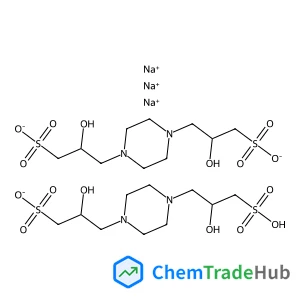
3,3'-(Piperazine-1,4-diyl)bis(2-hydroxypropane-1-sulfonic acid) Sodium Salt
CAS番号:
108321-08-0
分子式:
C20H41N4Na3O16S4
おすすめサプライヤー



免責事項
このページに表示される学術雑誌情報は、参考および研究目的のみを目的としています。当社は雑誌出版社とは提携しておらず、投稿の取り扱いも行っておりません。出版に関するお問い合わせは、各雑誌出版社に直接ご連絡ください。
表示されている情報に誤りがある場合は、support@chemtradehub.com までご連絡ください。迅速に確認し、対応いたします。