













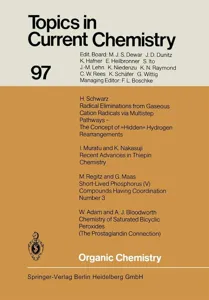
Topics in Current Chemistry
基本情報
略称:
TOPICS CURR CHEM
インパクトファクター:
7.1
ISSN:
2365-0869
研究分野:
CHEMICAL
h-index:
0
自己引用率:
1.4%
年間論文数:
35
SCI収録状況:
Science Citation Index Expanded
ジャーナルウェブサイト:
https://www.springer.com/journal/41061
ジャーナル紹介:
Topics in Current Chemistry presents critical reviews of the present and future trends in modern chemical research. The scope of coverage is all areas of chemical science including the interfaces with related disciplines such as biology, medicine, physics and materials science. The goal of each thematic collection is to give the non-specialist reader, whether in academia or industry, a comprehensive insight into an area where new research is emerging which is of interest to a larger scientific audience. Each review within the topical collection critically surveys one aspect of that topic and places it within the context of the collection as a whole. The most significant developments of the last 5 to 10 years are presented using selected examples to illustrate the principles discussed. The coverage is not intended to be an exhaustive summary of the field or include large quantities of data, but should rather be conceptual, concentrating on the methodological thinking that will allow the non-specialist reader to understand the information presented. Contributions also offer an outlook on potential future developments in the field.
CiteScore
CiteScore
13.7
SJR
1.26
SNIP
1.458
| 分野 | ランク | パーセンタイル |
|---|---|---|
ChemistryGeneral Chemistry |
39 / 408 | 90% |
ジャーナル統計
号/年
Submission to first decision (median): 21 days
査読期間
£2790/$4390/€3390
論文処理料
投稿情報
投稿サイト:
https://www.editorialmanager.com/TOCC関連論文
Acid/base equilibria in clusters and their role in proton exchange membranes: computational insight
Vassiliki-Alexandra Glezakou, Michel Dupuis, Christopher J. Mundy
2007-09-13
Paper
DOI: 10.1039/B709752B
Chlorine–benzene complexes—the reliability of density functionals for non-covalent radical complexes‡
A. K. Croft, H. M. Howard-Jones
2007-08-21
Paper
DOI: 10.1039/B704966H
Localized orbital theory and ammonia triborane
Joseph E. Subotnik, Alex Sodt, Martin Head-Gordon
2007-08-29
Paper
DOI: 10.1039/B709171K
How realistic is the pore size distribution calculated from adsorption isotherms if activated carbon is composed of fullerene-like fragments?
Artur P. Terzyk, Sylwester Furmaniak, Peter J. F. Harris, Piotr A. Gauden, Jerzy Włoch, Piotr Kowalczyk, Gerhard Rychlicki
2007-10-02
Paper
DOI: 10.1039/B710552E
Investigations on the gas-phase photolysis and OH radical kinetics of methyl-2-nitrophenols
Ian Barnes, Romeo Olariu, Shouming Zhou, Peter Wiesen, Thorsten Benter
2007-09-07
Paper
DOI: 10.1039/B709464G
Energy level promotion in the correlation from the tunnelling-doubled harmonic oscillator to the bi-rotor: application to internal rotation in molecules
2007-09-20
Paper
DOI: 10.1039/B710691B
Kinetic analysis of the ozone processing of an unsaturated organic monolayer as a model of an aerosol surface
Erick González-Labrada, Rolf Schmidt, Christine E. DeWolf
2007-09-20
Paper
DOI: 10.1039/B707890K
こちらもおすすめ
化合物よくある質問
1-{3-[5-(エチルカルボンイル)-2,4-ジメチル-1H-ピロロール-3-基]プロパニル}ピペリジン-4-カルボン酸について、適用される法規ガイドラインは何ですか?
この化合物はCAS番号1142209-81-1であり、GHS分類では corrosive (腐食性物質) と classified (分類物質) として指定され...
1142209-81-11-{3-[5-(Ethoxycarbo...
化合物よくある質問
2,2-二氟-1,3-ベンゾジオキサン-5-カルボキシlic酸とは何ですか?
2,2-二氟-1,3-ベンゾジオキサン-5-カルボキシlic酸は、CAS番号656-46-2の化合物で、化学式はC8H4F2O4です。この化合物は白色の結晶性粉...
656-46-22,2-Difluoro-1,3-ben...
化合物よくある質問
8-氯-4-色原酮の代替品はありますか?
8-氯-4-色原酮(CAS番号: 49701-11-3)の代替品には、他の色原酮類似物や、構造が似ている化合物があります。例えば、8-メチル-4-色原酮や、他の...
49701-11-38-Chloro-2,3-dihydro...
化合物よくある質問
エチル6,6-ジメチル-4,5,6,7-テトラヒドロ-1H-インドアゼー-3-カルボキシレートとは何ですか?
エチル6,6-ジメチル-4,5,6,7-テトラヒドロ-1H-インドアゼー-3-カルボキシレートは、CAS番号1233243-56-5を有する化合物です。これは有...
1233243-56-5Ethyl 6,6-dimethyl-4...
化合物よくある質問
4-叔丁基-6-氯-嘧啶に適用される法規ガイドラインは何ですか?
4-叔丁基-6-氯-嘧啶はCAS番号3435-24-3で、GHS分類では毒性物質とみなし、GHSの危険性分類が適用されます。REACH規則では登録が必要で、Eu...
3435-24-34-Tert-butyl-6-chlor...
化合物よくある質問
維库溴铵杂质Bはどのように合成されますか?
維库溴铵杂质Bは、アンドロステンデンから始まり、一連の合成反応、包括的な選択性と高い収率で合成されます。具体的には、ブロミド化、酸化、ジマーゼ反応、アミド化など...
50587-95-6(2beta,3alpha,5alpha...
化合物よくある質問
2-(4-氟苄基)-吡咯烷の物理化学的性質は何ですか?
CAS番号350017-04-8の2-(4-氟苄基)-吡咯烷は、結晶性の白色粉末です。分子量は199.17 g/molで、水に溶けにくいです。化学反応では比較的...
350017-04-82-(4-Fluorobenzyl)py...
化合物よくある質問
3-喹啉甲醛(2-チロール-8-エチル)は安全ですか?
3-喹啉甲醛(2-チロール-8-エチル)は一定の毒性を持つため、取扱には注意が必要です。使用する際は適切な防護具を着用し、密閉容器で保管・搬送し、直接的な接触を...
335196-05-92-Chloro-8-ethyl-3-q...
化合物よくある質問
エチル3-(ヒドロキシメチル)-1H-ピロール-2-カルボキシレートはどのように保存すればよいですか?
エチル3-(ヒドロキシメチル)-1H-ピロール-2-カルボキシレートは、室温(25℃)以下で保存し、直射日光を避け、乾燥した環境で保管することが推奨されます。ま...
75448-69-0Ethyl 3-(hydroxymeth...
119410-05-88-Chloro-11-(4-piper...
おすすめ化合物



![2-{3-[4-(3-Chlorophenyl)-1-piperazinyl]propyl}[1,2,4]triazolo[4,3-a]pyridin-3(2H)-one hydrochloride (1:1) structure](https://static.chemtradehub.com/structs/253/25332-39-2-496e.webp "2-{3-[4-(3-Chlorophenyl)-1-piperazinyl]propyl}[1,2,4]triazolo[4,3-a]pyridin-3(2H)-one hydrochloride (1:1) structure")


おすすめサプライヤー





免責事項
このページに表示される学術雑誌情報は、参考および研究目的のみを目的としています。当社は雑誌出版社とは提携しておらず、投稿の取り扱いも行っておりません。出版に関するお問い合わせは、各雑誌出版社に直接ご連絡ください。
表示されている情報に誤りがある場合は、support@chemtradehub.com までご連絡ください。迅速に確認し、対応いたします。