












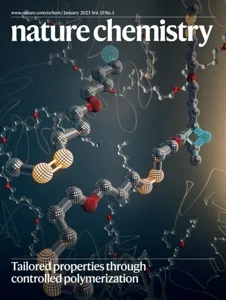
Nature Chemistry
基本情報
略称:
NAT CHEM
インパクトファクター:
19.2
ISSN:
1755-4330
研究分野:
CHEMICAL
h-index:
187
自己引用率:
1%
年間論文数:
183
SCI収録状況:
Science Citation Index Expanded
ジャーナルウェブサイト:
https://www.nature.com/nchem
ジャーナル紹介:
Nature Chemistry is a monthly journal dedicated to publishing high-quality papers that describe the most significant and cutting-edge research in all areas of chemistry. As well as reflecting the traditional core subjects of analytical, inorganic, organic and physical chemistry, the journal also features a broad range of chemical research including, but not limited to, catalysis, computational and theoretical chemistry, environmental chemistry, green chemistry, medicinal chemistry, nuclear chemistry, polymer chemistry, supramolecular chemistry and surface chemistry. Other cross-disciplinary topics such as bioinorganic, bioorganic, organometallic and physical–organic chemistry will also be featured. The submission of manuscripts detailing multidisciplinary research performed at the interface of chemistry and other scientific fields of inquiry such as biology, materials science, nanotechnology and physics is also encouraged, where the central theme of the work — and the major advances that are reported — fall within the bounds of chemistry. In addition to primary research, Nature Chemistry also publishes review articles, news and views, research highlights about important work reported in other journals, commentaries, book reviews, correspondence, and analysis of the broader chemical picture beyond the laboratory — including issues such as education, funding, policy, intellectual property, and the impact chemistry has on society. In this way, the journal aims to be the voice of the worldwide chemical community. Nature Chemistry is committed to publishing top-tier original research in all areas of chemistry through a fair and rigorous review process. It offers authors high visibility for their papers, access to a broad readership, high standards of copy editing and production, rapid publication and independence from academic societies and others with vested interests.
CiteScore
CiteScore
29.6
SJR
6.94
SNIP
3.334
| 分野 | ランク | パーセンタイル |
|---|---|---|
Chemical EngineeringGeneral Chemical Engineering |
4 / 273 | 98% |
ジャーナル統計
Monthly
号/年
Submission to first editorial decision (median days): 8
Submission to acceptance (median days): 273
査読期間
€10290 EUR/$12290 USD/£8890 GBP
論文処理料
投稿情報
投稿サイト:
https://mts-nchem.nature.com/収録タイプ:
Article
Correspondence
Matters Arising
News and Views
Books and Arts
Review
Perspective
Commentary
Correspondence
Matters Arising
News and Views
Books and Arts
Review
Perspective
Commentary
関連論文
Mixed antimonate-phosphonate ligands as polydentate bridging oxygen donors
Shoaib Ali, Viswanathan Baskar, Christopher A. Muryn, Richard E. P. Winpenny
2008-11-04
Communication
DOI: 10.1039/B815270E
Sensitive liposomes encoded with oligonucleotideamphiphiles: a biocompatible switch
Gregory Giannone
2008-09-23
Communication
DOI: 10.1039/B812398E
Lengthening alkyl spacers to increase SBA-15-anchored Rh–P complex activities in 1-octene hydroformylation
Wei Zhou, Dehua He
2008-10-01
Communication
DOI: 10.1039/B812910J
Solvothermal synthesis of N-doped TiO2nanotubes for visible-light-responsive photocatalysis
Fan Yang, Nianjun Luo, Bryan T. T. Chu, Deyin Sun, Huahong Shi, Tiancun Xiao, Peter P. Edwards
2008-11-04
Communication
DOI: 10.1039/B815430A
Simplified methods for the functionalisation of 3-hexoxythiophenes at the 5-position and further reactions to alkynyl and vinyl derivatives
Mike Joachim Zöllner, Ullrich Jahn, Eike Becker, Wolfgang Kowalsky, Hans-Hermann Johannes
2008-12-02
Communication
DOI: 10.1039/B817089D
Cyclisation of citronellal over heterogeneous inorganic fluorides—highly chemo- and diastereoselective catalysts for (±)-isopulegol
Pratap Patil, Stefan Wuttke, Erhard Kemnitz
2008-12-01
Communication
DOI: 10.1039/B817572A
Aqueous dispersions of TCNQ-anion-stabilized graphene sheets
Rui Hao, Wen Qian, Luhui Zhang, Yanglong Hou
2008-11-12
Communication
DOI: 10.1039/B816971C
The doping effect of fluorinated aromatic hydrocarbon solvents on the performance of common olefin metathesis catalysts: application in the preparation of biologically active compounds
Cezary Samojłowicz, Michał Bieniek, Andrzej Zarecki, Renat Kadyrov, Karol Grela
2008-10-22
Communication
DOI: 10.1039/B816567J
Engineered carbohydrate-binding module (CBM) protein-suspended single-walled carbon nanotubes in water
Qi Xu, Qing Song, Xin Ai, Timothy J. McDonald, Hai Long, Shi-You Ding, Michael E. Himmel, Garry Rumbles
2008-11-21
Communication
DOI: 10.1039/B815597F
Glycosylated asterisks are among the most potent low valency inducers of Concanavalin A aggregation
Mazen Sleiman, Annabelle Varrot, Jean-Manuel Raimundo, Marc Gingras, Peter G. Goekjian
2008-11-07
Communication
DOI: 10.1039/B814816C
こちらもおすすめ
化合物よくある質問
1-{3-[5-(エチルカルボンイル)-2,4-ジメチル-1H-ピロロール-3-基]プロパニル}ピペリジン-4-カルボン酸について、適用される法規ガイドラインは何ですか?
この化合物はCAS番号1142209-81-1であり、GHS分類では corrosive (腐食性物質) と classified (分類物質) として指定され...
1142209-81-11-{3-[5-(Ethoxycarbo...
化合物よくある質問
2,2-二氟-1,3-ベンゾジオキサン-5-カルボキシlic酸とは何ですか?
2,2-二氟-1,3-ベンゾジオキサン-5-カルボキシlic酸は、CAS番号656-46-2の化合物で、化学式はC8H4F2O4です。この化合物は白色の結晶性粉...
656-46-22,2-Difluoro-1,3-ben...
化合物よくある質問
8-氯-4-色原酮の代替品はありますか?
8-氯-4-色原酮(CAS番号: 49701-11-3)の代替品には、他の色原酮類似物や、構造が似ている化合物があります。例えば、8-メチル-4-色原酮や、他の...
49701-11-38-Chloro-2,3-dihydro...
化合物よくある質問
エチル6,6-ジメチル-4,5,6,7-テトラヒドロ-1H-インドアゼー-3-カルボキシレートとは何ですか?
エチル6,6-ジメチル-4,5,6,7-テトラヒドロ-1H-インドアゼー-3-カルボキシレートは、CAS番号1233243-56-5を有する化合物です。これは有...
1233243-56-5Ethyl 6,6-dimethyl-4...
化合物よくある質問
4-叔丁基-6-氯-嘧啶に適用される法規ガイドラインは何ですか?
4-叔丁基-6-氯-嘧啶はCAS番号3435-24-3で、GHS分類では毒性物質とみなし、GHSの危険性分類が適用されます。REACH規則では登録が必要で、Eu...
3435-24-34-Tert-butyl-6-chlor...
化合物よくある質問
維库溴铵杂质Bはどのように合成されますか?
維库溴铵杂质Bは、アンドロステンデンから始まり、一連の合成反応、包括的な選択性と高い収率で合成されます。具体的には、ブロミド化、酸化、ジマーゼ反応、アミド化など...
50587-95-6(2beta,3alpha,5alpha...
化合物よくある質問
2-(4-氟苄基)-吡咯烷の物理化学的性質は何ですか?
CAS番号350017-04-8の2-(4-氟苄基)-吡咯烷は、結晶性の白色粉末です。分子量は199.17 g/molで、水に溶けにくいです。化学反応では比較的...
350017-04-82-(4-Fluorobenzyl)py...
化合物よくある質問
3-喹啉甲醛(2-チロール-8-エチル)は安全ですか?
3-喹啉甲醛(2-チロール-8-エチル)は一定の毒性を持つため、取扱には注意が必要です。使用する際は適切な防護具を着用し、密閉容器で保管・搬送し、直接的な接触を...
335196-05-92-Chloro-8-ethyl-3-q...
化合物よくある質問
エチル3-(ヒドロキシメチル)-1H-ピロール-2-カルボキシレートはどのように保存すればよいですか?
エチル3-(ヒドロキシメチル)-1H-ピロール-2-カルボキシレートは、室温(25℃)以下で保存し、直射日光を避け、乾燥した環境で保管することが推奨されます。ま...
75448-69-0Ethyl 3-(hydroxymeth...
119410-05-88-Chloro-11-(4-piper...
おすすめ化合物
![2-{3-[4-(3-Chlorophenyl)-1-piperazinyl]propyl}[1,2,4]triazolo[4,3-a]pyridin-3(2H)-one hydrochloride (1:1) structure](https://static.chemtradehub.com/structs/253/25332-39-2-496e.webp "2-{3-[4-(3-Chlorophenyl)-1-piperazinyl]propyl}[1,2,4]triazolo[4,3-a]pyridin-3(2H)-one hydrochloride (1:1) structure")

![1-(Hexopyranosyloxy)-4a,5-dihydroxy-7-methyl-1,4a,5,6,7,7a-hexahydrocyclopenta[c]pyran-7-yl 3-phenylacrylate structure](https://static.chemtradehub.com/structs/192/19210-12-9-ecae.webp "1-(Hexopyranosyloxy)-4a,5-dihydroxy-7-methyl-1,4a,5,6,7,7a-hexahydrocyclopenta[c]pyran-7-yl 3-phenylacrylate structure")

![2-Bromodibenzo[b,d]furan structure](https://static.chemtradehub.com/structs/86-/86-76-0-1814.webp "2-Bromodibenzo[b,d]furan structure")


おすすめサプライヤー






免責事項
このページに表示される学術雑誌情報は、参考および研究目的のみを目的としています。当社は雑誌出版社とは提携しておらず、投稿の取り扱いも行っておりません。出版に関するお問い合わせは、各雑誌出版社に直接ご連絡ください。
表示されている情報に誤りがある場合は、support@chemtradehub.com までご連絡ください。迅速に確認し、対応いたします。