












![2-{3-[4-(3-Chlorophenyl)-1-piperazinyl]propyl}[1,2,4]triazolo[4,3-a]pyridin-3(2H)-one hydrochloride (1:1) structure](https://static.chemtradehub.com/structs/253/25332-39-2-496e.webp "2-{3-[4-(3-Chlorophenyl)-1-piperazinyl]propyl}[1,2,4]triazolo[4,3-a]pyridin-3(2H)-one hydrochloride (1:1) structure")
Journal of Molecular Liquids
基本情報
略称:
J MOL LIQ
インパクトファクター:
5.3
ISSN:
0167-7322
研究分野:
CHEMICAL
h-index:
82
自己引用率:
11.3%
年間論文数:
2454
SCI収録状況:
Science Citation Index Expanded
ジャーナルウェブサイト:
https://www.sciencedirect.com/journal/journal-of-molecular-liquids
ジャーナル紹介:
Structure, Interactions and Dynamics of Simple, Molecular, Ionic and Complex Liquids The Journal of Molecular Liquids includes papers in the following areas: – Simple organic liquids and mixtures – Ionic liquids and deep eutectic solvents – Surfactant solutions (including micelles and vesicles) and Colloids – Thermotropic and lyotropic liquid crystals and gels – Ferrofluids – Water, aqueous solutions and other hydrogen-bonded liquids – Lubricants, polymer solutions and melts – Molten metals and salts – Phase transitions and critical phenomena in liquids and confined fluids – Self assembly in complex liquids – Biomolecules in solution – Surface science involving solid-liquid and liquid-liquid interfaces. The emphasis is on the molecular (or microscopic) understanding of particular liquids or liquid systems, especially concerning structure, dynamics and intermolecular forces, and on the solvent roles in structural and dynamical properties, thermodynamic quantities, functions, and reactions at the molecular level. Experimental studies, computer simulations, quantum chemical simulations and analytical theory will be considered for publication. The experimental techniques used may include: – Conventional spectroscopy (mid-IR and far-IR, Raman, NMR, etc.) – Non-linear optics and time resolved spectroscopy (psec, fsec, asec, ISRS, etc.) – Light scattering (Rayleigh, Brillouin, PCS, etc.) – Dielectric relaxation – X-ray and neutron scattering and diffraction. Papers just reporting experimental results that do not contribute to the understanding of the fundamentals of molecular liquids and ionic liquids and solutions will not be accepted. Only papers of a non-routine nature and advancing the field will be considered for publication. Authors who wish to appeal the rejection of their manuscript may submit a formal appeal. Appeal requests must be made in writing to the Journal (you can find the Journal's email address on the Journal's homepage) with the word "appeal" and the manuscript number in the subject line. Authors should: submit their appeal within 1 month of receiving the rejection letter and should not submit their manuscript to any other journal while their appeal is being considered. detail in the appeal letter why they refute the decision and provide point-by-point responses to any of the editors' and/or reviewers' comments that seem to have contributed to the decision. A difference of opinion as to the interest, novelty, or suitability of the manuscript for the journal is not a sufficient reason for an appeal. provide any new information or data that the Journal should take into consideration. This should not be a repetition of what was included in the original submission or cover letter. provide evidence if they believe the Editor or Reviewer has made technical errors in their assessment of the manuscript. include evidence if they believe the Editor or Reviewer may have a conflict of interest or has been biased. The appeal will be considered by the Journal's Editors-in-Chief or their designated representative (such as members of a journal's Ethics Committee), or by Elsevier staff as needed. Even if the Journal agrees to reconsider the manuscript, acceptance is not guaranteed, and the reconsideration process may involve re-review by previous or new reviewers or Editors, and substantive revision. Only one appeal per submission will be considered and the Editor's decision will be final. The Journal is unable to consider appeals in which the subject matter is the focus of an on-going legal proceeding and reserves the right to decline, suspend or discontinue an appeal in the event that legal proceedings pertaining to the subject matter of the appeal should commence.
CiteScore
CiteScore
10.3
SJR
0.918
SNIP
1.136
| 分野 | ランク | パーセンタイル |
|---|---|---|
Physics and AstronomyCondensed Matter Physics |
37 / 434 | 91% |
ジャーナル統計
Monthly
号/年
Time to first decision: 23days
Review time: 79days
Submission to acceptance: 92days
Acceptance to publication: 5days
査読期間
$3380
論文処理料
投稿情報
投稿サイト:
https://www.editorialmanager.com/MOLLIQ/default.aspx収録タイプ:
Experimental studies, computer simulations (MD or MC) and analytical theory
関連論文
Formation of dibenzofuran, dibenzo-p-dioxin and their hydroxylated derivatives from catechol
Mohammednoor Altarawneh, Bogdan Z. Dlugogorski
2014-11-21
Paper
DOI: 10.1039/C4CP04168B
Structure of palladium nanoparticles under oxidative conditions
Cristina Popa, Tianwei Zhu, Ionut Tranca, Payam Kaghazchi, Emiel J. M. Hensen
2014-12-08
Paper
DOI: 10.1039/C4CP01761G
Modulation of physical properties of supramolecular hydrogels based on a hydrophobic core
Masashi Ohno, Shun Fujita, Kowichiro Saruhashi, Nobuhide Miyachi, Katsuaki Miyaji
2014-11-26
Paper
DOI: 10.1039/C4CP04395B
Intra-residue interactions in proteins: interplay between serine or cysteine side chains and backbone conformations, revealed by laser spectroscopy of isolated model peptides
Himansu S. Biswal
2014-11-27
Paper
DOI: 10.1039/C4CP04449E
Molecular dynamics simulations of longer n-alkanes in silicalite: state-of-the-art models achieving close agreement with experiment
2014-11-21
Paper
DOI: 10.1039/C4CP04898A
Selective hydrogenation of butadiene over TiO2 supported copper, gold and gold–copper catalysts prepared by deposition–precipitation
Padigapati S. Reddy, Jaysen Nelayah, Benjaram M. Reddy, Christian Ricolleau
2014-07-22
Paper
DOI: 10.1039/C4CP02141J
Durability, inactivation and regeneration of silver tetratantalate in photocatalytic H2 evolution
Gang Chen, Jingxue Sun, Chunmei Li, Chade Lv, Yidong Hu
2014-11-11
Communication
DOI: 10.1039/C4CP04273E
Concentration effects on intrachain polaron recombination in conjugated polymers
Luiz Antonio Ribeiro Junior, Wiliam Ferreira da Cunha, Antonio Luciano de Almeida Fonseca, Ricardo Gargano, Geraldo Magela e Silva
2014-11-18
Paper
DOI: 10.1039/C4CP04514A
Intermediates caught in the act: tracing insulin amyloid fibril formation in time by combined optical spectroscopy, light scattering, mass spectrometry and microscopy
A. Gladytz, T. Häupl, K. R. Siefermann
2014-11-12
Paper
DOI: 10.1039/C4CP03072A
Measurement and PC-SAFT modelling of three-phase behaviour
Iago Rodríguez-Palmeiro, Oscar Rodríguez, Ana Soto, Christoph Held
2014-11-24
Paper
DOI: 10.1039/C4CP04336G
こちらもおすすめ
化合物よくある質問
1-{3-[5-(エチルカルボンイル)-2,4-ジメチル-1H-ピロロール-3-基]プロパニル}ピペリジン-4-カルボン酸について、適用される法規ガイドラインは何ですか?
この化合物はCAS番号1142209-81-1であり、GHS分類では corrosive (腐食性物質) と classified (分類物質) として指定され...
1142209-81-11-{3-[5-(Ethoxycarbo...
化合物よくある質問
2,2-二氟-1,3-ベンゾジオキサン-5-カルボキシlic酸とは何ですか?
2,2-二氟-1,3-ベンゾジオキサン-5-カルボキシlic酸は、CAS番号656-46-2の化合物で、化学式はC8H4F2O4です。この化合物は白色の結晶性粉...
656-46-22,2-Difluoro-1,3-ben...
化合物よくある質問
8-氯-4-色原酮の代替品はありますか?
8-氯-4-色原酮(CAS番号: 49701-11-3)の代替品には、他の色原酮類似物や、構造が似ている化合物があります。例えば、8-メチル-4-色原酮や、他の...
49701-11-38-Chloro-2,3-dihydro...
化合物よくある質問
エチル6,6-ジメチル-4,5,6,7-テトラヒドロ-1H-インドアゼー-3-カルボキシレートとは何ですか?
エチル6,6-ジメチル-4,5,6,7-テトラヒドロ-1H-インドアゼー-3-カルボキシレートは、CAS番号1233243-56-5を有する化合物です。これは有...
1233243-56-5Ethyl 6,6-dimethyl-4...
化合物よくある質問
4-叔丁基-6-氯-嘧啶に適用される法規ガイドラインは何ですか?
4-叔丁基-6-氯-嘧啶はCAS番号3435-24-3で、GHS分類では毒性物質とみなし、GHSの危険性分類が適用されます。REACH規則では登録が必要で、Eu...
3435-24-34-Tert-butyl-6-chlor...
化合物よくある質問
維库溴铵杂质Bはどのように合成されますか?
維库溴铵杂质Bは、アンドロステンデンから始まり、一連の合成反応、包括的な選択性と高い収率で合成されます。具体的には、ブロミド化、酸化、ジマーゼ反応、アミド化など...
50587-95-6(2beta,3alpha,5alpha...
化合物よくある質問
2-(4-氟苄基)-吡咯烷の物理化学的性質は何ですか?
CAS番号350017-04-8の2-(4-氟苄基)-吡咯烷は、結晶性の白色粉末です。分子量は199.17 g/molで、水に溶けにくいです。化学反応では比較的...
350017-04-82-(4-Fluorobenzyl)py...
化合物よくある質問
3-喹啉甲醛(2-チロール-8-エチル)は安全ですか?
3-喹啉甲醛(2-チロール-8-エチル)は一定の毒性を持つため、取扱には注意が必要です。使用する際は適切な防護具を着用し、密閉容器で保管・搬送し、直接的な接触を...
335196-05-92-Chloro-8-ethyl-3-q...
化合物よくある質問
エチル3-(ヒドロキシメチル)-1H-ピロール-2-カルボキシレートはどのように保存すればよいですか?
エチル3-(ヒドロキシメチル)-1H-ピロール-2-カルボキシレートは、室温(25℃)以下で保存し、直射日光を避け、乾燥した環境で保管することが推奨されます。ま...
75448-69-0Ethyl 3-(hydroxymeth...
119410-05-88-Chloro-11-(4-piper...
おすすめ化合物
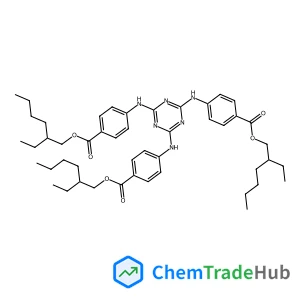
Tris(2-ethylhexyl) 4,4',4''-(1,3,5-triazine-2,4,6-triyltriimino)tribenzoate
CAS番号:
88122-99-0
分子式:
C48H66N6O6
![[2',6'-bis(propan-2-yloxy)-[1,1'-biphenyl]-3-yl]dicyclohexylphosphane structure](https://static.chemtradehub.com/structs/787/787618-22-8-dda2.webp "[2',6'-bis(propan-2-yloxy)-[1,1'-biphenyl]-3-yl]dicyclohexylphosphane structure")
[2',6'-bis(propan-2-yloxy)-[1,1'-biphenyl]-3-yl]dicyclohexylphosphane
CAS番号:
787618-22-8
分子式:
C30H43O2P



おすすめサプライヤー



免責事項
このページに表示される学術雑誌情報は、参考および研究目的のみを目的としています。当社は雑誌出版社とは提携しておらず、投稿の取り扱いも行っておりません。出版に関するお問い合わせは、各雑誌出版社に直接ご連絡ください。
表示されている情報に誤りがある場合は、support@chemtradehub.com までご連絡ください。迅速に確認し、対応いたします。