













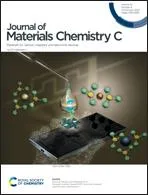
Journal of Materials Chemistry C
基本情報
略称:
J MATER CHEM C
インパクトファクター:
5.7
ISSN:
2050-7526
研究分野:
ENGINEERING TECHNOLOGY
h-index:
88
自己引用率:
7%
年間論文数:
1601
SCI収録状況:
Science Citation Index Expanded
ジャーナルウェブサイト:
https://pubs.rsc.org/en/journals/journalissues/tc
ジャーナル紹介:
Journal of Materials Chemistry A, B & C cover high quality studies across all fields of materials chemistry. The journals focus on those theoretical or experimental studies that report new understanding, applications, properties and synthesis of materials. The journals have a strong history of publishing quality reports of interest to interdisciplinary communities and providing an efficient and rigorous service through peer review and publication. The journals are led by an international team of Editors-in-Chief and Associate Editors who are all active researchers in their fields. Journal of Materials Chemistry A, B & C are separated by the intended application of the material studied. Broadly, applications in energy and sustainability are of interest to Journal of Materials Chemistry A, applications in biology and medicine are of interest to Journal of Materials Chemistry B, and applications in optical, magnetic and electronic devices are of interest to Journal of Materials Chemistry C. More than one Journal of Materials Chemistry journal may be suitable for certain fields and researchers are encouraged to submit their paper to the journal that they feel best fits for their particular article. Example topic areas within the scope of Journal of Materials Chemistry C are listed below. This list is neither exhaustive nor exclusive. Bioelectronics Conductors Detectors Dielectrics Displays Ferroelectrics Lasers LEDs Lighting Liquid crystals Memory Metamaterials Multiferroics Photonics Photovoltaics Semiconductors Sensors Single molecule conductors Spintronics Superconductors Thermoelectrics Topological insulators Transistors
CiteScore
CiteScore
10.8
SJR
1.358
SNIP
1.034
| 分野 | ランク | パーセンタイル |
|---|---|---|
Materials ScienceMaterials Chemistry |
32 / 317 | 90% |
ジャーナル統計
号/年
Time to first decision (peer reviewed only): 28 days
査読期間
£2,750
論文処理料
投稿情報
投稿サイト:
https://mc.manuscriptcentral.com/jmchemc収録タイプ:
Full papers
Communications
Reviews
Highlights
Perspectives
Comments
Communications
Reviews
Highlights
Perspectives
Comments
関連論文
Enhanced sub-band gap photosensitivity by an asymmetric source–drain electrode low operating voltage oxide transistor
Utkarsh Pandey, Akhilesh Kumar Yadav, Nila Pal, Pijush Kanti Aich, Bhola N. Pal
2023-10-10
Paper
DOI: 10.1039/D3TC02911E
Recent advances in the construction and application of stretchable PEDOT smart electronic membranes
Jiahua Chen, Chunfa Ye, Tianyu Cang, Rui Gao, Xiaoyan Li
2023-09-30
Review Article
DOI: 10.1039/D3TC02295A
Multifunctional properties of D–A luminophores based on acenaphtopyrido[2,3-b]pyrazine core: photophysics, photochemistry, and efficient solution-processed OLEDs
Leandro Espíndola, Karol Erfurt, Przemyslaw Data
2023-10-10
Paper
DOI: 10.1039/D3TC02860G
Platinum-adsorbed defective 2D monolayer boron nitride: a promising electrocatalyst for O2 reduction reaction
Lokesh Yadav
2023-09-30
Paper
DOI: 10.1039/D3TC02399K
1T and 2H mixed phase WS2 nanoflakes decorated with quasicrystal nanosheets for NO2 sensors
Sumit Kumar, Mustaque A. Khan, Shashank Shekhar Mishra, Nipun Sharma, Meng Gang, Chandra S. Tiwary, Krishanu Biswas, Mahesh Kumar
2023-10-05
Paper
DOI: 10.1039/D3TC02524A
Convolutional neural networks driving thermally enhanced upconversion luminescence for temperature sensing: achieving high accuracy and robustness across a wide temperature range
Wei Xu, Junqi Cui, Fengze Bai, Longjiang Zheng, Chunhai Hu, Zhiguo Zhang, Zhen Sun, Yungang Zhang
2023-10-12
Paper
DOI: 10.1039/D3TC02980H
Enhancing the CsPbBr3 PeLEC properties via PDMS/PMHS double-layer polymer encapsulation and high relative humidity stress-aging
R. Kenesbay, D. M. Mitin, D. S. Gets, D. V. Krasnikov, A. G. Nasibulin, R. M. Islamova
2023-10-11
Paper
DOI: 10.1039/D3TC01370G
こちらもおすすめ
化合物よくある質問
1-{3-[5-(エチルカルボンイル)-2,4-ジメチル-1H-ピロロール-3-基]プロパニル}ピペリジン-4-カルボン酸について、適用される法規ガイドラインは何ですか?
この化合物はCAS番号1142209-81-1であり、GHS分類では corrosive (腐食性物質) と classified (分類物質) として指定され...
1142209-81-11-{3-[5-(Ethoxycarbo...
化合物よくある質問
2,2-二氟-1,3-ベンゾジオキサン-5-カルボキシlic酸とは何ですか?
2,2-二氟-1,3-ベンゾジオキサン-5-カルボキシlic酸は、CAS番号656-46-2の化合物で、化学式はC8H4F2O4です。この化合物は白色の結晶性粉...
656-46-22,2-Difluoro-1,3-ben...
化合物よくある質問
8-氯-4-色原酮の代替品はありますか?
8-氯-4-色原酮(CAS番号: 49701-11-3)の代替品には、他の色原酮類似物や、構造が似ている化合物があります。例えば、8-メチル-4-色原酮や、他の...
49701-11-38-Chloro-2,3-dihydro...
化合物よくある質問
エチル6,6-ジメチル-4,5,6,7-テトラヒドロ-1H-インドアゼー-3-カルボキシレートとは何ですか?
エチル6,6-ジメチル-4,5,6,7-テトラヒドロ-1H-インドアゼー-3-カルボキシレートは、CAS番号1233243-56-5を有する化合物です。これは有...
1233243-56-5Ethyl 6,6-dimethyl-4...
化合物よくある質問
4-叔丁基-6-氯-嘧啶に適用される法規ガイドラインは何ですか?
4-叔丁基-6-氯-嘧啶はCAS番号3435-24-3で、GHS分類では毒性物質とみなし、GHSの危険性分類が適用されます。REACH規則では登録が必要で、Eu...
3435-24-34-Tert-butyl-6-chlor...
化合物よくある質問
維库溴铵杂质Bはどのように合成されますか?
維库溴铵杂质Bは、アンドロステンデンから始まり、一連の合成反応、包括的な選択性と高い収率で合成されます。具体的には、ブロミド化、酸化、ジマーゼ反応、アミド化など...
50587-95-6(2beta,3alpha,5alpha...
化合物よくある質問
2-(4-氟苄基)-吡咯烷の物理化学的性質は何ですか?
CAS番号350017-04-8の2-(4-氟苄基)-吡咯烷は、結晶性の白色粉末です。分子量は199.17 g/molで、水に溶けにくいです。化学反応では比較的...
350017-04-82-(4-Fluorobenzyl)py...
化合物よくある質問
3-喹啉甲醛(2-チロール-8-エチル)は安全ですか?
3-喹啉甲醛(2-チロール-8-エチル)は一定の毒性を持つため、取扱には注意が必要です。使用する際は適切な防護具を着用し、密閉容器で保管・搬送し、直接的な接触を...
335196-05-92-Chloro-8-ethyl-3-q...
化合物よくある質問
エチル3-(ヒドロキシメチル)-1H-ピロール-2-カルボキシレートはどのように保存すればよいですか?
エチル3-(ヒドロキシメチル)-1H-ピロール-2-カルボキシレートは、室温(25℃)以下で保存し、直射日光を避け、乾燥した環境で保管することが推奨されます。ま...
75448-69-0Ethyl 3-(hydroxymeth...
119410-05-88-Chloro-11-(4-piper...
おすすめ化合物

![1-(Hexopyranosyloxy)-4a,5-dihydroxy-7-methyl-1,4a,5,6,7,7a-hexahydrocyclopenta[c]pyran-7-yl 3-phenylacrylate structure](https://static.chemtradehub.com/structs/192/19210-12-9-ecae.webp "1-(Hexopyranosyloxy)-4a,5-dihydroxy-7-methyl-1,4a,5,6,7,7a-hexahydrocyclopenta[c]pyran-7-yl 3-phenylacrylate structure")


おすすめサプライヤー






免責事項
このページに表示される学術雑誌情報は、参考および研究目的のみを目的としています。当社は雑誌出版社とは提携しておらず、投稿の取り扱いも行っておりません。出版に関するお問い合わせは、各雑誌出版社に直接ご連絡ください。
表示されている情報に誤りがある場合は、support@chemtradehub.com までご連絡ください。迅速に確認し、対応いたします。