













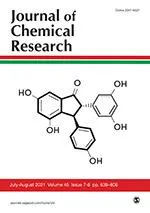
Journal of Chemical Research
基本情報
略称:
J CHEM RES
インパクトファクター:
1
ISSN:
1747-5198
研究分野:
CHEMICAL
h-index:
27
自己引用率:
23.4%
年間論文数:
60
SCI収録状況:
Science Citation Index Expanded
ジャーナルウェブサイト:
https://journals.sagepub.com/home/CHL
ジャーナル紹介:
From 1st January 2021, Journal of Chemical Research will become a fully open access journal. To facilitate this transition, all articles first submitted on or after 1st August 2020 will be subject to an open access article processing charge, and will be published under a Creative Commons license. The APC for this journal is 2000 USD (plus tax where applicable). The APC will be payable on acceptance if the article is accepted after peer review. The Journal of Chemical Research is a peer reviewed journal that publishes full-length review and research papers in all branches of experimental chemistry. The journal fills a niche by also publishing short papers, a format which favours particular types of work, e.g. the scope of new reagents or methodology, and the elucidation of the structure of novel compounds. Though welcome, short papers should not result in fragmentation of publication, they should describe a completed piece of work. The Journal is not intended as a vehicle for preliminary publications. The work must meet all the normal criteria for acceptance as regards scientific standards. Papers that contain extensive biological results or material relating to other areas of science may be diverted to more appropriate specialist journals. Areas of coverage include: Organic Chemistry Inorganic Chemistry Materials Chemistry Crystallography Computational Chemistry
CiteScore
CiteScore
2.3
SJR
0.241
SNIP
0.353
| 分野 | ランク | パーセンタイル |
|---|---|---|
ChemistryGeneral Chemistry |
246 / 408 | 39% |
ジャーナル統計
号/年
査読期間
論文処理料
投稿情報
投稿サイト:
http://www.sciencereviews2000.co.uk/member_area/register.php関連論文
Versatile one-step introduction of multiple hydrogen-bonding sites onto extended π-conjugated systems
Fu-Chuan Fang, Cheng-Che Chu, Chih-Hao Huang, Guillaume Raffy, André Del Guerzo, Ken-Tsung Wong, Dario M. Bassani
2008-11-06
Communication
DOI: 10.1039/B813704H
Anthraquinone based polymer as high performance cathode material for rechargeable lithium batteries
Zhiping Song, Hui Zhan, Yunhong Zhou
2008-11-24
Communication
DOI: 10.1039/B814515F
Photoinitiated polymerisation of monolithic stationary phases in polyimide coated capillaries using visible region LEDs
Zarah Walsh, Silvija Abele, Brian Lawless, Dominik Heger, Petr Klán, Michael C. Breadmore, Brett Paull, Mirek Macka
2008-11-07
Communication
DOI: 10.1039/B816958F
Shuffling lithiated mixed aggregates: NMR and Car–Parrinello molecular dynamics reveal an unexpected associative pathway
Franck Paté, Hélène Gérard, Hassan Oulyadi, Aurélien de la Lande, Anne Harrison-Marchand, Olivier Parisel, Jacques Maddaluno
2008-11-21
Communication
DOI: 10.1039/B814961E
Mercury or silver atoms bridging trinuclear titanium imido–nitrido systems
Avelino Martín, Noelia Martínez-Espada, Miguel Mena, Marta E. G. Mosquera, Adrián Pérez-Redondo, Carlos Yélamos
2008-11-11
Communication
DOI: 10.1039/B814982H
Trimacrocyclic arylamine and its polycationic states
Akihiro Ito, Yuko Yamagishi, Koji Fukui, Syuuzi Inoue, Yasukazu Hirao, Ko Furukawa, Tatsuhisa Kato
2008-11-12
Communication
DOI: 10.1039/B816311A
An approach to biodegradable star polymeric architectures using disulfide coupling
Jingquan Liu, Huiyun Liu, Zhongfan Jia, Volga Bulmus, Thomas P. Davis
2008-11-12
Communication
DOI: 10.1039/B817037A
Asymmetric heterometal string complexes: stereochemical control of the unique isomer of (4,0)[CuCuPd(npa)4Cl][PF6] and (4,0)[CuCuPt(npa)4Cl][PF6]
Chi-Hui Chen, Chi-Fen Chen, Gene-Hsiang Lee
2008-12-04
Communication
DOI: 10.1039/B817032K
One single catalyst, Pd(OAc)2, for two sequential very different steps: allylic alcohol oxidation–Heck reaction. Access to functionalised α,β-unsaturated ketones
Frédéric Batt, Christel Gozzi, Fabienne Fache
2008-09-30
Communication
DOI: 10.1039/B810538C
A diastereoselective route to 2,6-syn-disubstituted tetrahydropyrans: synthesis of the civet compound (+)-2-((2S,6S)-6-methyltetrahydro-2H-pyran-2-yl) acetic acid
Matthew O’Brien, Shane Cahill, Lyndsay A. Evans
2008-09-30
Communication
DOI: 10.1039/B810231G
こちらもおすすめ
化合物よくある質問
1-{3-[5-(エチルカルボンイル)-2,4-ジメチル-1H-ピロロール-3-基]プロパニル}ピペリジン-4-カルボン酸について、適用される法規ガイドラインは何ですか?
この化合物はCAS番号1142209-81-1であり、GHS分類では corrosive (腐食性物質) と classified (分類物質) として指定され...
1142209-81-11-{3-[5-(Ethoxycarbo...
化合物よくある質問
2,2-二氟-1,3-ベンゾジオキサン-5-カルボキシlic酸とは何ですか?
2,2-二氟-1,3-ベンゾジオキサン-5-カルボキシlic酸は、CAS番号656-46-2の化合物で、化学式はC8H4F2O4です。この化合物は白色の結晶性粉...
656-46-22,2-Difluoro-1,3-ben...
化合物よくある質問
8-氯-4-色原酮の代替品はありますか?
8-氯-4-色原酮(CAS番号: 49701-11-3)の代替品には、他の色原酮類似物や、構造が似ている化合物があります。例えば、8-メチル-4-色原酮や、他の...
49701-11-38-Chloro-2,3-dihydro...
化合物よくある質問
エチル6,6-ジメチル-4,5,6,7-テトラヒドロ-1H-インドアゼー-3-カルボキシレートとは何ですか?
エチル6,6-ジメチル-4,5,6,7-テトラヒドロ-1H-インドアゼー-3-カルボキシレートは、CAS番号1233243-56-5を有する化合物です。これは有...
1233243-56-5Ethyl 6,6-dimethyl-4...
化合物よくある質問
4-叔丁基-6-氯-嘧啶に適用される法規ガイドラインは何ですか?
4-叔丁基-6-氯-嘧啶はCAS番号3435-24-3で、GHS分類では毒性物質とみなし、GHSの危険性分類が適用されます。REACH規則では登録が必要で、Eu...
3435-24-34-Tert-butyl-6-chlor...
化合物よくある質問
維库溴铵杂质Bはどのように合成されますか?
維库溴铵杂质Bは、アンドロステンデンから始まり、一連の合成反応、包括的な選択性と高い収率で合成されます。具体的には、ブロミド化、酸化、ジマーゼ反応、アミド化など...
50587-95-6(2beta,3alpha,5alpha...
化合物よくある質問
2-(4-氟苄基)-吡咯烷の物理化学的性質は何ですか?
CAS番号350017-04-8の2-(4-氟苄基)-吡咯烷は、結晶性の白色粉末です。分子量は199.17 g/molで、水に溶けにくいです。化学反応では比較的...
350017-04-82-(4-Fluorobenzyl)py...
化合物よくある質問
3-喹啉甲醛(2-チロール-8-エチル)は安全ですか?
3-喹啉甲醛(2-チロール-8-エチル)は一定の毒性を持つため、取扱には注意が必要です。使用する際は適切な防護具を着用し、密閉容器で保管・搬送し、直接的な接触を...
335196-05-92-Chloro-8-ethyl-3-q...
化合物よくある質問
エチル3-(ヒドロキシメチル)-1H-ピロール-2-カルボキシレートはどのように保存すればよいですか?
エチル3-(ヒドロキシメチル)-1H-ピロール-2-カルボキシレートは、室温(25℃)以下で保存し、直射日光を避け、乾燥した環境で保管することが推奨されます。ま...
75448-69-0Ethyl 3-(hydroxymeth...
119410-05-88-Chloro-11-(4-piper...
おすすめ化合物

![1-(Hexopyranosyloxy)-4a,5-dihydroxy-7-methyl-1,4a,5,6,7,7a-hexahydrocyclopenta[c]pyran-7-yl 3-phenylacrylate structure](https://static.chemtradehub.com/structs/192/19210-12-9-ecae.webp "1-(Hexopyranosyloxy)-4a,5-dihydroxy-7-methyl-1,4a,5,6,7,7a-hexahydrocyclopenta[c]pyran-7-yl 3-phenylacrylate structure")



おすすめサプライヤー



免責事項
このページに表示される学術雑誌情報は、参考および研究目的のみを目的としています。当社は雑誌出版社とは提携しておらず、投稿の取り扱いも行っておりません。出版に関するお問い合わせは、各雑誌出版社に直接ご連絡ください。
表示されている情報に誤りがある場合は、support@chemtradehub.com までご連絡ください。迅速に確認し、対応いたします。