


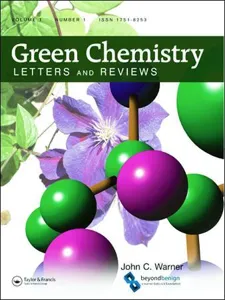
Green Chemistry Letters and Reviews
基本情報
略称:
GREEN CHEM LETT REV
インパクトファクター:
5.8
ISSN:
1751-8253
研究分野:
CHEMICAL
h-index:
27
自己引用率:
1.7%
年間論文数:
50
SCI収録状況:
Science Citation Index Expanded
ジャーナルウェブサイト:
https://www.tandfonline.com/journals/tgcl20
ジャーナル紹介:
Green Chemistry Letters and Reviews (GCLR) is an international, cross-disciplinary, fully open access journal focused on the contribution of chemistry to sustainable development. GCLR’s scope aims to build upon the definition of Green Chemistry as first defined by its Founding Editor John Warner, together with Paul Anastas, in Green Chemistry: Theory and Practice, Oxford University Press, Oxford, 1998. GCLR is dedicated to bringing together academic, teaching, and industry professionals, including environmental scientists and law and policy makers, who constitute the green chemistry community. We welcome original research letters and articles, review articles, perspective and feature articles, reports on recent innovations, as well as educational resources from those working in related disciplines across chemistry, chemical engineering, political science, jurisprudence, and economics. GCLR accepts the following article types: Research Article, Research Letter, Review Article, Methods, and Brief Reports. All contributions should clearly demonstrate impact to advancing the field by reference to the 12 Principles of Green Chemistry and the Sustainable Development Goals agreed by the United Nations in 2015. Such topics include, but are not limited to: Green synthesis and catalysis Green manufacturing and engineering Green product design Green chemistry education Critical raw materials and sustainable resources Energy harvest, storage, and savings Circular economy Environmental chemistry and green metrics Ethics, legislation, and economics We encourage authors to deposit their manuscripts as a pre-print to speed up the dissemination of research, which allows for feedback before formal peer review. Deposition of your manuscript in a pre-print server will have no bearing on the peer review process and final decision made on your manuscript. Authors who believe their manuscript would benefit from English editing prior to submission should seek a professional editing service or native English speaker. Details of editing services available from Taylor & Francis are available here. Peer Review Statement Green Chemistry Letters and Reviews is an international, peer-reviewed journal publishing high quality, original research contributions in the pursuit of scientific knowledge. All manuscript submissions are subject to initial appraisal by the Editor, and, if found suitable for further consideration, to single anonymized peer review by independent, anonymous expert referees. Publishing Ethics Statement Green Chemistry Letters and Reviews adheres to the highest standards of publishing ethics, with rigorous processes in place to ensure this is achieved. Taylor & Francis is a member of Committee of Publication Ethics (COPE) and utilizes Similarity Check via CrossRef for all journals. More information on our ethical standards and policies can be found here The Journal has an appeals and complaints policy which can be viewed here
CiteScore
CiteScore
9.1
SJR
1.138
SNIP
1.474
| 分野 | ランク | パーセンタイル |
|---|---|---|
ChemistryGeneral Chemistry |
62 / 408 | 84% |
ジャーナル統計
号/年
59 days avg. from submission to first decision
74 days avg. from submission to first post-review decision
13 days avg. from acceptance to online publication
査読期間
USD1680; GBP1344
論文処理料
投稿情報
投稿サイト:
https://rp.tandfonline.com/submission/create?journalCode=TGCLおすすめジャーナル

Coloration Technology

Angewandte Chemie International Edition

Journal of Medical Biochemistry

Physical Chemistry Chemical Physics

Mini-Reviews in Medicinal Chemistry

Molecular Diversity

Photochemical & Photobiological Sciences

European Journal of Organic Chemistry

Environmental Toxicology and Pharmacology

Journal of Enzyme inhibition and Medicinal Chemistry
関連論文
こちらもおすすめ
化合物よくある質問
1-{3-[5-(エチルカルボンイル)-2,4-ジメチル-1H-ピロロール-3-基]プロパニル}ピペリジン-4-カルボン酸について、適用される法規ガイドラインは何ですか?
この化合物はCAS番号1142209-81-1であり、GHS分類では corrosive (腐食性物質) と classified (分類物質) として指定され...
1142209-81-11-{3-[5-(Ethoxycarbo...
化合物よくある質問
2,2-二氟-1,3-ベンゾジオキサン-5-カルボキシlic酸とは何ですか?
2,2-二氟-1,3-ベンゾジオキサン-5-カルボキシlic酸は、CAS番号656-46-2の化合物で、化学式はC8H4F2O4です。この化合物は白色の結晶性粉...
656-46-22,2-Difluoro-1,3-ben...
化合物よくある質問
8-氯-4-色原酮の代替品はありますか?
8-氯-4-色原酮(CAS番号: 49701-11-3)の代替品には、他の色原酮類似物や、構造が似ている化合物があります。例えば、8-メチル-4-色原酮や、他の...
49701-11-38-Chloro-2,3-dihydro...
化合物よくある質問
エチル6,6-ジメチル-4,5,6,7-テトラヒドロ-1H-インドアゼー-3-カルボキシレートとは何ですか?
エチル6,6-ジメチル-4,5,6,7-テトラヒドロ-1H-インドアゼー-3-カルボキシレートは、CAS番号1233243-56-5を有する化合物です。これは有...
1233243-56-5Ethyl 6,6-dimethyl-4...
化合物よくある質問
4-叔丁基-6-氯-嘧啶に適用される法規ガイドラインは何ですか?
4-叔丁基-6-氯-嘧啶はCAS番号3435-24-3で、GHS分類では毒性物質とみなし、GHSの危険性分類が適用されます。REACH規則では登録が必要で、Eu...
3435-24-34-Tert-butyl-6-chlor...
化合物よくある質問
維库溴铵杂质Bはどのように合成されますか?
維库溴铵杂质Bは、アンドロステンデンから始まり、一連の合成反応、包括的な選択性と高い収率で合成されます。具体的には、ブロミド化、酸化、ジマーゼ反応、アミド化など...
50587-95-6(2beta,3alpha,5alpha...
化合物よくある質問
2-(4-氟苄基)-吡咯烷の物理化学的性質は何ですか?
CAS番号350017-04-8の2-(4-氟苄基)-吡咯烷は、結晶性の白色粉末です。分子量は199.17 g/molで、水に溶けにくいです。化学反応では比較的...
350017-04-82-(4-Fluorobenzyl)py...
化合物よくある質問
3-喹啉甲醛(2-チロール-8-エチル)は安全ですか?
3-喹啉甲醛(2-チロール-8-エチル)は一定の毒性を持つため、取扱には注意が必要です。使用する際は適切な防護具を着用し、密閉容器で保管・搬送し、直接的な接触を...
335196-05-92-Chloro-8-ethyl-3-q...
化合物よくある質問
エチル3-(ヒドロキシメチル)-1H-ピロール-2-カルボキシレートはどのように保存すればよいですか?
エチル3-(ヒドロキシメチル)-1H-ピロール-2-カルボキシレートは、室温(25℃)以下で保存し、直射日光を避け、乾燥した環境で保管することが推奨されます。ま...
75448-69-0Ethyl 3-(hydroxymeth...
119410-05-88-Chloro-11-(4-piper...
おすすめ化合物

![1-(Hexopyranosyloxy)-4a,5-dihydroxy-7-methyl-1,4a,5,6,7,7a-hexahydrocyclopenta[c]pyran-7-yl 3-phenylacrylate structure](https://static.chemtradehub.com/structs/192/19210-12-9-ecae.webp "1-(Hexopyranosyloxy)-4a,5-dihydroxy-7-methyl-1,4a,5,6,7,7a-hexahydrocyclopenta[c]pyran-7-yl 3-phenylacrylate structure")

Tris(2-ethylhexyl) 4,4',4''-(1,3,5-triazine-2,4,6-triyltriimino)tribenzoate
CAS番号:
88122-99-0
分子式:
C48H66N6O6
おすすめサプライヤー




免責事項
このページに表示される学術雑誌情報は、参考および研究目的のみを目的としています。当社は雑誌出版社とは提携しておらず、投稿の取り扱いも行っておりません。出版に関するお問い合わせは、各雑誌出版社に直接ご連絡ください。
表示されている情報に誤りがある場合は、support@chemtradehub.com までご連絡ください。迅速に確認し、対応いたします。