













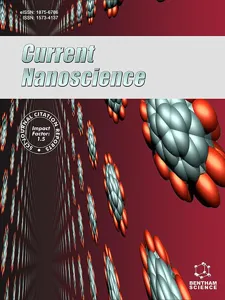
Current Nanoscience
基本情報
略称:
CURR NANOSCI
インパクトファクター:
1.4
ISSN:
1573-4137
研究分野:
ENGINEERING TECHNOLOGY
h-index:
37
自己引用率:
6.2%
年間論文数:
69
SCI収録状況:
Science Citation Index Expanded
ジャーナルウェブサイト:
https://benthamscience.com/journal/cnano
ジャーナル紹介:
Current Nanoscience publishes (a) Authoritative/Mini Reviews, and (b) Original Research and Highlights written by experts covering the most recent advances in nanoscience and nanotechnology. All aspects of the field are represented including nano-structures, nano-bubbles, nano-droplets and nanofluids. Applications of nanoscience in physics, material science, chemistry, synthesis, environmental science, electronics, biomedical nanotechnology, biomedical engineering, biotechnology, medicine and pharmaceuticals are also covered. The journal is essential to all researches involved in nanoscience and its applied and fundamental areas of science, chemistry, physics, material science, engineering and medicine. Current Nanoscience also welcomes submissions on the following topics of Nanoscience and Nanotechnology: ● Nanoelectronics and photonics ● Advanced Nanomaterials ● Nanofabrication and measurement ● Nanobiotechnology and nanomedicine ● Nanotechnology for energy ● Sensors and actuators ● Computational nanoscience and technology
CiteScore
CiteScore
3.5
SJR
0.267
SNIP
0.307
| 分野 | ランク | パーセンタイル |
|---|---|---|
MedicineMedicine (miscellaneous) |
156 / 398 | 60% |
ジャーナル統計
Quarterly
号/年
査読期間
論文処理料
投稿情報
投稿サイト:
https://bentham.manuscriptpoint.com/journals/cnanoおすすめジャーナル
関連論文
Photoelectrochemical hydrogen evolution of tapered silicon nanowires
Yanjun Xiao, Keya Zhou, Junna Wang, Stefan L. Schweizer, Alexander Sprafke, Jung-Ho Lee
2014-11-11
Communication
DOI: 10.1039/C4CP04396K
Reverse hydrotropy by complex formation
Kamil Wojciechowski, Thomas Gutberlet, Vikram Singh Raghuwanshi, Ann Terry
2014-10-16
Paper
DOI: 10.1039/C4CP03835E
Size selected clusters and particles: from physical chemistry and chemical physics to catalysis
2014-11-06
Editorial
DOI: 10.1039/C4CP90163K
Elucidating the effect of copper as a redox additive and dopant on the performance of a PANI based supercapacitor
Kavita Pandey, Pankaj Yadav, Indrajit Mukhopadhyay
2014-11-07
Paper
DOI: 10.1039/C4CP04321A
Analytic gradients, geometry optimization and excited state potential energy surfaces from the particle-particle random phase approximation
Du Zhang, Degao Peng, Peng Zhang
2014-11-12
Paper
DOI: 10.1039/C4CP04109G
Measurement and PC-SAFT modelling of three-phase behaviour
Iago Rodríguez-Palmeiro, Oscar Rodríguez, Ana Soto, Christoph Held
2014-11-24
Paper
DOI: 10.1039/C4CP04336G
Adsorption of metal adatoms on single-layer phosphorene
Oleksandr I. Malyi, Ping Wu
2014-11-12
Paper
DOI: 10.1039/C4CP03890H
Complex behaviour of vacancy point-defects in SrRuO3 thin films
Henning Schraknepper, Christoph Bäumer, Regina Dittmann, Roger A. De Souza
2014-11-12
Paper
DOI: 10.1039/C4CP03632H
Influence of dispersive forces on the final shape of a reverse micelle
I. León, R. Montero, A. Longarte, José A. Fernández
2014-12-02
Paper
DOI: 10.1039/C4CP03667K
こちらもおすすめ
化合物よくある質問
1-{3-[5-(エチルカルボンイル)-2,4-ジメチル-1H-ピロロール-3-基]プロパニル}ピペリジン-4-カルボン酸について、適用される法規ガイドラインは何ですか?
この化合物はCAS番号1142209-81-1であり、GHS分類では corrosive (腐食性物質) と classified (分類物質) として指定され...
1142209-81-11-{3-[5-(Ethoxycarbo...
化合物よくある質問
2,2-二氟-1,3-ベンゾジオキサン-5-カルボキシlic酸とは何ですか?
2,2-二氟-1,3-ベンゾジオキサン-5-カルボキシlic酸は、CAS番号656-46-2の化合物で、化学式はC8H4F2O4です。この化合物は白色の結晶性粉...
656-46-22,2-Difluoro-1,3-ben...
化合物よくある質問
8-氯-4-色原酮の代替品はありますか?
8-氯-4-色原酮(CAS番号: 49701-11-3)の代替品には、他の色原酮類似物や、構造が似ている化合物があります。例えば、8-メチル-4-色原酮や、他の...
49701-11-38-Chloro-2,3-dihydro...
化合物よくある質問
エチル6,6-ジメチル-4,5,6,7-テトラヒドロ-1H-インドアゼー-3-カルボキシレートとは何ですか?
エチル6,6-ジメチル-4,5,6,7-テトラヒドロ-1H-インドアゼー-3-カルボキシレートは、CAS番号1233243-56-5を有する化合物です。これは有...
1233243-56-5Ethyl 6,6-dimethyl-4...
化合物よくある質問
4-叔丁基-6-氯-嘧啶に適用される法規ガイドラインは何ですか?
4-叔丁基-6-氯-嘧啶はCAS番号3435-24-3で、GHS分類では毒性物質とみなし、GHSの危険性分類が適用されます。REACH規則では登録が必要で、Eu...
3435-24-34-Tert-butyl-6-chlor...
化合物よくある質問
維库溴铵杂质Bはどのように合成されますか?
維库溴铵杂质Bは、アンドロステンデンから始まり、一連の合成反応、包括的な選択性と高い収率で合成されます。具体的には、ブロミド化、酸化、ジマーゼ反応、アミド化など...
50587-95-6(2beta,3alpha,5alpha...
化合物よくある質問
2-(4-氟苄基)-吡咯烷の物理化学的性質は何ですか?
CAS番号350017-04-8の2-(4-氟苄基)-吡咯烷は、結晶性の白色粉末です。分子量は199.17 g/molで、水に溶けにくいです。化学反応では比較的...
350017-04-82-(4-Fluorobenzyl)py...
化合物よくある質問
3-喹啉甲醛(2-チロール-8-エチル)は安全ですか?
3-喹啉甲醛(2-チロール-8-エチル)は一定の毒性を持つため、取扱には注意が必要です。使用する際は適切な防護具を着用し、密閉容器で保管・搬送し、直接的な接触を...
335196-05-92-Chloro-8-ethyl-3-q...
化合物よくある質問
エチル3-(ヒドロキシメチル)-1H-ピロール-2-カルボキシレートはどのように保存すればよいですか?
エチル3-(ヒドロキシメチル)-1H-ピロール-2-カルボキシレートは、室温(25℃)以下で保存し、直射日光を避け、乾燥した環境で保管することが推奨されます。ま...
75448-69-0Ethyl 3-(hydroxymeth...
119410-05-88-Chloro-11-(4-piper...
おすすめ化合物




おすすめサプライヤー


免責事項
このページに表示される学術雑誌情報は、参考および研究目的のみを目的としています。当社は雑誌出版社とは提携しておらず、投稿の取り扱いも行っておりません。出版に関するお問い合わせは、各雑誌出版社に直接ご連絡ください。
表示されている情報に誤りがある場合は、support@chemtradehub.com までご連絡ください。迅速に確認し、対応いたします。