












![Bis[(1,2,3,4,5-eta)-1-(diphenylphosphino)cyclopentadienyl]iron structure](https://static.chemtradehub.com/structs/121/12150-46-8-ecd2.webp "Bis[(1,2,3,4,5-eta)-1-(diphenylphosphino)cyclopentadienyl]iron structure")
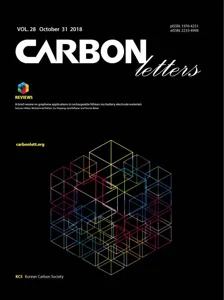
Carbon Letters
基本情報
略称:
CARBON LETT
インパクトファクター:
5.5
ISSN:
1976-4251
研究分野:
ENGINEERING TECHNOLOGY
h-index:
11
自己引用率:
20%
年間論文数:
197
SCI収録状況:
Science Citation Index Expanded
ジャーナルウェブサイト:
https://www.springer.com/42823
ジャーナル紹介:
Carbon Letters aims to be a comprehensive journal with complete coverage of carbon materials and carbon-rich molecules. These materials range from, but are not limited to, diamond and graphite through chars, semicokes, mesophase substances, carbon fibers, carbon nanotubes, graphenes, carbon blacks, activated carbons, pyrolytic carbons, glass-like carbons, etc. Papers on the secondary production of new carbon and composite materials from the above mentioned various carbons are within the scope of the journal. Papers on organic substances, including coals, will be considered only if the research has close relation to the resulting carbon materials. Carbon Letters also seeks to keep abreast of new developments in their specialist fields and to unite in finding alternative energy solutions to current issues such as the greenhouse effect and the depletion of the ozone layer. The renewable energy basics, energy storage and conversion, solar energy, wind energy, water energy, nuclear energy, biomass energy, hydrogen production technology, and other clean energy technologies are also within the scope of the journal. Carbon Letters invites original reports of fundamental research in all branches of the theory and practice of carbon science and technology.
CiteScore
CiteScore
7.3
SJR
0.855
SNIP
1.129
| 分野 | ランク | パーセンタイル |
|---|---|---|
ChemistryInorganic Chemistry |
14 / 79 | 82% |
ジャーナル統計
7 issues per year
号/年
Submission to first decision (median): 11 days
査読期間
£2090/$2990/€2390
論文処理料
投稿情報
投稿サイト:
https://www.editorialmanager.com/CALE関連論文
Electronic properties of PbX3CH3NH3 (X = Cl, Br, I) compounds for photovoltaic and photocatalytic applications
Sigismund Teunis Alexander George Melissen, Frédéric Labat, Philippe Sautet, Tangui Le Bahers
2014-11-26
Paper
DOI: 10.1039/C4CP04666H
In situ non-aqueous nucleation and growth of next generation rare-earth-free permanent magnets
Aoran Xu, George E. Sterbinsky, Dario A. Arena, Ziying Wang, Peter W. Stephens
2014-11-21
Paper
DOI: 10.1039/C4CP04451G
Ligand(s)-to-metal charge transfer as a factor controlling the equilibrium constants of late first-row transition metal complexes: revealing the Irving–Williams thermodynamical series
Pradeep R. Varadwaj, Arpita Varadwaj, Bih-Yaw Jin
2014-10-27
Communication
DOI: 10.1039/C4CP03953J
Near field plasmonic gradient effects on high vacuum tip-enhanced Raman spectroscopy
Mengtao Sun
2014-11-07
Perspective
DOI: 10.1039/C4CP03871A
Magnetic and geometric anisotropy in particle-crosslinked ferrohydrogels
Lisa Roeder, Philipp Bender, Matthias Kundt, Andreas Tschöpe, Annette M. Schmidt
2014-11-17
Paper
DOI: 10.1039/C4CP04493B
Intra-residue interactions in proteins: interplay between serine or cysteine side chains and backbone conformations, revealed by laser spectroscopy of isolated model peptides
Himansu S. Biswal
2014-11-27
Paper
DOI: 10.1039/C4CP04449E
The isotope method for the determination of stoichiometry between compounds forming the polypyrrole and glucose oxidase composite
A. Popov, A. Ramanaviciene, V. Remeikis
2014-11-25
Paper
DOI: 10.1039/C4CP04885G
Formation of 2- and 1-methyl-1,4-dihydronaphthalene isomers via the crossed beam reactions of phenyl radicals (C6H5) with isoprene (CH2C(CH3)CHCH2) and 1,3-pentadiene (CH2CHCHCHCH3)
Tao Yang, Lloyd Muzangwa, Dorian S. N. Parker, Ralf I. Kaiser, Alexander M. Mebel
2014-11-07
Paper
DOI: 10.1039/C4CP04612A
Chemical imaging of single catalyst particles with scanning μ-XANES-CT and μ-XRF-CT
S. W. T. Price, K. Ignatyev, K. Geraki, M. Basham, J. Filik, N. T. Vo, P. T. Witte, J. F. W. Mosselmans
2014-11-05
Paper
DOI: 10.1039/C4CP04488F
こちらもおすすめ
化合物よくある質問
1-{3-[5-(エチルカルボンイル)-2,4-ジメチル-1H-ピロロール-3-基]プロパニル}ピペリジン-4-カルボン酸について、適用される法規ガイドラインは何ですか?
この化合物はCAS番号1142209-81-1であり、GHS分類では corrosive (腐食性物質) と classified (分類物質) として指定され...
1142209-81-11-{3-[5-(Ethoxycarbo...
化合物よくある質問
2,2-二氟-1,3-ベンゾジオキサン-5-カルボキシlic酸とは何ですか?
2,2-二氟-1,3-ベンゾジオキサン-5-カルボキシlic酸は、CAS番号656-46-2の化合物で、化学式はC8H4F2O4です。この化合物は白色の結晶性粉...
656-46-22,2-Difluoro-1,3-ben...
化合物よくある質問
8-氯-4-色原酮の代替品はありますか?
8-氯-4-色原酮(CAS番号: 49701-11-3)の代替品には、他の色原酮類似物や、構造が似ている化合物があります。例えば、8-メチル-4-色原酮や、他の...
49701-11-38-Chloro-2,3-dihydro...
化合物よくある質問
エチル6,6-ジメチル-4,5,6,7-テトラヒドロ-1H-インドアゼー-3-カルボキシレートとは何ですか?
エチル6,6-ジメチル-4,5,6,7-テトラヒドロ-1H-インドアゼー-3-カルボキシレートは、CAS番号1233243-56-5を有する化合物です。これは有...
1233243-56-5Ethyl 6,6-dimethyl-4...
化合物よくある質問
4-叔丁基-6-氯-嘧啶に適用される法規ガイドラインは何ですか?
4-叔丁基-6-氯-嘧啶はCAS番号3435-24-3で、GHS分類では毒性物質とみなし、GHSの危険性分類が適用されます。REACH規則では登録が必要で、Eu...
3435-24-34-Tert-butyl-6-chlor...
化合物よくある質問
維库溴铵杂质Bはどのように合成されますか?
維库溴铵杂质Bは、アンドロステンデンから始まり、一連の合成反応、包括的な選択性と高い収率で合成されます。具体的には、ブロミド化、酸化、ジマーゼ反応、アミド化など...
50587-95-6(2beta,3alpha,5alpha...
化合物よくある質問
2-(4-氟苄基)-吡咯烷の物理化学的性質は何ですか?
CAS番号350017-04-8の2-(4-氟苄基)-吡咯烷は、結晶性の白色粉末です。分子量は199.17 g/molで、水に溶けにくいです。化学反応では比較的...
350017-04-82-(4-Fluorobenzyl)py...
化合物よくある質問
3-喹啉甲醛(2-チロール-8-エチル)は安全ですか?
3-喹啉甲醛(2-チロール-8-エチル)は一定の毒性を持つため、取扱には注意が必要です。使用する際は適切な防護具を着用し、密閉容器で保管・搬送し、直接的な接触を...
335196-05-92-Chloro-8-ethyl-3-q...
化合物よくある質問
エチル3-(ヒドロキシメチル)-1H-ピロール-2-カルボキシレートはどのように保存すればよいですか?
エチル3-(ヒドロキシメチル)-1H-ピロール-2-カルボキシレートは、室温(25℃)以下で保存し、直射日光を避け、乾燥した環境で保管することが推奨されます。ま...
75448-69-0Ethyl 3-(hydroxymeth...
119410-05-88-Chloro-11-(4-piper...
おすすめ化合物





おすすめサプライヤー



免責事項
このページに表示される学術雑誌情報は、参考および研究目的のみを目的としています。当社は雑誌出版社とは提携しておらず、投稿の取り扱いも行っておりません。出版に関するお問い合わせは、各雑誌出版社に直接ご連絡ください。
表示されている情報に誤りがある場合は、support@chemtradehub.com までご連絡ください。迅速に確認し、対応いたします。