












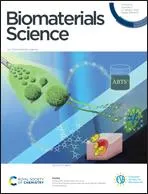
Front cover
文献情報
出版日
2024-01-30
DOI
10.1039/D4BM90008A
インパクトファクター
6.843
著者
原文を見る
要旨
A graphical abstract is available for this content
おすすめジャーナル
関連文献
Reversibly crosslinked thermo- and redox-responsive nanogels for controlled drug release
Christophe Detrembleur, Marie Hurtgen, Antoine Debuigne, Marie-Claire De Pauw-Gillet, Stéphane Mornet, Etienne Duguet, Christine Jérôme
2013-07-31
Paper
DOI: 10.1039/C3PY00839H
Polyacetylenes containing BODIPY pendants with different connectivities: synthesis, characterization and opto-electronic properties
Bin Liu, Lingfeng Li, Cuiling Lin, Jingdan Zhou, Zhexin Zhu, Hongyao Xu, Huayu Qiu, Shouchun Yin
2013-09-11
Paper
DOI: 10.1039/C3PY01021J
Combining oxyanionic polymerization and click-chemistry: a general strategy for the synthesis of polyether polyol macromonomers
Anja Thomas, Kerstin Niederer, Frederik Wurm, Holger Frey
2013-09-26
Paper
DOI: 10.1039/C3PY01078C
A versatile Fe3O4 based platform via iron-catalyzed AGET ATRP: towards various multifunctional nanomaterials
Weiwei He, Liang Cheng, Lifen Zhang, Zhuang Liu, Zhenping Cheng, Xiulin Zhu
2013-09-27
Paper
DOI: 10.1039/C3PY00920C
Click chemistry as a powerful and chemoselective tool for the attachment of targeting ligands to polymer drug carriers
Robert Pola, Alena Braunová, Richard Laga, Michal Pechar, Karel Ulbrich
2013-10-29
Paper
DOI: 10.1039/C3PY01376F
Acetyl protected thiol methacrylic polymers as effective ligands to keep quantum dots in luminescent standby mode
Marta Liras, Isabel Quijada-Garrido, Marta Palacios-Cuesta, Sonia Muñoz-Durieux, Olga García
2013-08-30
Paper
DOI: 10.1039/C3PY00987D
One pot synthesis and characterization of novel poly(ether ester) mutiblock copolymers containing poly(tetramethylene oxide) and poly(ethylene terephthalate)
Weichun Huang, Yingbo Wan, Jianying Chen, Qiaozhen Xu, Xiaohong Li, Xiaoming Yang, Yaowen Li, Yingfeng Tu
2013-10-18
Paper
DOI: 10.1039/C3PY00932G
Chalcone derivatives as highly versatile photoinitiators for radical, cationic, thiol–ene and IPN polymerization reactions upon exposure to visible light
Mohamad-Ali Tehfe, Frédéric Dumur, Pu Xiao, Marie Delgove, Bernadette Graff, Jean-Pierre Fouassier, Didier Gigmes, Jacques Lalevée
2013-08-20
Paper
DOI: 10.1039/C3PY00922J
Salt-induced reentrant hydrogel of poly(ethylene glycol)–poly(lactide-co-glycolide) block copolymers
Ting Li, Tianyuan Ci, Liang Chen, Lin Yu, Jiandong Ding
2013-09-26
Paper
DOI: 10.1039/C3PY01107K
Absolut “copper catalyzation perfected”; robust living polymerization of NIPAM: Guinness is good for SET-LRP
Christopher Waldron, Qiang Zhang, Zaidong Li, Vasiliki Nikolaou, Gabit Nurumbetov, Jamie Godfrey, Ronan McHale, Gokhan Yilmaz, Rajan K. Randev, Mony Girault, Kayleigh McEwan, David M. Haddleton, Martijn Droesbeke, Alice J. Haddleton, Paul Wilson, Alexandre Simula, Jennifer Collins, Danielle J. Lloyd, James A. Burns, Christopher Summers, Claudia Houben, Athina Anastasaki, Muxiu Li, C. Remzi Becer, Jenny K. Kiviaho, Nuttapol Risangud
2013-09-11
Communication
DOI: 10.1039/C3PY01075A
こちらもおすすめ
28770-01-62-(2-Isopropyl-1,3-o...
化合物よくある質問
「邻羟基阿托伐他汀内酯标准品」に適用される法規ガイドelinesは何ですか?
CAS番号163217-74-1の「邻羟基阿托伐他汀内酯标准品」は、GHS分類では危険物に分類されず、主にREACH規則とFDA/EPAの管理対象となります。R...
163217-74-1ortho-Hydroxy Atorva...
化合物よくある質問
メチル(3R)-3-アミノ-2,3-ジヒドロ-1-ベンゾファンラニン-5-カルボイル酸塩塩酸塩の主な用途は何ですか?
メチル(3R)-3-アミノ-2,3-ジヒドロ-1-ベンゾファンラニン-5-カルボイル酸塩塩酸塩は、医薬品や合成化学の研究に広く用いられます。また、特定の薬物の前...
2241594-15-8Methyl (3R)-3-amino-...
化合物よくある質問
トランス-4-メチルピロリジン-3-オール塩酸塩はどのように合成されますか?
トランス-4-メチルピロリジン-3-オール塩酸塩は、4-メチルピロリジンの塩酸塩化によって合成されます。一般的な合成方法では、4-メチルピロリジンを塩酸に加えて...
265108-42-7trans-4-Methylpyrrol...
化合物よくある質問
硫雜環丁烷-1,1-二氧化物は安全ですか?
硫雜環丁烷-1,1-二氧化物は安全ではありません。毒性は報告されていませんが、高温下で分解し、可燃性があるため、高圧ガスは注意が必要です。密閉した容器で保管し、...
5687-92-3Thietane 1,1-dioxide
6054-10-02H, 8H-Benzo[1,2-b
化合物よくある質問
9-ヒドロキシエリプチシネ塩酸塩はどのように合成されますか?
9-ヒドロキシエリプチシネ塩酸塩は、エリプチシネから塩酸を添加することで合成されます。選択性は高いですが、収率は約70%です。
52238-35-49-Hydroxyellipticine...
化合物よくある質問
5-塩素-2-(メチルアミノ)フェニル-(2-塩素フェニル)メタン酮の物理化学的性質は何ですか?
5-塩素-2-(メチルアミノ)フェニル-(2-塩素フェニル)メタン酮のCAS番号は5621-86-3です。この化合物は白色の結晶性粉末で、分子量は415.03で...
5621-86-3[5-Chloro-2-(methyla...
化合物よくある質問
1-[2-(4-甲氧基-苯氧基)-乙基]-哌嗪はどのように保存すればよいですか?
1-[2-(4-甲氧基-苯氧基)-乙基]-哌嗪は、直射日光を避けて暗所に、室温(15-25℃)で保管し、密閉容器に入れることで安定性を保つことができます。
117132-44-21-[2-(4-Methoxy-phen...
化合物よくある質問
2-[3-(4-甲氧基フェニル)プロピル]-4,4,5,5-四メチル-1,3,2-ドイボロロールアンの主な用途は何ですか?
2-[3-(4-甲氧基フェニル)プロピル]-4,4,5,5-四メチル-1,3,2-ドイボロロールアンは、医薬品の合成、有機合成化学、および新材料の研究で使用され...
1073371-72-82-[3-(4-Methoxypheny...
掲載誌
Biomaterials Science
CiteScore:
11.5
自己引用率:
3.4%
年間論文数:
492
Biomaterials Science is an international high impact journal exploring the science of biomaterials and their translation towards clinical use. Its scope encompasses new concepts in biomaterials design, studies into the interaction of biomaterials with the body, and the use of materials to answer fundamental biological questions. Papers do not necessarily need to report a new biomaterial but should provide novel insight into the biological applications of the biomaterial. Articles that primarily focus on demonstrating novel materials chemistry and bring a molecular picture to bear on a given material’s suitability as a biomaterial are more suited to our companion journal, Journal of Materials Chemistry B. Biomaterials Science publishes primary research and review-type articles in the following areas: molecular design of biomaterials, including translation of emerging chemistries to biomaterials science of cells and materials at the nanoscale and microscale materials as model systems for stem cell and human biology materials for tissue engineering and regenerative medicine (Nano)materials and (nano)systems for therapeutic delivery interactions at the biointerface biologically inspired and biomimetic materials, including bio-inspired self-assembly systems and cell-inspired synthetic tools next-generation biomaterials tools and methods
おすすめ化合物
![[(1S,2S,3R,4S,7R,9S,10S,12R,15S)-4,12-Diacetyloxy-15-[(2R,3S)-3-benzamido-3-phenyl-2-(2,2,2-trichloroethoxycarbonyloxy)propanoyl]oxy-1,9-dihydroxy-10,14,17,17-tetramethyl-11-oxo-6-oxatetracyclo[11.3.1.03,10.04,7]heptadec-13-en-2-yl] benzoate structure](https://static.chemtradehub.com/structs/100/100431-55-8-7104.webp "[(1S,2S,3R,4S,7R,9S,10S,12R,15S)-4,12-Diacetyloxy-15-[(2R,3S)-3-benzamido-3-phenyl-2-(2,2,2-trichloroethoxycarbonyloxy)propanoyl]oxy-1,9-dihydroxy-10,14,17,17-tetramethyl-11-oxo-6-oxatetracyclo[11.3.1.03,10.04,7]heptadec-13-en-2-yl] benzoate structure")
おすすめサプライヤー





免責事項
このページに表示される学術雑誌情報は、参考および研究目的のみを目的としています。当社は雑誌出版社とは提携しておらず、投稿の取り扱いも行っておりません。出版に関するお問い合わせは、各雑誌出版社に直接ご連絡ください。
表示されている情報に誤りがある場合は、support@chemtradehub.com までご連絡ください。迅速に確認し、対応いたします。