


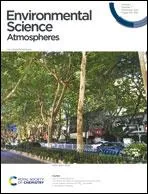
Influence of ambient and endogenous H2O2 on reactive oxygen species concentrations and OH radical production in the respiratory tract
文献情報
出版日
2023-05-01
DOI
10.1039/D2EA00179A
インパクトファクター
0
著者
Eleni Dovrou, Steven Lelieveld, Ashmi Mishra, Ulrich Pöschl, Thomas Berkemeier
原文を見る
要旨
Air pollution is a major health risk, but the underlying chemical mechanisms are not yet well understood. Fine particulate matter (PM2.5) and gaseous pollutants can generate reactive oxygen species (ROS) in the epithelial lining fluid (ELF), and hydrogen peroxide (H2O2) is the most abundant ROS in the human body. Here, we show that H2O2 concentrations in the ELF may be primarily determined by the release of endogenous H2O2 and the inhalation of ambient gas-phase H2O2, while the chemical production of H2O2 through inhaled PM2.5 is less important. The production of hydroxyl radicals (˙OH), however, was strongly correlated with Fenton chemistry of PM2.5 in the model calculations. Hence, our findings suggest that the adverse health effects of PM2.5 may not be primarily related to direct chemical production of H2O2, but rather to the conversion of peroxides into more reactive species such as the ˙OH radical, or the stimulation of biological ROS production. The analysis highlights remaining uncertainties in the relevant physical, chemical and biological parameters, suggesting a critical reassessment of current paradigms in elucidating and mitigating the health effects of different types of air pollutants.
おすすめジャーナル

Russian Journal of General Chemistry

Acta Materialia

Russian Journal of Organic Chemistry

Current Opinion in Colloid & Interface Science

Chemistry Education Research and Practice

Nature Medicine

Current Opinion in Solid State & Materials Science

Journal of Saudi Chemical Society

Russian Journal of Bioorganic Chemistry

New Journal of Chemistry
関連文献
Effect of chemically modified graphene oxide on the phase separation behaviour and properties of an epoxy/polyetherimide binary system
Guijun Yu, Peiyi Wu
2013-07-31
Paper
DOI: 10.1039/C3PY00878A
Nitroxide mediated polymerization of methacrylates at moderate temperature
Christophe Detrembleur, Christine Jérôme, Julien De Winter, Pascal Gerbaux, Jean-Louis Clément, Yohann Guillaneuf, Didier Gigmes
2013-09-17
Communication
DOI: 10.1039/C3PY01133J
(Meth)acrylic monomers with heteroatom-containing ester side chains: a systematic PLP-SEC and polymerization study
Marek Stach, Anna Chovancová, Andrea M. Misske, Igor Lacík
2013-09-03
Paper
DOI: 10.1039/C3PY00948C
Soluble and stable alternating main-chain merocyanine copolymers through quantitative spiropyran–merocyanine conversion
Hartmut Komber, Stefan Müllers, Alexander Held, Michael Walter
2013-08-22
Paper
DOI: 10.1039/C3PY00853C
One-step synthesis of polypyrazoles and self-assembled polypyrazole–copper catalysts for click chemistry
Longqiang Xiao, Shaojun Cai, Qingye Liu, Liqiong Liao, Xin Guo, Yan Li, Xiangxiang Jia, Feifei Li, Lijian Liu
2013-09-03
Paper
DOI: 10.1039/C3PY01105D
Synergistic effects of hydrophobicity and gas barrier properties on the anticorrosion property of PMMA nanocomposite coatings embedded with graphene nanosheets
Kung-Chin Chang, Wei-Fu Ji, Mei-Chun Lai, You-Rong Hsiao, Chien-Hua Hsu, Tsao-Li Chuang, Yen Wei, Jui-Ming Yeh, Wei-Ren Liu
2013-10-04
Paper
DOI: 10.1039/C3PY01178J
Hyperbranched polyisobutylenes for self-healing polymers
D. Döhler, P. Zare, W. H. Binder
2013-10-03
Paper
DOI: 10.1039/C3PY01151H
Reversibly crosslinked thermo- and redox-responsive nanogels for controlled drug release
Christophe Detrembleur, Marie Hurtgen, Antoine Debuigne, Marie-Claire De Pauw-Gillet, Stéphane Mornet, Etienne Duguet, Christine Jérôme
2013-07-31
Paper
DOI: 10.1039/C3PY00839H
Photo-induced cobalt-mediated radical polymerization of vinyl acetate
Xuelang Miao, Wei Zhu, Zhengbiao Zhang, Wei Zhang, Xiulin Zhu, Jian Zhu
2013-08-28
Paper
DOI: 10.1039/C3PY00913K
Poly(ionic liquid)s-based nanocomposite polyelectrolytes with tunable ionic conductivity prepared via SI-ATRP
Ping Wang, Yin-Ning Zhou, Jiang-Shui Luo, Zheng-Hong Luo
2013-09-18
Paper
DOI: 10.1039/C3PY01025B
こちらもおすすめ
28770-01-62-(2-Isopropyl-1,3-o...
化合物よくある質問
「邻羟基阿托伐他汀内酯标准品」に適用される法規ガイドelinesは何ですか?
CAS番号163217-74-1の「邻羟基阿托伐他汀内酯标准品」は、GHS分類では危険物に分類されず、主にREACH規則とFDA/EPAの管理対象となります。R...
163217-74-1ortho-Hydroxy Atorva...
化合物よくある質問
メチル(3R)-3-アミノ-2,3-ジヒドロ-1-ベンゾファンラニン-5-カルボイル酸塩塩酸塩の主な用途は何ですか?
メチル(3R)-3-アミノ-2,3-ジヒドロ-1-ベンゾファンラニン-5-カルボイル酸塩塩酸塩は、医薬品や合成化学の研究に広く用いられます。また、特定の薬物の前...
2241594-15-8Methyl (3R)-3-amino-...
化合物よくある質問
トランス-4-メチルピロリジン-3-オール塩酸塩はどのように合成されますか?
トランス-4-メチルピロリジン-3-オール塩酸塩は、4-メチルピロリジンの塩酸塩化によって合成されます。一般的な合成方法では、4-メチルピロリジンを塩酸に加えて...
265108-42-7trans-4-Methylpyrrol...
化合物よくある質問
硫雜環丁烷-1,1-二氧化物は安全ですか?
硫雜環丁烷-1,1-二氧化物は安全ではありません。毒性は報告されていませんが、高温下で分解し、可燃性があるため、高圧ガスは注意が必要です。密閉した容器で保管し、...
5687-92-3Thietane 1,1-dioxide
6054-10-02H, 8H-Benzo[1,2-b
化合物よくある質問
9-ヒドロキシエリプチシネ塩酸塩はどのように合成されますか?
9-ヒドロキシエリプチシネ塩酸塩は、エリプチシネから塩酸を添加することで合成されます。選択性は高いですが、収率は約70%です。
52238-35-49-Hydroxyellipticine...
化合物よくある質問
5-塩素-2-(メチルアミノ)フェニル-(2-塩素フェニル)メタン酮の物理化学的性質は何ですか?
5-塩素-2-(メチルアミノ)フェニル-(2-塩素フェニル)メタン酮のCAS番号は5621-86-3です。この化合物は白色の結晶性粉末で、分子量は415.03で...
5621-86-3[5-Chloro-2-(methyla...
化合物よくある質問
1-[2-(4-甲氧基-苯氧基)-乙基]-哌嗪はどのように保存すればよいですか?
1-[2-(4-甲氧基-苯氧基)-乙基]-哌嗪は、直射日光を避けて暗所に、室温(15-25℃)で保管し、密閉容器に入れることで安定性を保つことができます。
117132-44-21-[2-(4-Methoxy-phen...
化合物よくある質問
2-[3-(4-甲氧基フェニル)プロピル]-4,4,5,5-四メチル-1,3,2-ドイボロロールアンの主な用途は何ですか?
2-[3-(4-甲氧基フェニル)プロピル]-4,4,5,5-四メチル-1,3,2-ドイボロロールアンは、医薬品の合成、有機合成化学、および新材料の研究で使用され...
1073371-72-82-[3-(4-Methoxypheny...
掲載誌
おすすめ化合物

おすすめサプライヤー


免責事項
このページに表示される学術雑誌情報は、参考および研究目的のみを目的としています。当社は雑誌出版社とは提携しておらず、投稿の取り扱いも行っておりません。出版に関するお問い合わせは、各雑誌出版社に直接ご連絡ください。
表示されている情報に誤りがある場合は、support@chemtradehub.com までご連絡ください。迅速に確認し、対応いたします。