



Carbonized propagation synthesis of porous CQDs–SrTiO3/graphene and its photocatalytic performance for removal of methylene blue
文献情報
出版日
2022-01-20
DOI
10.1039/D1EW00758K
インパクトファクター
4.251
著者
Jianghui Liu, Xunfeng Xia, Huahua Guo, Jianfeng Gao, Shengwang Gao
原文を見る
要旨
A porous carbon quantum dots (CQDs)–SrTiO3/graphene material (CSG) was synthesized using a novel sol–gel carbonized propagation method (SCPM). In this method, the prepared gel was first immersed in an organic solvent with low-temperature self-propagating properties, and after being ignited, the product is obtained through carbonized propagation processes. Various characterization studies showed that CQDs, SrTiO3 and graphene can be combined through the SCPM, and CQDs and SrTiO3 form a heterojunction on the surface of the material, which is conducive to the recovery of the photocatalyst and improvement of the photocatalytic performance. The existence of a reducing atmosphere resulted in the occurrence of the doping process of CQDs. Photocatalytic degradation experiments showed that, with the increase of ethanol consumption, the catalytic performance tends to be stable. CSG-5, which consumes 80 mL of ethanol, has the best effect on MB degradation. When the dosage is 1.5 g L−1 and the concentration of MB is 5 mg L−1, the degradation rate is 94%. h+ and ˙O2− played a major role in the degradation system of CSG-5. UPLC-MS/MS results showed that 8 kinds of intermediates were produced during the degradation process. The special structure and preparation method of CSG-5 might help to prepare better photocatalysts.
おすすめジャーナル

Journal of Peptide Science

Russian Journal of Organic Chemistry

Organic Process Research & Development

Drug Discovery Today

Acta Materialia

Chemistry Education Research and Practice

Current Opinion in Colloid & Interface Science

Russian Chemical Bulletin

Current Opinion in Solid State & Materials Science

Russian Journal of Bioorganic Chemistry
関連文献
Deciphering the mechanism of action of 5FDQD and the design of new neutral analogues for the FMN riboswitch: a well-tempered metadynamics simulation study
2021-11-29
Paper
DOI: 10.1039/D1CP01348C
Adsorption and reaction mechanisms of single and double H2O molecules on graphene surfaces with defects: a density functional theory study
Zeng Liang, Kejiang Li, Ziming Wang, Yushan Bu, Jianliang Zhang
2021-08-11
Paper
DOI: 10.1039/D1CP02595C
Photoelectron photofragment coincidence spectroscopy of aromatic carboxylates: benzoate and p-coumarate
J. A. Gibbard, E. Castracane, A. I. Krylov, R. E. Continetti
2021-08-16
Paper
DOI: 10.1039/D1CP02972J
Exploring vibronic coupling in the benzene radical cation and anion with different levels of the GW approximation
Zi Cheng Wong, Liviu Ungur
2021-08-07
Paper
DOI: 10.1039/D1CP02795F
Bonding analysis of water clusters using quasi-atomic orbitals
Jorge L. Galvez Vallejo, Juan Duchimaza Heredia, Mark S. Gordon
2021-08-06
Paper
DOI: 10.1039/D1CP02301B
Structure and solvation dynamics of the hydroxide ion in ice-like water clusters: a CCSD(T) and car–parrinello molecular dynamics study
2021-08-24
Paper
DOI: 10.1039/D1CP02524D
First principles calculations on lithium diffusion near the surface and in the bulk of Fe-doped LiCoPO4
Kuan-Ching Wu, Chieh-Ming Hsieh, Bor Kae Chang
2021-12-07
Paper
DOI: 10.1039/D1CP04517B
Covalent photofunctionalization and electronic repair of 2H-MoS2via nitrogen incorporation
Helena Osthues, Christian Schwermann, Johann A. Preuß, Thorsten Deilmann, Rudolf Bratschitsch, Michael Rohlfing, Nikos L. Doltsinis
2021-08-13
Paper
DOI: 10.1039/D1CP02313F
Specific chemical bond relaxation unraveled by analysis of shake-up satellites in the oxygen single site double core hole spectrum of CO2
Anthony Ferté, Francis Penent, Jérôme Palaudoux, Hiroshi Iwayama, Eiji Shigemasa, Yasumasa Hikosaka, Kouichi Soejima, Pascal Lablanquie, Richard Taïeb, Stéphane Carniato
2021-11-22
Paper
DOI: 10.1039/D1CP03947D
こちらもおすすめ
28770-01-62-(2-Isopropyl-1,3-o...
化合物よくある質問
「邻羟基阿托伐他汀内酯标准品」に適用される法規ガイドelinesは何ですか?
CAS番号163217-74-1の「邻羟基阿托伐他汀内酯标准品」は、GHS分類では危険物に分類されず、主にREACH規則とFDA/EPAの管理対象となります。R...
163217-74-1ortho-Hydroxy Atorva...
化合物よくある質問
メチル(3R)-3-アミノ-2,3-ジヒドロ-1-ベンゾファンラニン-5-カルボイル酸塩塩酸塩の主な用途は何ですか?
メチル(3R)-3-アミノ-2,3-ジヒドロ-1-ベンゾファンラニン-5-カルボイル酸塩塩酸塩は、医薬品や合成化学の研究に広く用いられます。また、特定の薬物の前...
2241594-15-8Methyl (3R)-3-amino-...
化合物よくある質問
トランス-4-メチルピロリジン-3-オール塩酸塩はどのように合成されますか?
トランス-4-メチルピロリジン-3-オール塩酸塩は、4-メチルピロリジンの塩酸塩化によって合成されます。一般的な合成方法では、4-メチルピロリジンを塩酸に加えて...
265108-42-7trans-4-Methylpyrrol...
化合物よくある質問
硫雜環丁烷-1,1-二氧化物は安全ですか?
硫雜環丁烷-1,1-二氧化物は安全ではありません。毒性は報告されていませんが、高温下で分解し、可燃性があるため、高圧ガスは注意が必要です。密閉した容器で保管し、...
5687-92-3Thietane 1,1-dioxide
6054-10-02H, 8H-Benzo[1,2-b
化合物よくある質問
9-ヒドロキシエリプチシネ塩酸塩はどのように合成されますか?
9-ヒドロキシエリプチシネ塩酸塩は、エリプチシネから塩酸を添加することで合成されます。選択性は高いですが、収率は約70%です。
52238-35-49-Hydroxyellipticine...
化合物よくある質問
5-塩素-2-(メチルアミノ)フェニル-(2-塩素フェニル)メタン酮の物理化学的性質は何ですか?
5-塩素-2-(メチルアミノ)フェニル-(2-塩素フェニル)メタン酮のCAS番号は5621-86-3です。この化合物は白色の結晶性粉末で、分子量は415.03で...
5621-86-3[5-Chloro-2-(methyla...
化合物よくある質問
1-[2-(4-甲氧基-苯氧基)-乙基]-哌嗪はどのように保存すればよいですか?
1-[2-(4-甲氧基-苯氧基)-乙基]-哌嗪は、直射日光を避けて暗所に、室温(15-25℃)で保管し、密閉容器に入れることで安定性を保つことができます。
117132-44-21-[2-(4-Methoxy-phen...
化合物よくある質問
2-[3-(4-甲氧基フェニル)プロピル]-4,4,5,5-四メチル-1,3,2-ドイボロロールアンの主な用途は何ですか?
2-[3-(4-甲氧基フェニル)プロピル]-4,4,5,5-四メチル-1,3,2-ドイボロロールアンは、医薬品の合成、有機合成化学、および新材料の研究で使用され...
1073371-72-82-[3-(4-Methoxypheny...
掲載誌
おすすめ化合物
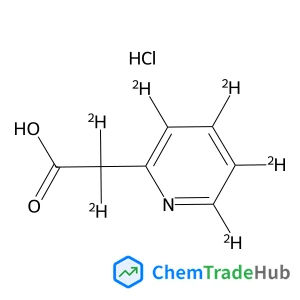
2,2-dideuterio-2-(3,4,5,6-tetradeuterio-2-pyridyl)acetic acid;hydrochloride
CAS番号:
1329799-67-8
分子式:
C7H2ClD6NO2

![[(1S,2S,3R,4S,7R,9S,10S,12R,15S)-4,12-Diacetyloxy-15-[(2R,3S)-3-benzamido-3-phenyl-2-(2,2,2-trichloroethoxycarbonyloxy)propanoyl]oxy-1,9-dihydroxy-10,14,17,17-tetramethyl-11-oxo-6-oxatetracyclo[11.3.1.03,10.04,7]heptadec-13-en-2-yl] benzoate structure](https://static.chemtradehub.com/structs/100/100431-55-8-7104.webp "[(1S,2S,3R,4S,7R,9S,10S,12R,15S)-4,12-Diacetyloxy-15-[(2R,3S)-3-benzamido-3-phenyl-2-(2,2,2-trichloroethoxycarbonyloxy)propanoyl]oxy-1,9-dihydroxy-10,14,17,17-tetramethyl-11-oxo-6-oxatetracyclo[11.3.1.03,10.04,7]heptadec-13-en-2-yl] benzoate structure")
おすすめサプライヤー






免責事項
このページに表示される学術雑誌情報は、参考および研究目的のみを目的としています。当社は雑誌出版社とは提携しておらず、投稿の取り扱いも行っておりません。出版に関するお問い合わせは、各雑誌出版社に直接ご連絡ください。
表示されている情報に誤りがある場合は、support@chemtradehub.com までご連絡ください。迅速に確認し、対応いたします。