











Subtle structure matters: boosting surface-directed photoelectron transfer via the introduction of specific monovalent oxygen vacancies in TiO2
文献情報
出版日
2021-08-18
DOI
10.1039/D1CP02787E
インパクトファクター
3.676
著者
Fei Li, Dong Wang, Xue-Qing Gong
原文を見る
要旨
Oxygen vacancies (Ov) are widely considered to play crucial roles in photocatalysis, but how and why they contribute to improved performances remains controversial. In this work, we studied the promotional effect of Ov on photoelectron transfer in TiO2, using first-principles density functional theory calculations with correction for on-site Coulomb interactions. We explicitly identified three types of Ov with different charge states (i.e., charge-neutral , monovalent , divalent Ov2+) via electronic structure analysis. Electron transfer energy calculations revealed that the ionized Ov in anatase TiO2 are able to collect excess electrons whereas those in the rutile phase are not. The presence of ionized Ov further endows anatase TiO2 with directional electron transfer along the [100] orientation, in favor of anatase TiO2(101) for photocatalytic reduction surpassing the (001) termination. After examining various combination modes of ionized Ov involving different charge states and spatial distributions, we demonstrated that the vertical chain in anatase TiO2(101) is the most catalytically effective Ov pattern in TiO2. These results signify the importance of subtle defects in photocatalysis and may assist future photocatalyst design toward higher photocatalytic efficiency.
関連文献
Mechanical properties of calcium silicate hydrate under uniaxial and biaxial strain conditions: a molecular dynamics study
Dongyun Liu, Rongjia Wen, Qian Yu, Lennart Elfgren
2021-12-20
Paper
DOI: 10.1039/D1CP04474E
One order of magnitude increase of triplet state lifetime observed in deprotonated form selenium substituted uracil
Peipei Jin, Xueli Wang, Haifeng Pan
2021-12-01
Paper
DOI: 10.1039/D1CP04811B
The n-type and p-type conductivity mechanisms of the bulk BiOCl photocatalyst from hybrid density functional theory calculations
Bo Kong, Wentao Wang
2021-08-17
Paper
DOI: 10.1039/D1CP02794H
Exploring vibronic coupling in the benzene radical cation and anion with different levels of the GW approximation
Zi Cheng Wong, Liviu Ungur
2021-08-07
Paper
DOI: 10.1039/D1CP02795F
Crucial impact of exchange between layers on temperature programmed desorption
Tobias Dickbreder, Ralf Bechstein, Angelika Kühnle
2021-08-06
Paper
DOI: 10.1039/D1CP01924D
High time resolution measurements of droplet evaporation kinetics and particle crystallisation
D. A. Hardy, J. Archer, P. Lemaitre, R. Vehring, J. P. Reid, J. S. Walker
2021-08-11
Paper
DOI: 10.1039/D1CP02840E
Correction: Flexible lipid nanomaterials studied by NMR spectroscopy
Jacob J. Kinnun, Horia I. Petrache
2021-08-19
Correction
DOI: 10.1039/D1CP90155A
Exploring the thermodynamic, kinetic and inhibitory mechanisms of 5-iTU targeting mitotic kinase haspin by integrated molecular dynamics
Qianqian Wang, Qinggao Zhang, Elaine Lai Han Leung, Yingqing Chen, Xiaojun Yao
2021-08-03
Paper
DOI: 10.1039/D1CP02783B
Progress in phase-sensitive sum frequency generation spectroscopy
Shoichi Yamaguchi, Takuhiro Otosu
2021-06-25
Perspective
DOI: 10.1039/D1CP01994E
こちらもおすすめ
28770-01-62-(2-Isopropyl-1,3-o...
化合物よくある質問
「邻羟基阿托伐他汀内酯标准品」に適用される法規ガイドelinesは何ですか?
CAS番号163217-74-1の「邻羟基阿托伐他汀内酯标准品」は、GHS分類では危険物に分類されず、主にREACH規則とFDA/EPAの管理対象となります。R...
163217-74-1ortho-Hydroxy Atorva...
化合物よくある質問
メチル(3R)-3-アミノ-2,3-ジヒドロ-1-ベンゾファンラニン-5-カルボイル酸塩塩酸塩の主な用途は何ですか?
メチル(3R)-3-アミノ-2,3-ジヒドロ-1-ベンゾファンラニン-5-カルボイル酸塩塩酸塩は、医薬品や合成化学の研究に広く用いられます。また、特定の薬物の前...
2241594-15-8Methyl (3R)-3-amino-...
化合物よくある質問
トランス-4-メチルピロリジン-3-オール塩酸塩はどのように合成されますか?
トランス-4-メチルピロリジン-3-オール塩酸塩は、4-メチルピロリジンの塩酸塩化によって合成されます。一般的な合成方法では、4-メチルピロリジンを塩酸に加えて...
265108-42-7trans-4-Methylpyrrol...
化合物よくある質問
硫雜環丁烷-1,1-二氧化物は安全ですか?
硫雜環丁烷-1,1-二氧化物は安全ではありません。毒性は報告されていませんが、高温下で分解し、可燃性があるため、高圧ガスは注意が必要です。密閉した容器で保管し、...
5687-92-3Thietane 1,1-dioxide
6054-10-02H, 8H-Benzo[1,2-b
化合物よくある質問
9-ヒドロキシエリプチシネ塩酸塩はどのように合成されますか?
9-ヒドロキシエリプチシネ塩酸塩は、エリプチシネから塩酸を添加することで合成されます。選択性は高いですが、収率は約70%です。
52238-35-49-Hydroxyellipticine...
化合物よくある質問
5-塩素-2-(メチルアミノ)フェニル-(2-塩素フェニル)メタン酮の物理化学的性質は何ですか?
5-塩素-2-(メチルアミノ)フェニル-(2-塩素フェニル)メタン酮のCAS番号は5621-86-3です。この化合物は白色の結晶性粉末で、分子量は415.03で...
5621-86-3[5-Chloro-2-(methyla...
化合物よくある質問
1-[2-(4-甲氧基-苯氧基)-乙基]-哌嗪はどのように保存すればよいですか?
1-[2-(4-甲氧基-苯氧基)-乙基]-哌嗪は、直射日光を避けて暗所に、室温(15-25℃)で保管し、密閉容器に入れることで安定性を保つことができます。
117132-44-21-[2-(4-Methoxy-phen...
化合物よくある質問
2-[3-(4-甲氧基フェニル)プロピル]-4,4,5,5-四メチル-1,3,2-ドイボロロールアンの主な用途は何ですか?
2-[3-(4-甲氧基フェニル)プロピル]-4,4,5,5-四メチル-1,3,2-ドイボロロールアンは、医薬品の合成、有機合成化学、および新材料の研究で使用され...
1073371-72-82-[3-(4-Methoxypheny...
掲載誌
Physical Chemistry Chemical Physics

CiteScore:
5.5
自己引用率:
10.3%
年間論文数:
3036
Physical Chemistry Chemical Physics (PCCP) is an international journal co-owned by 19 physical chemistry and physics societies from around the world. This journal publishes original, cutting-edge research in physical chemistry, chemical physics and biophysical chemistry. To be suitable for publication in PCCP, articles must include significant innovation and/or insight into physical chemistry; this is the most important criterion that reviewers and Editors will judge against when evaluating submissions. The journal has a broad scope and welcomes contributions spanning experiment, theory, computation and data science. Topical coverage includes spectroscopy, dynamics, kinetics, statistical mechanics, thermodynamics, electrochemistry, catalysis, surface science, quantum mechanics, quantum computing and machine learning. Interdisciplinary research areas such as polymers and soft matter, materials, nanoscience, energy, surfaces/interfaces, and biophysical chemistry are welcomed if they demonstrate significant innovation and/or insight into physical chemistry. Joined experimental/theoretical studies are particularly appreciated when complementary and based on up-to-date approaches.
おすすめ化合物
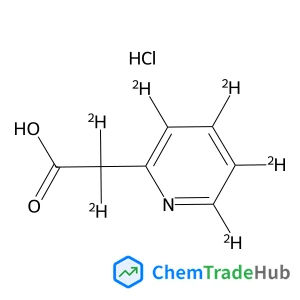
2,2-dideuterio-2-(3,4,5,6-tetradeuterio-2-pyridyl)acetic acid;hydrochloride
CAS番号:
1329799-67-8
分子式:
C7H2ClD6NO2
![[(1S,2S,3R,4S,7R,9S,10S,12R,15S)-4,12-Diacetyloxy-15-[(2R,3S)-3-benzamido-3-phenyl-2-(2,2,2-trichloroethoxycarbonyloxy)propanoyl]oxy-1,9-dihydroxy-10,14,17,17-tetramethyl-11-oxo-6-oxatetracyclo[11.3.1.03,10.04,7]heptadec-13-en-2-yl] benzoate structure](https://static.chemtradehub.com/structs/100/100431-55-8-7104.webp "[(1S,2S,3R,4S,7R,9S,10S,12R,15S)-4,12-Diacetyloxy-15-[(2R,3S)-3-benzamido-3-phenyl-2-(2,2,2-trichloroethoxycarbonyloxy)propanoyl]oxy-1,9-dihydroxy-10,14,17,17-tetramethyl-11-oxo-6-oxatetracyclo[11.3.1.03,10.04,7]heptadec-13-en-2-yl] benzoate structure")
おすすめサプライヤー





免責事項
このページに表示される学術雑誌情報は、参考および研究目的のみを目的としています。当社は雑誌出版社とは提携しておらず、投稿の取り扱いも行っておりません。出版に関するお問い合わせは、各雑誌出版社に直接ご連絡ください。
表示されている情報に誤りがある場合は、support@chemtradehub.com までご連絡ください。迅速に確認し、対応いたします。