











An overview of hydroxy-based polyanionic cathode insertion materials for metal-ion batteries
文献情報
出版日
2021-07-26
DOI
10.1039/D1CP01741A
インパクトファクター
3.676
著者
Shashwat Singh, Valérie Pralong, Prabeer Barpanda
原文を見る
要旨
Rechargeable batteries based on Li-ion and post Li-ion chemistry have come a long way since their inception in the early 1980s. The last four decades have witnessed steady development and discovery of myriads of cathode materials taking into account their processing, economy, and performance along with ecological sustainability. Though oxides rule the battery sector with their high energy and power density, polyanionic insertion compounds work as gold mines for designing insertion compounds with rich structural diversity leading to tuneable redox potential coupled with high structural/chemical/thermal stability. The scope of polyanionic compounds can be taken a step further by combining two or more different types of polyanions to get suites of mixed polyanionic materials. While most cathodes are built with metal polyhedra constituted by oxygen (MOm|XOm, M = 3d metals, X = P, S, Si, B, W, etc., m = 3–6), in some cases, selected oxygen sites can form bonding with hydrogen to form OH/H2O ligands. It can lead to the family of hydroxy-based mixed-polyanionic cathode materials. The presence of hydroxy components can affect the crystal structure, local chemical bonding, and electronic, magnetic, diffusivity and electrochemical properties. Employing a mineralogical survey, the current review renders a sneak peek on various hydroxy-based polyanionic cathode materials for Li-ion and post Li-ion batteries. Their crystal structure, and electrochemical properties have been overviewed to outline future research focus and scope for real-life application.
おすすめジャーナル
関連文献
Bonding analysis of water clusters using quasi-atomic orbitals
Jorge L. Galvez Vallejo, Juan Duchimaza Heredia, Mark S. Gordon
2021-08-06
Paper
DOI: 10.1039/D1CP02301B
Induced VCD and conformational chirality in host–guest complexes of a chiral ammonium salt with crown ethers
Luisa Weirich, Christian Merten
2021-06-01
Paper
DOI: 10.1039/D1CP01846A
Impact of fluorination and chlorination on the electronic structure, topology and in-plane ring normal modes of pyridines
Enrico Benassi, Tamara Vaganova, Evgenij Malykhin, Haiyan Fan
2021-07-29
Paper
DOI: 10.1039/D1CP02342J
Characterization of the deformation behaviors under uniaxial stress for bicontinuous nanoporous amorphous alloys
Yuhang Zhang, Yiqun Hu, Suhang Ding, Fuying Du
2021-12-20
Paper
DOI: 10.1039/D1CP04970D
Fitting potential energy and induced dipole surfaces of the van der Waals complex CH4–N2 using non-product quadrature grids
Yulia N. Kalugina, Iouli E. Gordon
2021-08-04
Paper
DOI: 10.1039/D1CP02161C
UVPD spectroscopy of differential mobility-selected prototropic isomers of protonated adenine
Mircea Guna, Bradley B. Schneider, J. C. Yves Le Blanc, Marcel Nooijen
2021-08-30
Paper
DOI: 10.1039/D1CP02688G
Crucial impact of exchange between layers on temperature programmed desorption
Tobias Dickbreder, Ralf Bechstein, Angelika Kühnle
2021-08-06
Paper
DOI: 10.1039/D1CP01924D
Fcc vs. hcp competition in colloidal hard-sphere nucleation: on their relative stability, interfacial free energy and nucleation rate
Ignacio Sanchez-Burgos, Eduardo Sanz, Carlos Vega, Jorge R. Espinosa
2021-08-13
Paper
DOI: 10.1039/D1CP01784E
Exploring vibronic coupling in the benzene radical cation and anion with different levels of the GW approximation
Zi Cheng Wong, Liviu Ungur
2021-08-07
Paper
DOI: 10.1039/D1CP02795F
こちらもおすすめ
28770-01-62-(2-Isopropyl-1,3-o...
化合物よくある質問
「邻羟基阿托伐他汀内酯标准品」に適用される法規ガイドelinesは何ですか?
CAS番号163217-74-1の「邻羟基阿托伐他汀内酯标准品」は、GHS分類では危険物に分類されず、主にREACH規則とFDA/EPAの管理対象となります。R...
163217-74-1ortho-Hydroxy Atorva...
化合物よくある質問
メチル(3R)-3-アミノ-2,3-ジヒドロ-1-ベンゾファンラニン-5-カルボイル酸塩塩酸塩の主な用途は何ですか?
メチル(3R)-3-アミノ-2,3-ジヒドロ-1-ベンゾファンラニン-5-カルボイル酸塩塩酸塩は、医薬品や合成化学の研究に広く用いられます。また、特定の薬物の前...
2241594-15-8Methyl (3R)-3-amino-...
化合物よくある質問
トランス-4-メチルピロリジン-3-オール塩酸塩はどのように合成されますか?
トランス-4-メチルピロリジン-3-オール塩酸塩は、4-メチルピロリジンの塩酸塩化によって合成されます。一般的な合成方法では、4-メチルピロリジンを塩酸に加えて...
265108-42-7trans-4-Methylpyrrol...
化合物よくある質問
硫雜環丁烷-1,1-二氧化物は安全ですか?
硫雜環丁烷-1,1-二氧化物は安全ではありません。毒性は報告されていませんが、高温下で分解し、可燃性があるため、高圧ガスは注意が必要です。密閉した容器で保管し、...
5687-92-3Thietane 1,1-dioxide
6054-10-02H, 8H-Benzo[1,2-b
化合物よくある質問
9-ヒドロキシエリプチシネ塩酸塩はどのように合成されますか?
9-ヒドロキシエリプチシネ塩酸塩は、エリプチシネから塩酸を添加することで合成されます。選択性は高いですが、収率は約70%です。
52238-35-49-Hydroxyellipticine...
化合物よくある質問
5-塩素-2-(メチルアミノ)フェニル-(2-塩素フェニル)メタン酮の物理化学的性質は何ですか?
5-塩素-2-(メチルアミノ)フェニル-(2-塩素フェニル)メタン酮のCAS番号は5621-86-3です。この化合物は白色の結晶性粉末で、分子量は415.03で...
5621-86-3[5-Chloro-2-(methyla...
化合物よくある質問
1-[2-(4-甲氧基-苯氧基)-乙基]-哌嗪はどのように保存すればよいですか?
1-[2-(4-甲氧基-苯氧基)-乙基]-哌嗪は、直射日光を避けて暗所に、室温(15-25℃)で保管し、密閉容器に入れることで安定性を保つことができます。
117132-44-21-[2-(4-Methoxy-phen...
化合物よくある質問
2-[3-(4-甲氧基フェニル)プロピル]-4,4,5,5-四メチル-1,3,2-ドイボロロールアンの主な用途は何ですか?
2-[3-(4-甲氧基フェニル)プロピル]-4,4,5,5-四メチル-1,3,2-ドイボロロールアンは、医薬品の合成、有機合成化学、および新材料の研究で使用され...
1073371-72-82-[3-(4-Methoxypheny...
掲載誌
Physical Chemistry Chemical Physics

CiteScore:
5.5
自己引用率:
10.3%
年間論文数:
3036
Physical Chemistry Chemical Physics (PCCP) is an international journal co-owned by 19 physical chemistry and physics societies from around the world. This journal publishes original, cutting-edge research in physical chemistry, chemical physics and biophysical chemistry. To be suitable for publication in PCCP, articles must include significant innovation and/or insight into physical chemistry; this is the most important criterion that reviewers and Editors will judge against when evaluating submissions. The journal has a broad scope and welcomes contributions spanning experiment, theory, computation and data science. Topical coverage includes spectroscopy, dynamics, kinetics, statistical mechanics, thermodynamics, electrochemistry, catalysis, surface science, quantum mechanics, quantum computing and machine learning. Interdisciplinary research areas such as polymers and soft matter, materials, nanoscience, energy, surfaces/interfaces, and biophysical chemistry are welcomed if they demonstrate significant innovation and/or insight into physical chemistry. Joined experimental/theoretical studies are particularly appreciated when complementary and based on up-to-date approaches.
おすすめ化合物
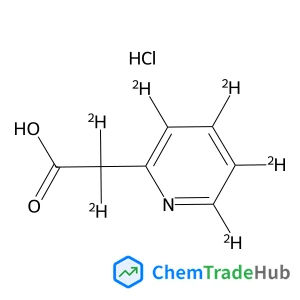
2,2-dideuterio-2-(3,4,5,6-tetradeuterio-2-pyridyl)acetic acid;hydrochloride
CAS番号:
1329799-67-8
分子式:
C7H2ClD6NO2
![(3R,5R)-1-[(Benzyloxy)carbonyl]-5-methyl-3-piperidinecarboxylic acid structure](https://static.chemtradehub.com/structs/126/1269757-29-0-c552.webp "(3R,5R)-1-[(Benzyloxy)carbonyl]-5-methyl-3-piperidinecarboxylic acid structure")
(3R,5R)-1-[(Benzyloxy)carbonyl]-5-methyl-3-piperidinecarboxylic acid
CAS番号:
1269757-29-0
分子式:
C15H19NO4
![(2E)-3-(3-Chlorophenyl)-N-{2-[4-(methylsulfonyl)-1-piperazinyl]-2-oxoethyl}acrylamide structure](https://static.chemtradehub.com/structs/250/2505001-54-5-c1e9.webp "(2E)-3-(3-Chlorophenyl)-N-{2-[4-(methylsulfonyl)-1-piperazinyl]-2-oxoethyl}acrylamide structure")
(2E)-3-(3-Chlorophenyl)-N-{2-[4-(methylsulfonyl)-1-piperazinyl]-2-oxoethyl}acrylamide
CAS番号:
2505001-54-5
分子式:
C16H20ClN3O4S
![S-[2,3-Bis(palmitoyloxy)propyl]-N-[(9H-fluoren-9-ylmethoxy)(hydroxy)methylene]cysteine structure](https://static.chemtradehub.com/structs/210/210532-98-2-f6a7.webp "S-[2,3-Bis(palmitoyloxy)propyl]-N-[(9H-fluoren-9-ylmethoxy)(hydroxy)methylene]cysteine structure")
おすすめサプライヤー




免責事項
このページに表示される学術雑誌情報は、参考および研究目的のみを目的としています。当社は雑誌出版社とは提携しておらず、投稿の取り扱いも行っておりません。出版に関するお問い合わせは、各雑誌出版社に直接ご連絡ください。
表示されている情報に誤りがある場合は、support@chemtradehub.com までご連絡ください。迅速に確認し、対応いたします。