


The physical stage of radiolysis of solvated DNA by high-energy-transfer particles: insights from new first principles simulations
文献情報
出版日
2020-03-12
DOI
10.1039/D0CP00165A
インパクトファクター
3.676
著者
Aurelio Alvarez-Ibarra, Aurélien de la Lande
原文を見る
要旨
The primary processes that occur following direct irradiation of bio-macromolecules by ionizing radiation determine the multiscale responses that lead to biomolecular lesions. The so-called physical stage loosely describes processes of energy deposition and molecular ionization/excitation but remains largely elusive. We propose a new approach based on first principles density functional theory to simulate energy deposition in large and heterogeneous biomolecules by high-energy-transfer particles. Unlike traditional Monte Carlo approaches, our methodology does not rely on pre-parametrized sets of cross-sections, but captures excitation, ionization and low energy electron emission at the heart of complex biostructures. It furthermore gives access to valuable insights on ultrafast charge and hole dynamics on the femtosecond time scale. With this new tool, we reveal the mechanisms of ionization by swift ions in microscopic DNA models and solvated DNA comprising almost 750 atoms treated at the DFT level of description. We reveal a so-called ebb-and-flow ionization mechanism in which polarization of the irradiated moieties appears as a key feature. We also investigate where secondary electrons produced by irradiation localize on chemical moieties composing DNA. We compare irradiation of solvated DNA by light (H+, and He2+) vs. heavier (C6+) ions, highlighting the much higher probability of double ionization with the latter. Our methodology constitutes a stepping stone towards a greater understanding of the chemical stage and more generally towards the multiscale modelling of radiation damage in biology using first principles.
おすすめジャーナル

Advances in Colloid and Interface Science

Accounts of Chemical Research

Chemistry of Heterocyclic Compounds

Analyst

Australian Journal of Chemistry

Journal of the American Chemical Society

Bulletin of the Chemical Society of Japan

Biopolymers

Cement and Concrete Research

Journal of the Chinese Chemical Society
関連文献
Self-assembly and multi-stimuli responsive behavior of PAA-b-PAzoMA-b-PNIPAM triblock copolymers
Fei Gao, Yaohui Xing, Yuan Yao, Liuying Sun, Yao Sun, Xiaohua He, Shaoliang Lin
2017-10-31
Paper
DOI: 10.1039/C7PY01591G
A new echelon of precision polypentenamers: highly isotactic branching on every five carbons
Stefan Brits, William J. Neary, Goutam Palui, Justin G. Kennemur
2018-01-02
Paper
DOI: 10.1039/C7PY01922J
Photoinduced Fe-mediated atom transfer radical polymerization in aqueous media
Chao Bian, Yin-Ning Zhou, Jun-Kang Guo, Zheng-Hong Luo
2017-11-08
Paper
DOI: 10.1039/C7PY01762F
Highly efficient luminescent side-chain polymers with short-spacer attached tetraphenylethylene AIEgens via RAFT polymerization capable of naked eye explosive detection
Qian Li, Xiao Li, Zhongying Wu, Yuhao Sun, Jianglin Fang, Dongzhong Chen
2018-07-02
Paper
DOI: 10.1039/C8PY00710A
こちらもおすすめ
28770-01-62-(2-Isopropyl-1,3-o...
化合物よくある質問
「邻羟基阿托伐他汀内酯标准品」に適用される法規ガイドelinesは何ですか?
CAS番号163217-74-1の「邻羟基阿托伐他汀内酯标准品」は、GHS分類では危険物に分類されず、主にREACH規則とFDA/EPAの管理対象となります。R...
163217-74-1ortho-Hydroxy Atorva...
化合物よくある質問
メチル(3R)-3-アミノ-2,3-ジヒドロ-1-ベンゾファンラニン-5-カルボイル酸塩塩酸塩の主な用途は何ですか?
メチル(3R)-3-アミノ-2,3-ジヒドロ-1-ベンゾファンラニン-5-カルボイル酸塩塩酸塩は、医薬品や合成化学の研究に広く用いられます。また、特定の薬物の前...
2241594-15-8Methyl (3R)-3-amino-...
化合物よくある質問
トランス-4-メチルピロリジン-3-オール塩酸塩はどのように合成されますか?
トランス-4-メチルピロリジン-3-オール塩酸塩は、4-メチルピロリジンの塩酸塩化によって合成されます。一般的な合成方法では、4-メチルピロリジンを塩酸に加えて...
265108-42-7trans-4-Methylpyrrol...
化合物よくある質問
硫雜環丁烷-1,1-二氧化物は安全ですか?
硫雜環丁烷-1,1-二氧化物は安全ではありません。毒性は報告されていませんが、高温下で分解し、可燃性があるため、高圧ガスは注意が必要です。密閉した容器で保管し、...
5687-92-3Thietane 1,1-dioxide
6054-10-02H, 8H-Benzo[1,2-b
化合物よくある質問
9-ヒドロキシエリプチシネ塩酸塩はどのように合成されますか?
9-ヒドロキシエリプチシネ塩酸塩は、エリプチシネから塩酸を添加することで合成されます。選択性は高いですが、収率は約70%です。
52238-35-49-Hydroxyellipticine...
化合物よくある質問
5-塩素-2-(メチルアミノ)フェニル-(2-塩素フェニル)メタン酮の物理化学的性質は何ですか?
5-塩素-2-(メチルアミノ)フェニル-(2-塩素フェニル)メタン酮のCAS番号は5621-86-3です。この化合物は白色の結晶性粉末で、分子量は415.03で...
5621-86-3[5-Chloro-2-(methyla...
化合物よくある質問
1-[2-(4-甲氧基-苯氧基)-乙基]-哌嗪はどのように保存すればよいですか?
1-[2-(4-甲氧基-苯氧基)-乙基]-哌嗪は、直射日光を避けて暗所に、室温(15-25℃)で保管し、密閉容器に入れることで安定性を保つことができます。
117132-44-21-[2-(4-Methoxy-phen...
化合物よくある質問
2-[3-(4-甲氧基フェニル)プロピル]-4,4,5,5-四メチル-1,3,2-ドイボロロールアンの主な用途は何ですか?
2-[3-(4-甲氧基フェニル)プロピル]-4,4,5,5-四メチル-1,3,2-ドイボロロールアンは、医薬品の合成、有機合成化学、および新材料の研究で使用され...
1073371-72-82-[3-(4-Methoxypheny...
掲載誌
Physical Chemistry Chemical Physics

CiteScore:
5.5
自己引用率:
10.3%
年間論文数:
3036
Physical Chemistry Chemical Physics (PCCP) is an international journal co-owned by 19 physical chemistry and physics societies from around the world. This journal publishes original, cutting-edge research in physical chemistry, chemical physics and biophysical chemistry. To be suitable for publication in PCCP, articles must include significant innovation and/or insight into physical chemistry; this is the most important criterion that reviewers and Editors will judge against when evaluating submissions. The journal has a broad scope and welcomes contributions spanning experiment, theory, computation and data science. Topical coverage includes spectroscopy, dynamics, kinetics, statistical mechanics, thermodynamics, electrochemistry, catalysis, surface science, quantum mechanics, quantum computing and machine learning. Interdisciplinary research areas such as polymers and soft matter, materials, nanoscience, energy, surfaces/interfaces, and biophysical chemistry are welcomed if they demonstrate significant innovation and/or insight into physical chemistry. Joined experimental/theoretical studies are particularly appreciated when complementary and based on up-to-date approaches.
おすすめ化合物

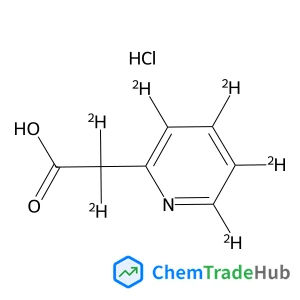
2,2-dideuterio-2-(3,4,5,6-tetradeuterio-2-pyridyl)acetic acid;hydrochloride
CAS番号:
1329799-67-8
分子式:
C7H2ClD6NO2
おすすめサプライヤー






免責事項
このページに表示される学術雑誌情報は、参考および研究目的のみを目的としています。当社は雑誌出版社とは提携しておらず、投稿の取り扱いも行っておりません。出版に関するお問い合わせは、各雑誌出版社に直接ご連絡ください。
表示されている情報に誤りがある場合は、support@chemtradehub.com までご連絡ください。迅速に確認し、対応いたします。