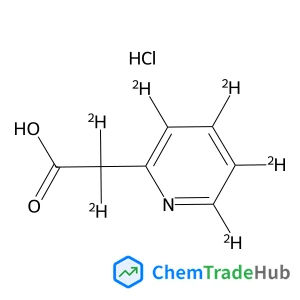
2,2-dideuterio-2-(3,4,5,6-tetradeuterio-2-pyridyl)acetic acid;hydrochloride
CAS番号:
1329799-67-8
分子式:
C7H2ClD6NO2
Bohak Yoon, Haley M. Stowe
Thermal degradation of aqueous monoethanolamine (MEA), a benchmark solvent, in CO2 capture processes still remains a challenge. Here, we present molecular mechanisms underlying thermal degradation of MEA based on ab initio molecular dynamics simulations coupled with metadynamics sampling. Isocyanate formation via dehydration of carbamic acid (MEACOOH) is predicted to be highly probable and more kinetically favorable than the competing cyclization–dehydration reaction to 2-oxazolidinone (OZD), albeit not substantially. Isocyanate may undergo cyclization to form OZD, which is found to be more facile in aqueous MEA solution than reaction with MEA to form urea, although the latter is thermodynamically more favorable than the former. Our simulations also clearly demonstrate that OZD is a long-lived intermediate that plays a key role in MEA thermal degradation to experimentally observed products. Overall, this work highlights the importance of entropic contributions associated with the local structure and dynamics of solvent molecules around the intermediates, which cannot be solely explained by thermodynamics, in predicting the mechanism and kinetics of thermal degradation of CO2-loaded aqueous amine solutions.
Thomas Blin, Antoine Niederberger, Lazhar Benyahia, Jérôme Fresnais, Véronique Montembault, Laurent Fontaine
DOI: 10.1039/C8PY01006D
Rodinel Ardeleanu, Andrei I. Dascalu, Dragos Peptanariu, Cristina M. Uritu, Alina Nicolescu, Mihail Barboiu, Mariana Pinteala
DOI: 10.1039/C7PY01256J
Marc Guerre, Mineto Uchiyama, Gérald Lopez, Bruno Améduri, Masami Kamigaito, Vincent Ladmiral
DOI: 10.1039/C7PY01924F
Jing Zhang, Qingzhong Zhang, Shuaifeng Zhou, Yuping Liu, Wei Huang
DOI: 10.1039/C7PY01476G
Patxi Garra, Céline Dietlin, Fabrice Morlet-Savary, Frédéric Dumur, Didier Gigmes, Jean-Pierre Fouassier, Jacques Lalevée
DOI: 10.1039/C7PY01778B
Sheng Chen, Xuguang Lv, Xianghui Han, Hang Luo, Chris R. Bowen, Dou Zhang
DOI: 10.1039/C7PY01914A
Hiroaki Imoto, Ryoichi Katoh, Kensuke Naka
DOI: 10.1039/C8PY00758F
Shohei Ida, Hironobu Kitanaka, Tatsuya Ishikawa, Shokyoku Kanaoka, Yoshitsugu Hirokawa
DOI: 10.1039/C7PY01793F
CAS番号163217-74-1の「邻羟基阿托伐他汀内酯标准品」は、GHS分類では危険物に分類されず、主にREACH規則とFDA/EPAの管理対象となります。R...
メチル(3R)-3-アミノ-2,3-ジヒドロ-1-ベンゾファンラニン-5-カルボイル酸塩塩酸塩は、医薬品や合成化学の研究に広く用いられます。また、特定の薬物の前...
トランス-4-メチルピロリジン-3-オール塩酸塩は、4-メチルピロリジンの塩酸塩化によって合成されます。一般的な合成方法では、4-メチルピロリジンを塩酸に加えて...
硫雜環丁烷-1,1-二氧化物は安全ではありません。毒性は報告されていませんが、高温下で分解し、可燃性があるため、高圧ガスは注意が必要です。密閉した容器で保管し、...
9-ヒドロキシエリプチシネ塩酸塩は、エリプチシネから塩酸を添加することで合成されます。選択性は高いですが、収率は約70%です。
5-塩素-2-(メチルアミノ)フェニル-(2-塩素フェニル)メタン酮のCAS番号は5621-86-3です。この化合物は白色の結晶性粉末で、分子量は415.03で...
1-[2-(4-甲氧基-苯氧基)-乙基]-哌嗪は、直射日光を避けて暗所に、室温(15-25℃)で保管し、密閉容器に入れることで安定性を保つことができます。
2-[3-(4-甲氧基フェニル)プロピル]-4,4,5,5-四メチル-1,3,2-ドイボロロールアンは、医薬品の合成、有機合成化学、および新材料の研究で使用され...

Physical Chemistry Chemical Physics (PCCP) is an international journal co-owned by 19 physical chemistry and physics societies from around the world. This journal publishes original, cutting-edge research in physical chemistry, chemical physics and biophysical chemistry. To be suitable for publication in PCCP, articles must include significant innovation and/or insight into physical chemistry; this is the most important criterion that reviewers and Editors will judge against when evaluating submissions. The journal has a broad scope and welcomes contributions spanning experiment, theory, computation and data science. Topical coverage includes spectroscopy, dynamics, kinetics, statistical mechanics, thermodynamics, electrochemistry, catalysis, surface science, quantum mechanics, quantum computing and machine learning. Interdisciplinary research areas such as polymers and soft matter, materials, nanoscience, energy, surfaces/interfaces, and biophysical chemistry are welcomed if they demonstrate significant innovation and/or insight into physical chemistry. Joined experimental/theoretical studies are particularly appreciated when complementary and based on up-to-date approaches.