












Strategies to combine ROP with ATRP or RAFT polymerization for the synthesis of biodegradable polymeric nanoparticles for biomedical applications
文献情報
出版日
2018-07-09
DOI
10.1039/C8PY00649K
インパクトファクター
5.582
著者
Mattia Sponchioni, Nicolò Manfredini, Matteo Maraldi, Davide Moscatelli
原文を見る
要旨
The architecture, composition and molecular weight (MW) of polymers and copolymers made via free radical polymerization are important parameters that affect the end-use of both these polymeric materials and the nanoparticles that they compose. In order to gain control over these parameters, several controlled radical polymerizations (CRPs)—such as atom transfer radical polymerization (ATRP) and reversible addition fragmentation chain transfer (RAFT) polymerization—have been developed over the past few decades. However, the toxicity, biocompatibility and degradation profile of these materials are emerging as key features for their final disposal and for certain applications, such as the synthesis of biomaterials. In this case, polyesters made via ring opening polymerization (ROP) are preferred due to the control over the synthesis that this technique allows as well as the biodegradability of the final material. The combination of ROP with CRP techniques has allowed for the synthesis of polymeric surfactants capable of self-assembling into biodegradable nanoparticles (NPs) for biomedical applications. This review presents and critically discusses the primary strategies for the synthesis of highly engineered colloids via the combination of ROP with two CRP techniques: ATRP and RAFT polymerization.
関連文献
Phosphaacene as a structural analogue of thienoacenes for organic semiconductors
Kyohei Matsuo, Rina Okumura, Hironobu Hayashi, Naoki Aratani, Seihou Jinnai, Yutaka Ie, Akinori Saeki, Hiroko Yamada
2022-11-14
Communication
DOI: 10.1039/D2CC05122B
Magnetic properties of charge-transfer complexes based on TEMPO radicals
Paper
DOI: 10.1039/A606293H
A possible means of realizing a sacrifice-free three component separation of lignocellulose from wood biomass using an amino acid ionic liquid
Yukoh Hamada, Kohei Yoshida, Ryo-ichi Asai, Shuichi Hayase, Toshiki Nokami, Shunsuke Izumi, Toshiyuki Itoh
2013-06-06
Communication
DOI: 10.1039/C3GC40445E
MOF/COF hybrids as next generation materials for energy and biomedical applications
Cigdem Altintas, Ilknur Erucar, Seda Keskin
2022-10-14
Highlight
DOI: 10.1039/D2CE01296K
Dispersion of PM and VOC pollutants from open burning of municipal solid wastes on host communities: emission inventory estimation and dispersion modelling study
Adewemimo Oluwakunmi Popoola, Lukuman Adekilekun Jimoda, Olusesan Abel Olu-Arotiowa, Oyetola Ogunkunle, Opeyeolu Timothy Laseinde, Sunday Adekunle Adebanjo, Wuraola Abake Raji
2023-06-02
Paper
DOI: 10.1039/D3EA00041A
Novel fluorene-based functional ‘click polymers’ for quasi-solid-state dye-sensitized solar cells
Md. Anwarul Karim, Yong-Rae Cho, Jin Su Park, Sung Chul Kim, Hee Joo Kim, Jae Wook Lee, Yeong-Soon Gal, Sung-Ho Jin
2008-03-06
Communication
DOI: 10.1039/B800032H
Conversion of glucose and cellulose into value-added products in water and ionic liquids
Jinliang Song, Honglei Fan, Jun Ma, Buxing Han
2013-07-31
Tutorial Review
DOI: 10.1039/C3GC41141A
Fluorescent probe: complexation of Fe3+with the myo-inositol 1,2,3-trisphosphate motif
David Mansell, Nicholas Rattray, Laura L. Etchells, Carl H. Schwalbe, Alexander J. Blake, Elena V. Bichenkova, Richard A. Bryce, Christopher J. Barker, Alvaro Díaz, Carlos Kremer, Sally Freeman
2008-09-29
Communication
DOI: 10.1039/B809238A
こちらもおすすめ
28770-01-62-(2-Isopropyl-1,3-o...
化合物よくある質問
「邻羟基阿托伐他汀内酯标准品」に適用される法規ガイドelinesは何ですか?
CAS番号163217-74-1の「邻羟基阿托伐他汀内酯标准品」は、GHS分類では危険物に分類されず、主にREACH規則とFDA/EPAの管理対象となります。R...
163217-74-1ortho-Hydroxy Atorva...
化合物よくある質問
メチル(3R)-3-アミノ-2,3-ジヒドロ-1-ベンゾファンラニン-5-カルボイル酸塩塩酸塩の主な用途は何ですか?
メチル(3R)-3-アミノ-2,3-ジヒドロ-1-ベンゾファンラニン-5-カルボイル酸塩塩酸塩は、医薬品や合成化学の研究に広く用いられます。また、特定の薬物の前...
2241594-15-8Methyl (3R)-3-amino-...
化合物よくある質問
トランス-4-メチルピロリジン-3-オール塩酸塩はどのように合成されますか?
トランス-4-メチルピロリジン-3-オール塩酸塩は、4-メチルピロリジンの塩酸塩化によって合成されます。一般的な合成方法では、4-メチルピロリジンを塩酸に加えて...
265108-42-7trans-4-Methylpyrrol...
化合物よくある質問
硫雜環丁烷-1,1-二氧化物は安全ですか?
硫雜環丁烷-1,1-二氧化物は安全ではありません。毒性は報告されていませんが、高温下で分解し、可燃性があるため、高圧ガスは注意が必要です。密閉した容器で保管し、...
5687-92-3Thietane 1,1-dioxide
6054-10-02H, 8H-Benzo[1,2-b
化合物よくある質問
9-ヒドロキシエリプチシネ塩酸塩はどのように合成されますか?
9-ヒドロキシエリプチシネ塩酸塩は、エリプチシネから塩酸を添加することで合成されます。選択性は高いですが、収率は約70%です。
52238-35-49-Hydroxyellipticine...
化合物よくある質問
5-塩素-2-(メチルアミノ)フェニル-(2-塩素フェニル)メタン酮の物理化学的性質は何ですか?
5-塩素-2-(メチルアミノ)フェニル-(2-塩素フェニル)メタン酮のCAS番号は5621-86-3です。この化合物は白色の結晶性粉末で、分子量は415.03で...
5621-86-3[5-Chloro-2-(methyla...
化合物よくある質問
1-[2-(4-甲氧基-苯氧基)-乙基]-哌嗪はどのように保存すればよいですか?
1-[2-(4-甲氧基-苯氧基)-乙基]-哌嗪は、直射日光を避けて暗所に、室温(15-25℃)で保管し、密閉容器に入れることで安定性を保つことができます。
117132-44-21-[2-(4-Methoxy-phen...
化合物よくある質問
2-[3-(4-甲氧基フェニル)プロピル]-4,4,5,5-四メチル-1,3,2-ドイボロロールアンの主な用途は何ですか?
2-[3-(4-甲氧基フェニル)プロピル]-4,4,5,5-四メチル-1,3,2-ドイボロロールアンは、医薬品の合成、有機合成化学、および新材料の研究で使用され...
1073371-72-82-[3-(4-Methoxypheny...
掲載誌
Polymer Chemistry

CiteScore:
8.6
自己引用率:
7.3%
年間論文数:
457
Polymer Chemistry welcomes submissions in all areas of polymer science that have a strong focus on macromolecular chemistry. Manuscripts may cover a broad range of fields, yet no direct application focus is required.
おすすめ化合物
![(3R,5R)-1-[(Benzyloxy)carbonyl]-5-methyl-3-piperidinecarboxylic acid structure](https://static.chemtradehub.com/structs/126/1269757-29-0-c552.webp "(3R,5R)-1-[(Benzyloxy)carbonyl]-5-methyl-3-piperidinecarboxylic acid structure")
(3R,5R)-1-[(Benzyloxy)carbonyl]-5-methyl-3-piperidinecarboxylic acid
CAS番号:
1269757-29-0
分子式:
C15H19NO4
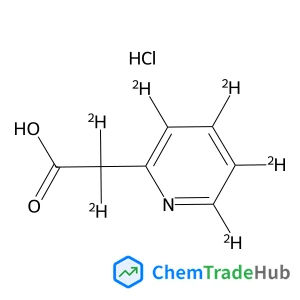
2,2-dideuterio-2-(3,4,5,6-tetradeuterio-2-pyridyl)acetic acid;hydrochloride
CAS番号:
1329799-67-8
分子式:
C7H2ClD6NO2
おすすめサプライヤー






免責事項
このページに表示される学術雑誌情報は、参考および研究目的のみを目的としています。当社は雑誌出版社とは提携しておらず、投稿の取り扱いも行っておりません。出版に関するお問い合わせは、各雑誌出版社に直接ご連絡ください。
表示されている情報に誤りがある場合は、support@chemtradehub.com までご連絡ください。迅速に確認し、対応いたします。