


Hydrogen adsorption on transition metal carbides: a DFT study
文献情報
出版日
2019-01-17
DOI
10.1039/C8CP05975F
インパクトファクター
3.676
著者
Fabrizio Silveri, Matthew G. Quesne, Alberto Roldan, Nora H. de Leeuw, C. Richard A. Catlow
原文を見る
要旨
Transition metal carbides are a class of materials widely known for both their interesting physical properties and catalytic activity. In this work, we have used plane-wave DFT methods to study the interaction with increasing amounts of molecular hydrogen on the low-index surfaces of four major carbides – TiC, VC, ZrC and NbC. Adsorption is found to be generally exothermic and occurs predominantly on the surface carbon atoms. We identify trends over the carbides and their surfaces for the energetics of the adsorption as a function of their electronic and geometrical characteristics. An ab initio thermodynamics formalism is used to study the properties of the slabs as the hydrogen coverage is increased.
おすすめジャーナル

Journal of Natural Medicines

Russian Journal of Applied Chemistry

Russian Chemical Bulletin

Nature Medicine

Current Opinion in Solid State & Materials Science

Russian Journal of Organic Chemistry

Organic Process Research & Development

Russian Journal of Bioorganic Chemistry

Crystallography Reports

Current Opinion in Colloid & Interface Science
関連文献
Experimental characterization of aircraft combustor soot: Microstructure, surface area, porosity and water adsorption
O. B. Popovitcheva, N. M. Persiantseva, M. E. Trukhin, G. B. Rulev, N. K. Shonija, Yu. Ya. Buriko, A. M. Starik, B. Demirdjian, D. Ferry, J. Suzanne
2000-09-15
Paper
DOI: 10.1039/B004345L
Effect of 1-alkanols on the native conformation of Lysozyme
Vania Calandrini, Giuseppe Onori, Aldo Santucci
2000-08-25
Paper
DOI: 10.1039/B003746J
Static (hyper-)polarizabilities of infinite, conjugated polymers in the framework of density-functional theory
Paper
DOI: 10.1039/A808605B
Molecular dynamics simulations of the lithium coordination environment in phosphate glasses
Todd M. Alam, Jian-Jie Liang, Randall T. Cygan
2000-09-15
Paper
DOI: 10.1039/B004627M
Huge splitting of dichroic absorption energies in ordered cyanine dye films
Paper
DOI: 10.1039/A808610I
Stability of dye loaded faujasites against organic solvents: effect of SiCl4 treatment
Wolfgang F. Hölderich, Nadja Röhrlich, Peter Bartl, Laurent Chassot
2000-08-04
Paper
DOI: 10.1039/B003425H
CeO2–La2O3 catalytic system Part I. Preparation and characterisation of catalysts
G. Colón, J. A. Navío, R. Monaci, I. Ferino
2000-09-15
Paper
DOI: 10.1039/B002815K
Experimental and theoretical study of the F, Cl and Br reactions with formaldehyde and acetaldehyde
J. A. Beukes, B. D'Anna, V. Bakken, C. J. Nielsen
2000-08-10
Paper
DOI: 10.1039/B004546M
Electron transfer at a distance induced by site-selective photoionization of 2-aminopurine in oligonucleotides and investigated by transient absorption techniques
Vladimir Shafirovich, Alexander Dourandin, Weidong Huang, Natalia P. Luneva, Nicholas E. Geacintov
2000-09-15
Paper
DOI: 10.1039/B004896H
こちらもおすすめ
化合物よくある質問
4-アミノフェノール酸ナトリウム水和物とは何ですか?
4-アミノフェノール酸ナトリウム水和物は、CAS番号206557-08-6の化合物で、4-アミノフェノールとナトリウムが結合した塩と水和物です。この化合物は、白...
206557-08-64-Aminobenzoic acid ...
化合物よくある質問
Methyl 3-methyl-N-{[(2-methyl-2-propanyl)oxy]carbonyl}-L-histidinateの代替品はありますか?
この化合物は特定の合成プロセスに使用される可能性がありますが、代替品として、他の类似的な化合物、例えばMethyl 3-methyl-N-{[(2-methyl...
72212-51-2Methyl 3-methyl-N-{[...
化合物よくある質問
4-Boc-2-哌嗪甲酸の市場動向や研究トレンドはどうですか?
4-Boc-2-哌嗪甲酸は、薬品開発や合成化学分野で広く使用されており、その需要は継続的に推移しています。特に、新薬開発における合成化学分野での需要が高まってい...
192330-11-3(2R)-4-[(tert-butoxy...
化合物よくある質問
4,4'-二羟甲基联苯の物理化学的性質は何ですか?
4,4'-二羟甲基联苯のCAS番号は1667-12-5です。この化合物は白色の結晶粉末で、分子量は154.20です。水にわずかに溶けますが、アルコールや有機溶媒...
1667-12-54,4'-Biphenyldiyldim...
化合物よくある質問
5-甲硫基戊腈はどの業界で使用されていますか?
5-甲硫基戊腈は医薬品産業で使用される可能性があります。また、ポリマー合成の触媒として、センサー製造の一部として、半導体製造のプロセス改善に使用される可能性があ...
59121-25-45-(Methylsulfanyl)pe...
化合物よくある質問
CAS番号1311961-50-8の化合物はどのように合成されますか?
この化合物は、1-abieta-8,11,13-trien-19-イルと6'-メトキシシンコナナン-9-基を含有する窒素含有化合物から合成されます。一般的な合成...
1311961-50-81-Abieta-8,11,13-tri...
化合物よくある質問
6-ブロモベンジジミダゾール-2-カルビルデオキシドはどのように保存すればよいですか?
6-ブロモベンジジミダゾール-2-カルビルデオキシドは、避光・乾燥した容器(密閉容器)で-20℃~4℃の低温で保存してください。高温や直射日光、湿気は避けてくだ...
885280-26-25-Bromo-1H-benzimida...
化合物よくある質問
Boc-N-甲基氨甲环酸とは何ですか?
621-65-8のCAS番号を持つBoc-N-甲基氨甲环酸は、化学式C7H13NO5を有する化合物です。この化合物は白色の結晶性粉末で、吸湿性があります。
621-65-83-Hydroxy-1,2-propan...
化合物よくある質問
乙基三氟硼酸钾はどのように合成されますか?
乙基三氟硼酸钾は、トリフLUオール酸カリウムとエチルブロミドを反応させて合成されます。この反応は高い選択性と収率を持ち、触媒を用いることで効率的に進行します。
882871-21-8Potassium ethyltrifl...
化合物よくある質問
2-フロウロ-5-クロロ-4-アミノフェノールはどのように保存すればよいですか?
2-フロウロ-5-クロロ-4-アミノフェノールは、直射日光を避けて冷却された暗所で保存し、密閉容器に保管してください。温度は常温か低温が適しています。
847872-10-04-Amino-5-chloro-2-f...
掲載誌
Physical Chemistry Chemical Physics

CiteScore:
5.5
自己引用率:
10.3%
年間論文数:
3036
Physical Chemistry Chemical Physics (PCCP) is an international journal co-owned by 19 physical chemistry and physics societies from around the world. This journal publishes original, cutting-edge research in physical chemistry, chemical physics and biophysical chemistry. To be suitable for publication in PCCP, articles must include significant innovation and/or insight into physical chemistry; this is the most important criterion that reviewers and Editors will judge against when evaluating submissions. The journal has a broad scope and welcomes contributions spanning experiment, theory, computation and data science. Topical coverage includes spectroscopy, dynamics, kinetics, statistical mechanics, thermodynamics, electrochemistry, catalysis, surface science, quantum mechanics, quantum computing and machine learning. Interdisciplinary research areas such as polymers and soft matter, materials, nanoscience, energy, surfaces/interfaces, and biophysical chemistry are welcomed if they demonstrate significant innovation and/or insight into physical chemistry. Joined experimental/theoretical studies are particularly appreciated when complementary and based on up-to-date approaches.
おすすめ化合物
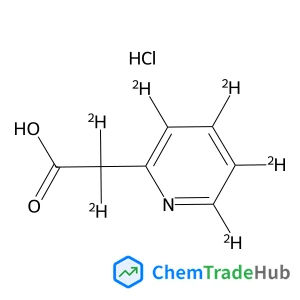
2,2-dideuterio-2-(3,4,5,6-tetradeuterio-2-pyridyl)acetic acid;hydrochloride
CAS番号:
1329799-67-8
分子式:
C7H2ClD6NO2
おすすめサプライヤー





免責事項
このページに表示される学術雑誌情報は、参考および研究目的のみを目的としています。当社は雑誌出版社とは提携しておらず、投稿の取り扱いも行っておりません。出版に関するお問い合わせは、各雑誌出版社に直接ご連絡ください。
表示されている情報に誤りがある場合は、support@chemtradehub.com までご連絡ください。迅速に確認し、対応いたします。