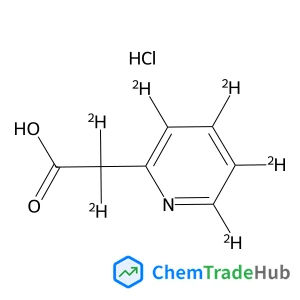
2,2-dideuterio-2-(3,4,5,6-tetradeuterio-2-pyridyl)acetic acid;hydrochloride
CAS番号:
1329799-67-8
分子式:
C7H2ClD6NO2
Nam Kim, Emily Sahadeo, Chanyuan Liu, Olivia Rose
Considering the tortuous, random porous nanostructures existing in many battery electrodes, it is essential to understand electronic and ionic behaviors in such a confined nanoscale porous geometry in which electron and ion transports can change dynamically. Here, we have carefully designed three dimensional (3D) interconnected porous electrode structures and performed experiments to probe how the ion and electron transport is impacted within these controlled geometries. By using anodized aluminum oxide as a template, we were able to fabricate both 1D array electrodes and 3D electrodes with varying numbers of interconnections, utilizing vanadium oxide (V2O5) as the active material. We demonstrate that the inherent properties of the electrode material in combination with the structural properties of the electrodes can both positively and negatively impact electrochemical characteristics. Most notably, electrodes with seven interconnecting layers in their structure had 19.7% less capacity at 25C than electrodes with zero interconnecting layers, demonstrating the negative effect of interconnections combined with poor electronic conductivity of V2O5 upon lithiation beyond one Li insertion. These results indicate that a careful consideration of the material and structural properties is needed for the design of high performance battery systems.

Chemistry Education Research and Practice

Russian Journal of General Chemistry

Organic Process Research & Development

Current Opinion in Solid State & Materials Science

Journal of Saudi Chemical Society

Crystallography Reports

New Journal of Chemistry

Russian Journal of Organic Chemistry

Journal of Natural Medicines

Current Opinion in Colloid & Interface Science
Tsao-Cheng Huang, Lu-Chen Yeh, Hsiu-Ying Huang, Zheng-Yong Nian, Yi-Chun Yeh, Yi-Chen Chou, Jui-Ming Yeh, Mei-Hui Tsai
DOI: 10.1039/C3PY00787A
Qijing Chen, Yuanyuan Xu, Xueteng Cao, Lianjie Qin, Zesheng An
DOI: 10.1039/C3PY00942D
Huiying Liao, Ke Zhang, Gangsheng Tong, Guyu Xiao, Deyue Yan
DOI: 10.1039/C3PY00821E
Ying-Hsuan Chou, Sanae Takasugi, Raita Goseki, Takashi Ishizone, Wen-Chang Chen
DOI: 10.1039/C3PY01124K
Wenhan He, Yingbing Jiang, Yang Qin
DOI: 10.1039/C3PY01396K
Susanne Boye, Mihaela Cernescu, Hartmut Komber, Bernhard Brutschy, Dietmar Appelhans
DOI: 10.1039/C3PY01152F
Kaidian Zou, Qiuming Liu, Jing Chen, Jianzhong Du
DOI: 10.1039/C3PY00966A
Ye Zhao, Haiyang Gao, Guodong Liang, Fangming Zhu, Qing Wu
DOI: 10.1039/C3PY01289A
Masaki Takara, Masayuki Toyoshima, Hirokazu Seto, Yu Hoshino, Yoshiko Miura
DOI: 10.1039/C3PY01001E
Li-Min Zhang, Tao Wang, Bao-Hang Han
DOI: 10.1039/C3PY00854A
CAS番号163217-74-1の「邻羟基阿托伐他汀内酯标准品」は、GHS分類では危険物に分類されず、主にREACH規則とFDA/EPAの管理対象となります。R...
メチル(3R)-3-アミノ-2,3-ジヒドロ-1-ベンゾファンラニン-5-カルボイル酸塩塩酸塩は、医薬品や合成化学の研究に広く用いられます。また、特定の薬物の前...
トランス-4-メチルピロリジン-3-オール塩酸塩は、4-メチルピロリジンの塩酸塩化によって合成されます。一般的な合成方法では、4-メチルピロリジンを塩酸に加えて...
硫雜環丁烷-1,1-二氧化物は安全ではありません。毒性は報告されていませんが、高温下で分解し、可燃性があるため、高圧ガスは注意が必要です。密閉した容器で保管し、...
9-ヒドロキシエリプチシネ塩酸塩は、エリプチシネから塩酸を添加することで合成されます。選択性は高いですが、収率は約70%です。
5-塩素-2-(メチルアミノ)フェニル-(2-塩素フェニル)メタン酮のCAS番号は5621-86-3です。この化合物は白色の結晶性粉末で、分子量は415.03で...
1-[2-(4-甲氧基-苯氧基)-乙基]-哌嗪は、直射日光を避けて暗所に、室温(15-25℃)で保管し、密閉容器に入れることで安定性を保つことができます。
2-[3-(4-甲氧基フェニル)プロピル]-4,4,5,5-四メチル-1,3,2-ドイボロロールアンは、医薬品の合成、有機合成化学、および新材料の研究で使用され...

Physical Chemistry Chemical Physics (PCCP) is an international journal co-owned by 19 physical chemistry and physics societies from around the world. This journal publishes original, cutting-edge research in physical chemistry, chemical physics and biophysical chemistry. To be suitable for publication in PCCP, articles must include significant innovation and/or insight into physical chemistry; this is the most important criterion that reviewers and Editors will judge against when evaluating submissions. The journal has a broad scope and welcomes contributions spanning experiment, theory, computation and data science. Topical coverage includes spectroscopy, dynamics, kinetics, statistical mechanics, thermodynamics, electrochemistry, catalysis, surface science, quantum mechanics, quantum computing and machine learning. Interdisciplinary research areas such as polymers and soft matter, materials, nanoscience, energy, surfaces/interfaces, and biophysical chemistry are welcomed if they demonstrate significant innovation and/or insight into physical chemistry. Joined experimental/theoretical studies are particularly appreciated when complementary and based on up-to-date approaches.