












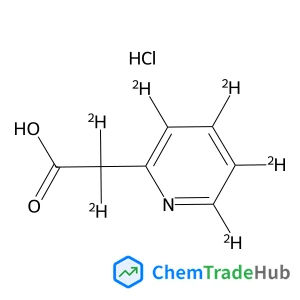
2,2-dideuterio-2-(3,4,5,6-tetradeuterio-2-pyridyl)acetic acid;hydrochloride
CAS番号:
1329799-67-8
分子式:
C7H2ClD6NO2
The influence of entropy in multiple chemical equilibria is investigated for systems with different types of sites for the condition that the binding enthalpy of the species is the same within each type of sites and independent of those species that are already bonded. This allows splitting of the free reaction enthalpy into the particle distribution term and all other contributions for each type of sites separately and, hence, to evaluate this entropy contribution to the free reaction enthalpy. The situations for which this applies can be chemically very different, e.g. acid base, ligand exchange, isomerisation, conformational change, rearrangement of a ligand, ion exchange, adsorption of a species on the surface of a particle or a dendrimer, insertion of charged or neutral species into the cavities of a microporous or mesoporous host. We provide physical insight by discussing Xrc1{n1ABn2}Xrc2 systems. The number of coordination sites A and B are n1 and n2, respectively. The indices rc1 = 1, 2,…,n1 and rc2 = 1, 2,…,n2 count the number of X bonded to sites A and sites B, respectively. An important result is that the large number of equilibrium constants needed to describe those situations can be expressed as a function of two constants only. This allows studying systems quantitatively by experimental and theoretical means which otherwise might be difficult to handle. It has also implication for theoretical studies in the sense that it is sufficient to model only two reactions instead of many in order to describe a system. The results remain valid for systems with more than two types of different sites. The description of the entropy driven development of the fractional equilibrium coverage of the sites provides a new tool for understanding adsorption and ion exchange isotherms. The fractional equilibrium coverage of the sites can be described as a linear combination of individual Langmuir isotherms despite of the fact that such a linear combination has never the shape of the original Langmuir isotherm. This is remarkable and very useful. It provides us with new tools for describing and testing isotherms based on well defined, transparent physical ideas. Explicit solution for systems with 2, 3, 4, 5, 6, and 12 coordination sites are reported. Applications to a system with 12 coordination sites serve to illustrate information that can be obtained for complex situations.
Siham Telitel, Yoshifumi Amamoto, Julien Poly, Fabrice Morlet-Savary, Olivier Soppera, Jacques Lalevée, Krzysztof Matyjaszewski
DOI: 10.1039/C3PY01162C
Bunyamin Karagoz, Hien T. Duong, Johan S. Basuki, Cyrille Boyer
DOI: 10.1039/C3PY01306E
Lin Yang, Yaling Lin, Lianshi Wang, Anqiang Zhang
DOI: 10.1039/C3PY01005H
DOI: 10.1039/C3PY01118F
Dahlia N. Amato, Gregory A. Strange, John P. Swanson, Anton D. Chavez, Suzanne E. Roy, Kim L. Varney, Craig A. Machado, Douglas V. Amato, Philip J. Costanzo
DOI: 10.1039/C3PY01024D
Christopher Waldron, Athina Anastasaki, Ronan McHale, Paul Wilson, Zaidong Li, Tim Smith, David M. Haddleton
DOI: 10.1039/C3PY01241G
Yongxi Li, Zhe Pan, Lei Miao, Ying Xing, Chao Li, Yu Chen
DOI: 10.1039/C3PY01018J
Yiliu Liu, Zehuan Huang, Kai Liu, Hans Kelgtermans, Wim Dehaen, Zhiqiang Wang, Xi Zhang
DOI: 10.1039/C3PY01036H
CAS番号163217-74-1の「邻羟基阿托伐他汀内酯标准品」は、GHS分類では危険物に分類されず、主にREACH規則とFDA/EPAの管理対象となります。R...
メチル(3R)-3-アミノ-2,3-ジヒドロ-1-ベンゾファンラニン-5-カルボイル酸塩塩酸塩は、医薬品や合成化学の研究に広く用いられます。また、特定の薬物の前...
トランス-4-メチルピロリジン-3-オール塩酸塩は、4-メチルピロリジンの塩酸塩化によって合成されます。一般的な合成方法では、4-メチルピロリジンを塩酸に加えて...
硫雜環丁烷-1,1-二氧化物は安全ではありません。毒性は報告されていませんが、高温下で分解し、可燃性があるため、高圧ガスは注意が必要です。密閉した容器で保管し、...
9-ヒドロキシエリプチシネ塩酸塩は、エリプチシネから塩酸を添加することで合成されます。選択性は高いですが、収率は約70%です。
5-塩素-2-(メチルアミノ)フェニル-(2-塩素フェニル)メタン酮のCAS番号は5621-86-3です。この化合物は白色の結晶性粉末で、分子量は415.03で...
1-[2-(4-甲氧基-苯氧基)-乙基]-哌嗪は、直射日光を避けて暗所に、室温(15-25℃)で保管し、密閉容器に入れることで安定性を保つことができます。
2-[3-(4-甲氧基フェニル)プロピル]-4,4,5,5-四メチル-1,3,2-ドイボロロールアンは、医薬品の合成、有機合成化学、および新材料の研究で使用され...

Physical Chemistry Chemical Physics (PCCP) is an international journal co-owned by 19 physical chemistry and physics societies from around the world. This journal publishes original, cutting-edge research in physical chemistry, chemical physics and biophysical chemistry. To be suitable for publication in PCCP, articles must include significant innovation and/or insight into physical chemistry; this is the most important criterion that reviewers and Editors will judge against when evaluating submissions. The journal has a broad scope and welcomes contributions spanning experiment, theory, computation and data science. Topical coverage includes spectroscopy, dynamics, kinetics, statistical mechanics, thermodynamics, electrochemistry, catalysis, surface science, quantum mechanics, quantum computing and machine learning. Interdisciplinary research areas such as polymers and soft matter, materials, nanoscience, energy, surfaces/interfaces, and biophysical chemistry are welcomed if they demonstrate significant innovation and/or insight into physical chemistry. Joined experimental/theoretical studies are particularly appreciated when complementary and based on up-to-date approaches.
phosphoryl}methyl 4-methylbenzenesulfonate structure](https://static.chemtradehub.com/structs/864/864068-45-1-ba7c.webp "{[3-(Hexadecyloxy)propoxy](hydroxy)phosphoryl}methyl 4-methylbenzenesulfonate structure")
![S-[2,3-Bis(palmitoyloxy)propyl]-N-[(9H-fluoren-9-ylmethoxy)(hydroxy)methylene]cysteine structure](https://static.chemtradehub.com/structs/210/210532-98-2-f6a7.webp "S-[2,3-Bis(palmitoyloxy)propyl]-N-[(9H-fluoren-9-ylmethoxy)(hydroxy)methylene]cysteine structure")

![(2E)-3-(3-Chlorophenyl)-N-{2-[4-(methylsulfonyl)-1-piperazinyl]-2-oxoethyl}acrylamide structure](https://static.chemtradehub.com/structs/250/2505001-54-5-c1e9.webp "(2E)-3-(3-Chlorophenyl)-N-{2-[4-(methylsulfonyl)-1-piperazinyl]-2-oxoethyl}acrylamide structure")




