


Borophene's tryst with stability: exploring 2D hydrogen boride as an electrode for rechargeable batteries
文献情報
出版日
2018-08-01
DOI
10.1039/C8CP03686A
インパクトファクター
3.676
著者
Vivekanand Shukla, Rafael B. Araujo, Naresh K. Jena
原文を見る
要旨
Graphene's emergence can be viewed as a positive upheaval in 2D materials research. Along the same line, the realization of a related elemental 2D material, borophene, is another breakthrough. To circumvent the stability issues of borophene, which is reported to have been synthesized on metallic substrates under extreme conditions, hydrogenation of borophene (otherwise called as borophane or hydrogen boride or boron hydride) has been a plausible solution, but only proposed computationally. A recent report (H. Nishino, T. Fujita, N. T. Cuong, S. Tominaka, M. Miyauchi, S. Iimura, A. Hirata, N. Umezawa, S. Okada, E. Nishibori, A. Fujino, T. Fujimori, S. Ito, J. Nakamura, H. Hosono and T. Kondo, J. Am. Chem. Soc., 2017, 139(39), 13761–13769) brings to fore its experimental realization. Our current study delves into the possibilities of employing this intriguing 2D hydrogen boride as anodes in Li/Na ion batteries. Using first-principles density functional theory methods, we computed relevant properties such as the ion (Li/Na) adsorption behavior, the possible pathways of ionic diffusion with the estimation of barriers as well as the theoretical specific capacities and average voltages to uniquely demonstrate that this material is of particular significance for battery applications. It is noted that the use of hydrogen boride leads to a high specific capacity of 861.78 mA h g−1 for Li ions, which is remarkably higher than the value reported in relation to its computationally predicted structure. Furthermore, Na ion intercalation leads to negative voltage profiles, implying the unsuitability of 2D hydrogen boride for this particular ion. Our findings are timely and pertinent towards adding insightful details relevant to the progress of applications of 2D materials for energy storage.
おすすめジャーナル

Russian Journal of General Chemistry

Crystallography Reports

Russian Chemical Bulletin

Organic Process Research & Development

Current Opinion in Solid State & Materials Science

Chemical Communications

Journal of Natural Medicines

Russian Journal of Bioorganic Chemistry

Acta Materialia

Russian Journal of Applied Chemistry
関連文献
Rotational conformers of m-methoxybenzyl radical in a supersonic jet
Kosaku Sakeda, Tadashi Suzuki, Yoshihisa Matsushita, Teijiro Ichimura
2002-04-18
Paper
DOI: 10.1039/B111406A
Acyl/aroylperoxyl radicals: a comparative study of the reactivity of peroxyl radicals resulting from the α-cleavage of ketones
Ali El-Agamey, David J. McGarvey
2002-03-22
Paper
DOI: 10.1039/B109309F
Analysis of the ν3 + ν7 combination band of CF2Cl2 from spectra obtained by high resolution diode laser and FTIR supersonic jet techniques
Giuseppe D'Amico, Marcel Snels, Hans Hollenstein, Martin Quack
2002-03-25
Paper
DOI: 10.1039/B110919G
Is xenon an “ennobled” alkane?
Eduardo J. M. Filipe, Lino M. B. Dias, Jorge C. G. Calado, Clare McCabe, George Jackson
2002-03-26
Paper
DOI: 10.1039/B109165B
Internal pressure of a thermodynamically ideal mixture and the excess internal pressure
2002-04-15
Paper
DOI: 10.1039/B110887E
NMR studies of the molecular dynamics of tert-butyl chloride confined in the mesoporous molecular sieve MCM-41
Lidia Wasyluk, Barbara Peplinska, Stefan Jurga
2002-04-30
Paper
DOI: 10.1039/B200634K
Coadsorption of CO and O2 on small free gold cluster anions at cryogenic temperatures: Model complexes for catalytic CO oxidation
Jan Hagen, Liana D. Socaciu, Maryam Elijazyfer, Ueli Heiz, Thorsten M. Bernhardt, Ludger Wöste
2002-04-15
Communication
DOI: 10.1039/B201236G
Transformation of diamond nanoparticles into carbon onions under electron irradiation
V. V. Roddatis, V. L. Kuznetsov, Yu. V. Butenko, D. S. Su, R. Schlögl
2002-04-09
Paper
DOI: 10.1039/B110487J
Probing the electronic structure of polynuclear metal clusters with total electron spin S > 1/2 and significant zero-field splitting; Application to the clusters of the nitrogenase MoFe-protein
Jan Petersen, David J. Lowe
2002-04-30
Paper
DOI: 10.1039/B110486C
Rheology of glycocalix model at air/water interface
Matthias F. Schneider, Kwangmo Lim, Gerald G. Fuller, Motomu Tanaka
2002-04-04
Paper
DOI: 10.1039/B110631G
こちらもおすすめ
化合物よくある質問
4-アミノフェノール酸ナトリウム水和物とは何ですか?
4-アミノフェノール酸ナトリウム水和物は、CAS番号206557-08-6の化合物で、4-アミノフェノールとナトリウムが結合した塩と水和物です。この化合物は、白...
206557-08-64-Aminobenzoic acid ...
化合物よくある質問
Methyl 3-methyl-N-{[(2-methyl-2-propanyl)oxy]carbonyl}-L-histidinateの代替品はありますか?
この化合物は特定の合成プロセスに使用される可能性がありますが、代替品として、他の类似的な化合物、例えばMethyl 3-methyl-N-{[(2-methyl...
72212-51-2Methyl 3-methyl-N-{[...
化合物よくある質問
4-Boc-2-哌嗪甲酸の市場動向や研究トレンドはどうですか?
4-Boc-2-哌嗪甲酸は、薬品開発や合成化学分野で広く使用されており、その需要は継続的に推移しています。特に、新薬開発における合成化学分野での需要が高まってい...
192330-11-3(2R)-4-[(tert-butoxy...
化合物よくある質問
4,4'-二羟甲基联苯の物理化学的性質は何ですか?
4,4'-二羟甲基联苯のCAS番号は1667-12-5です。この化合物は白色の結晶粉末で、分子量は154.20です。水にわずかに溶けますが、アルコールや有機溶媒...
1667-12-54,4'-Biphenyldiyldim...
化合物よくある質問
5-甲硫基戊腈はどの業界で使用されていますか?
5-甲硫基戊腈は医薬品産業で使用される可能性があります。また、ポリマー合成の触媒として、センサー製造の一部として、半導体製造のプロセス改善に使用される可能性があ...
59121-25-45-(Methylsulfanyl)pe...
化合物よくある質問
CAS番号1311961-50-8の化合物はどのように合成されますか?
この化合物は、1-abieta-8,11,13-trien-19-イルと6'-メトキシシンコナナン-9-基を含有する窒素含有化合物から合成されます。一般的な合成...
1311961-50-81-Abieta-8,11,13-tri...
化合物よくある質問
6-ブロモベンジジミダゾール-2-カルビルデオキシドはどのように保存すればよいですか?
6-ブロモベンジジミダゾール-2-カルビルデオキシドは、避光・乾燥した容器(密閉容器)で-20℃~4℃の低温で保存してください。高温や直射日光、湿気は避けてくだ...
885280-26-25-Bromo-1H-benzimida...
化合物よくある質問
Boc-N-甲基氨甲环酸とは何ですか?
621-65-8のCAS番号を持つBoc-N-甲基氨甲环酸は、化学式C7H13NO5を有する化合物です。この化合物は白色の結晶性粉末で、吸湿性があります。
621-65-83-Hydroxy-1,2-propan...
化合物よくある質問
乙基三氟硼酸钾はどのように合成されますか?
乙基三氟硼酸钾は、トリフLUオール酸カリウムとエチルブロミドを反応させて合成されます。この反応は高い選択性と収率を持ち、触媒を用いることで効率的に進行します。
882871-21-8Potassium ethyltrifl...
化合物よくある質問
2-フロウロ-5-クロロ-4-アミノフェノールはどのように保存すればよいですか?
2-フロウロ-5-クロロ-4-アミノフェノールは、直射日光を避けて冷却された暗所で保存し、密閉容器に保管してください。温度は常温か低温が適しています。
847872-10-04-Amino-5-chloro-2-f...
掲載誌
Physical Chemistry Chemical Physics

CiteScore:
5.5
自己引用率:
10.3%
年間論文数:
3036
Physical Chemistry Chemical Physics (PCCP) is an international journal co-owned by 19 physical chemistry and physics societies from around the world. This journal publishes original, cutting-edge research in physical chemistry, chemical physics and biophysical chemistry. To be suitable for publication in PCCP, articles must include significant innovation and/or insight into physical chemistry; this is the most important criterion that reviewers and Editors will judge against when evaluating submissions. The journal has a broad scope and welcomes contributions spanning experiment, theory, computation and data science. Topical coverage includes spectroscopy, dynamics, kinetics, statistical mechanics, thermodynamics, electrochemistry, catalysis, surface science, quantum mechanics, quantum computing and machine learning. Interdisciplinary research areas such as polymers and soft matter, materials, nanoscience, energy, surfaces/interfaces, and biophysical chemistry are welcomed if they demonstrate significant innovation and/or insight into physical chemistry. Joined experimental/theoretical studies are particularly appreciated when complementary and based on up-to-date approaches.
おすすめ化合物
![2,4-Dichloro-6-isopropyl-5H-pyrrolo[3,4-d]pyrimidin-7(6H)-one structure](https://static.chemtradehub.com/structs/107/1079649-94-7-ad4a.webp "2,4-Dichloro-6-isopropyl-5H-pyrrolo[3,4-d]pyrimidin-7(6H)-one structure")

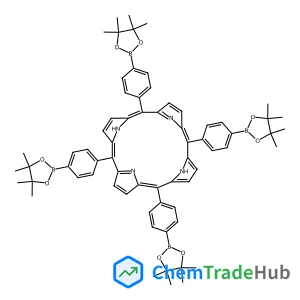
5,10,15,20-tetrakis(4-boronic acid pinacol ester phenyl) porphyrin
CAS番号:
1332748-00-1
分子式:
C68H74B4N4O8
おすすめサプライヤー




免責事項
このページに表示される学術雑誌情報は、参考および研究目的のみを目的としています。当社は雑誌出版社とは提携しておらず、投稿の取り扱いも行っておりません。出版に関するお問い合わせは、各雑誌出版社に直接ご連絡ください。
表示されている情報に誤りがある場合は、support@chemtradehub.com までご連絡ください。迅速に確認し、対応いたします。