













Self-assembly of random co-polymers for selective binding and detection of peptides
文献情報
出版日
2017-12-19
DOI
10.1039/C7PY01947E
インパクトファクター
5.582
著者
Bo Zhao, Mahalia A. C. Serrano, Jingjing Gao, Jiaming Zhuang
原文を見る
要旨
Amphiphilic random co-polymers, which form stable reverse micelle-type assemblies, have been designed and synthesized. We demonstrate that the reverse micelles, formed by these co-polymers are capable of selectively binding peptides through electrostatic interactions, indicating that these random polymers can self-organize into functionally selective materials. Moreover, these random co-polymers also enable the ordered co-crystallization of matrix and extract guest molecules, giving rise to substantial signal enhancements during MALDI-MS detection. Together, these observations represent an excellent example of how random polymers can self-assemble into ordered, functional materials.
関連文献
Potential application of metallacarboranes as an internal reference: an electrochemical comparative study to ferrocene
Jewel Ann Maria Xavier, Clara Viñas, Francesc Teixidor
2022-03-04
Communication
DOI: 10.1039/D2CC00424K
Nickel catalyzed Grob fragmentation: ω-dienyl aldehydes synthesis
Masahiko Mori, Masanari Kimura, Yushi Takahashi, Yoshinao Tamaru
2006-09-01
Communication
DOI: 10.1039/B610164J
Tunable cyano substituents in D–A conjugated polymers accessed via direct arylation for photocatalytic hydrogen production
Yu-Jie Zhang, Zhi-Rong Tan, Yu-Qin Xing, Zhengwang Chen, Jia-Bin Qiu, Shi-Yong Liu
2022-10-18
Communication
DOI: 10.1039/D2CC04625C
Formation mechanism of twinned β-form anhydrous guanine platelets in scallop eyes
Dongmei Guo, Yiqun Liu, Xiubin Hou, Xubo Wang, Chenge Fan, Lixia Bao, Xinpeng He, Hongmei Zhang, Yurong Ma
2023-07-04
Paper
DOI: 10.1039/D3CE00485F
Near-unity electrochemical conversion of nitrate to ammonia on crystalline nickel porphyrin-based covalent organic frameworks
Mingzi Sun
2022-11-23
Paper
DOI: 10.1039/D2EE02647C
Correction: Activity-based NIR fluorescent probes based on the versatile hemicyanine scaffold: design strategy, biomedical applications, and outlook
Heejeong Kim, Jingjing Han, Qichao Yao, Juyoung Yoon
2022-02-21
Correction
DOI: 10.1039/D2CS90019J
Mechanistic study of the complex photooxidation of allyl methyl sulfide (AMS): reaction paths and products of addition under different atmospheric conditions
Alejandro L. Cardona, María B. Blanco, Mariano A. Teruel, Oscar N. Ventura
2023-05-05
Paper
DOI: 10.1039/D3EA00010A
Growing Co–Ni–Se nanosheets on 3D carbon frameworks as advanced dual functional electrodes for supercapacitors and sodium ion batteries
Mingyue Gao, Yanchun Xue, Yutang Zhang, Chengxing Zhu, Haiwei Yu, Xingmei Guo, Shasha Sun, Shenglin Xiong, Qinghong Kong, Junhao Zhang
2022-06-13
Research Article
DOI: 10.1039/D2QI00695B
Giant thermal expansion associated with a macroscopic polarization change in a single crystal of a Zn(ii) complex
Zheng Tang, Chengdong Liu, Yan Zhang, Xiao-Peng Sun, Jun Tao, Zi-Shuo Yao
2022-12-01
Research Article
DOI: 10.1039/D2QI02371G
こちらもおすすめ
28770-01-62-(2-Isopropyl-1,3-o...
化合物よくある質問
「邻羟基阿托伐他汀内酯标准品」に適用される法規ガイドelinesは何ですか?
CAS番号163217-74-1の「邻羟基阿托伐他汀内酯标准品」は、GHS分類では危険物に分類されず、主にREACH規則とFDA/EPAの管理対象となります。R...
163217-74-1ortho-Hydroxy Atorva...
化合物よくある質問
メチル(3R)-3-アミノ-2,3-ジヒドロ-1-ベンゾファンラニン-5-カルボイル酸塩塩酸塩の主な用途は何ですか?
メチル(3R)-3-アミノ-2,3-ジヒドロ-1-ベンゾファンラニン-5-カルボイル酸塩塩酸塩は、医薬品や合成化学の研究に広く用いられます。また、特定の薬物の前...
2241594-15-8Methyl (3R)-3-amino-...
化合物よくある質問
トランス-4-メチルピロリジン-3-オール塩酸塩はどのように合成されますか?
トランス-4-メチルピロリジン-3-オール塩酸塩は、4-メチルピロリジンの塩酸塩化によって合成されます。一般的な合成方法では、4-メチルピロリジンを塩酸に加えて...
265108-42-7trans-4-Methylpyrrol...
化合物よくある質問
硫雜環丁烷-1,1-二氧化物は安全ですか?
硫雜環丁烷-1,1-二氧化物は安全ではありません。毒性は報告されていませんが、高温下で分解し、可燃性があるため、高圧ガスは注意が必要です。密閉した容器で保管し、...
5687-92-3Thietane 1,1-dioxide
6054-10-02H, 8H-Benzo[1,2-b
化合物よくある質問
9-ヒドロキシエリプチシネ塩酸塩はどのように合成されますか?
9-ヒドロキシエリプチシネ塩酸塩は、エリプチシネから塩酸を添加することで合成されます。選択性は高いですが、収率は約70%です。
52238-35-49-Hydroxyellipticine...
化合物よくある質問
5-塩素-2-(メチルアミノ)フェニル-(2-塩素フェニル)メタン酮の物理化学的性質は何ですか?
5-塩素-2-(メチルアミノ)フェニル-(2-塩素フェニル)メタン酮のCAS番号は5621-86-3です。この化合物は白色の結晶性粉末で、分子量は415.03で...
5621-86-3[5-Chloro-2-(methyla...
化合物よくある質問
1-[2-(4-甲氧基-苯氧基)-乙基]-哌嗪はどのように保存すればよいですか?
1-[2-(4-甲氧基-苯氧基)-乙基]-哌嗪は、直射日光を避けて暗所に、室温(15-25℃)で保管し、密閉容器に入れることで安定性を保つことができます。
117132-44-21-[2-(4-Methoxy-phen...
化合物よくある質問
2-[3-(4-甲氧基フェニル)プロピル]-4,4,5,5-四メチル-1,3,2-ドイボロロールアンの主な用途は何ですか?
2-[3-(4-甲氧基フェニル)プロピル]-4,4,5,5-四メチル-1,3,2-ドイボロロールアンは、医薬品の合成、有機合成化学、および新材料の研究で使用され...
1073371-72-82-[3-(4-Methoxypheny...
掲載誌
Polymer Chemistry

CiteScore:
8.6
自己引用率:
7.3%
年間論文数:
457
Polymer Chemistry welcomes submissions in all areas of polymer science that have a strong focus on macromolecular chemistry. Manuscripts may cover a broad range of fields, yet no direct application focus is required.
おすすめ化合物
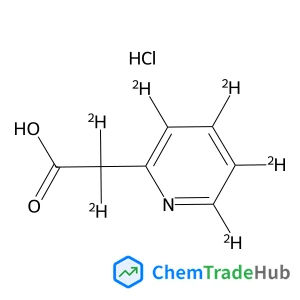
2,2-dideuterio-2-(3,4,5,6-tetradeuterio-2-pyridyl)acetic acid;hydrochloride
CAS番号:
1329799-67-8
分子式:
C7H2ClD6NO2

おすすめサプライヤー






免責事項
このページに表示される学術雑誌情報は、参考および研究目的のみを目的としています。当社は雑誌出版社とは提携しておらず、投稿の取り扱いも行っておりません。出版に関するお問い合わせは、各雑誌出版社に直接ご連絡ください。
表示されている情報に誤りがある場合は、support@chemtradehub.com までご連絡ください。迅速に確認し、対応いたします。