












The power of the ring: a pH-responsive hydrophobic epoxide monomer for superior micelle stability
文献情報
出版日
2017-10-06
DOI
10.1039/C7PY01613A
インパクトファクター
5.582
著者
Jaeeun Song, L. Palanikumar, Yeongkyu Choi, Inhye Kim, Tae-young Heo, Eungjin Ahn, Soo-Hyung Choi, Eunji Lee, Yuji Shibasaki, Ja-Hyoung Ryu
原文を見る
要旨
Despite the growing interest in amphiphilic block copolymers for their application in micelles as ideal drug delivery carriers, there remain some challenges related to biocompatibility, stability, degradability, and loading efficiency of the micelles. Herein, we report a novel hydrophobic, pH-responsive epoxide monomer, tetrahydropyranyl glycidyl ether (TGE). Anionic ring-opening polymerization affords the controlled synthesis of a series of its homopolymers (PTGE) and amphiphilic polymers, poly(ethylene glycol)-block-poly(tetrahydropyranyl glycidyl ether) (PEG-b-PTGE). Interestingly, these block copolymers with cyclic TGE moieties showed superior stability in biological media, high loading capacity, tunable release, and controllable degradation compared to the block copolymers with its acyclic analogue, 1-ethoxyethyl glycidyl ether (EEGE), widely employed in polyether, which satisfy all the required design principles and address the challenges in drug delivery systems. The superior biocompatibility coupled with the high stability of the novel functional epoxide monomer is anticipated to lead to the development of a versatile platform for smart drug delivery systems.
関連文献
A switchable DNA origami/plasmonic hybrid device with a precisely tuneable DNA-free interparticle gap
Michael Erkelenz, Richard Kosinski, Helene Giesler, Oliver Sritharan, Jesil Jose, Barbara Saccà, Sebastian Schlücker
2022-11-10
Communication
DOI: 10.1039/D2CC05324A
Synthesis of glycerol 1,2-carbonate by transesterification of glycerol with dimethyl carbonate using triethylamine as a facile separable homogeneous catalyst
Olga Gómez-Jiménez-Aberasturi, Camilo Ramírez-López, Belén Maestro-Madurga
2012-10-02
Paper
DOI: 10.1039/C2GC35992H
Facile access to 2-hydroxy-2-substituted indole-3-ones via a copper-catalyzed oxidative cyclization of 2-arylethynylanilines
Weiqiang Sun, Xueli Cui, Jing Qu, Xiaojia Cai, Jinhui Hu, Zhuang Xiong, Suqin Guo, Wen-Hua Chen, Jia-Qiang Wu
2023-05-15
Communication
DOI: 10.1039/D3CC01390A
A new MCM-41 supported HPF6 catalyst for the library synthesis of highly substituted 1,4-dihydropyridines and oxidation to pyridines: report of one-dimensional packing towards LMSOMs and studies on their photophysical properties
Suman Ray, Mike Brown, Asim Bhaumik, Arghya Dutta, Chhanda Mukhopadhyay
2013-04-09
Paper
DOI: 10.1039/C3GC40441B
In situ modification of metal electrode by integrated microbial corrosion and microbial mineralization using Shewanella oneidensis for efficient oxygen evolution
Yang-Chun Yong, Jian-Li Mi
2023-03-06
Paper
DOI: 10.1039/D2CY01981G
Mechanistic study of the complex photooxidation of allyl methyl sulfide (AMS): reaction paths and products of addition under different atmospheric conditions
Alejandro L. Cardona, María B. Blanco, Mariano A. Teruel, Oscar N. Ventura
2023-05-05
Paper
DOI: 10.1039/D3EA00010A
Low quantum efficiency of μ-oxo iron bisporphyrin photocatalysts explained with femtosecond M-edge XANES
Kori M. Sye, Clare A. Leahy, Josh Vura-Weis
2022-09-02
Paper
DOI: 10.1039/D2CY01081J
An enantioselective fluorescence sensing assay for quantitative analysis of chiral carboxylic acids and amino acid derivatives
Christian Wolf, Shuanglong Liu, Brian C. Reinhardt
2006-09-01
Communication
DOI: 10.1039/B609880K
こちらもおすすめ
28770-01-62-(2-Isopropyl-1,3-o...
化合物よくある質問
「邻羟基阿托伐他汀内酯标准品」に適用される法規ガイドelinesは何ですか?
CAS番号163217-74-1の「邻羟基阿托伐他汀内酯标准品」は、GHS分類では危険物に分類されず、主にREACH規則とFDA/EPAの管理対象となります。R...
163217-74-1ortho-Hydroxy Atorva...
化合物よくある質問
メチル(3R)-3-アミノ-2,3-ジヒドロ-1-ベンゾファンラニン-5-カルボイル酸塩塩酸塩の主な用途は何ですか?
メチル(3R)-3-アミノ-2,3-ジヒドロ-1-ベンゾファンラニン-5-カルボイル酸塩塩酸塩は、医薬品や合成化学の研究に広く用いられます。また、特定の薬物の前...
2241594-15-8Methyl (3R)-3-amino-...
化合物よくある質問
トランス-4-メチルピロリジン-3-オール塩酸塩はどのように合成されますか?
トランス-4-メチルピロリジン-3-オール塩酸塩は、4-メチルピロリジンの塩酸塩化によって合成されます。一般的な合成方法では、4-メチルピロリジンを塩酸に加えて...
265108-42-7trans-4-Methylpyrrol...
化合物よくある質問
硫雜環丁烷-1,1-二氧化物は安全ですか?
硫雜環丁烷-1,1-二氧化物は安全ではありません。毒性は報告されていませんが、高温下で分解し、可燃性があるため、高圧ガスは注意が必要です。密閉した容器で保管し、...
5687-92-3Thietane 1,1-dioxide
6054-10-02H, 8H-Benzo[1,2-b
化合物よくある質問
9-ヒドロキシエリプチシネ塩酸塩はどのように合成されますか?
9-ヒドロキシエリプチシネ塩酸塩は、エリプチシネから塩酸を添加することで合成されます。選択性は高いですが、収率は約70%です。
52238-35-49-Hydroxyellipticine...
化合物よくある質問
5-塩素-2-(メチルアミノ)フェニル-(2-塩素フェニル)メタン酮の物理化学的性質は何ですか?
5-塩素-2-(メチルアミノ)フェニル-(2-塩素フェニル)メタン酮のCAS番号は5621-86-3です。この化合物は白色の結晶性粉末で、分子量は415.03で...
5621-86-3[5-Chloro-2-(methyla...
化合物よくある質問
1-[2-(4-甲氧基-苯氧基)-乙基]-哌嗪はどのように保存すればよいですか?
1-[2-(4-甲氧基-苯氧基)-乙基]-哌嗪は、直射日光を避けて暗所に、室温(15-25℃)で保管し、密閉容器に入れることで安定性を保つことができます。
117132-44-21-[2-(4-Methoxy-phen...
化合物よくある質問
2-[3-(4-甲氧基フェニル)プロピル]-4,4,5,5-四メチル-1,3,2-ドイボロロールアンの主な用途は何ですか?
2-[3-(4-甲氧基フェニル)プロピル]-4,4,5,5-四メチル-1,3,2-ドイボロロールアンは、医薬品の合成、有機合成化学、および新材料の研究で使用され...
1073371-72-82-[3-(4-Methoxypheny...
掲載誌
Polymer Chemistry

CiteScore:
8.6
自己引用率:
7.3%
年間論文数:
457
Polymer Chemistry welcomes submissions in all areas of polymer science that have a strong focus on macromolecular chemistry. Manuscripts may cover a broad range of fields, yet no direct application focus is required.
おすすめ化合物
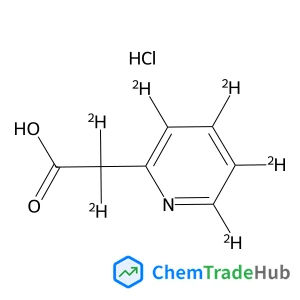
2,2-dideuterio-2-(3,4,5,6-tetradeuterio-2-pyridyl)acetic acid;hydrochloride
CAS番号:
1329799-67-8
分子式:
C7H2ClD6NO2
![S-[2,3-Bis(palmitoyloxy)propyl]-N-[(9H-fluoren-9-ylmethoxy)(hydroxy)methylene]cysteine structure](https://static.chemtradehub.com/structs/210/210532-98-2-f6a7.webp "S-[2,3-Bis(palmitoyloxy)propyl]-N-[(9H-fluoren-9-ylmethoxy)(hydroxy)methylene]cysteine structure")
おすすめサプライヤー




免責事項
このページに表示される学術雑誌情報は、参考および研究目的のみを目的としています。当社は雑誌出版社とは提携しておらず、投稿の取り扱いも行っておりません。出版に関するお問い合わせは、各雑誌出版社に直接ご連絡ください。
表示されている情報に誤りがある場合は、support@chemtradehub.com までご連絡ください。迅速に確認し、対応いたします。