













Supramolecular fluorescent nanoparticles functionalized with controllable physical properties and temperature-responsive release behavior
文献情報
出版日
2017-03-09
DOI
10.1039/C7PY00276A
インパクトファクター
5.582
著者
Chih-Chia Cheng, Jyun-Jie Huang, Adem Ali Muhable, Zhi-Sheng Liao, Shan-You Huang, Shun-Chieh Lee, Chih-Wei Chiu
原文を見る
要旨
Supramolecular fluorescent nanoparticles (SFNs), a combination of hydrogen-bonded supramolecular macromers and fluorescent pyrene dyes, can spontaneously self-assemble into thermosensitive micelles in an aqueous environment; the resulting micelles exhibit unique thermo-responsiveness and tunable phase transition behavior, making them highly attractive for the development of next-generation biomedical imaging tools and smart drug delivery applications. Herein, we developed a low-molecular-weight supramolecular polymer, adenine end-capped difunctional polypropylene glycol (BA-PPG), containing an adenine multiple hydrogen bonding moiety that effectively encapsulates pyrene molecules to generate the desired nanoparticle size, pyrene-loading content, and fluorescence properties in aqueous solution. Importantly, pyrene-loaded BA-PPG micelles act as a stable nanocarrier to greatly improve the pyrene-entrapment stability and generate high green-colored excimer emission under physiological conditions. Increasing the temperature above the lower critical solution temperature (45 °C) triggered a rapid release of the encapsulated pyrene from the loaded micelles due to the dissociation of the dynamic hydrogen bonds between adenine moieties, leading to the release of pyrene into aqueous solution and a gradual decrease in pyrene excimer emission. Given its simplicity of fabrication, low cost, high efficiency and multi-functionality, this newly-developed temperature-responsive micelle offers a new pathway for the development of high-efficiency SFNs.
関連文献
Charge polarization in partially lithiated single-walled carbon nanotubes
A. A. Makarova
2018-07-23
Paper
DOI: 10.1039/C8CP01510D
Spin–orbit coupling as a probe to decipher halogen bonding
Jérôme Graton, Seyfeddine Rahali, Jean-Yves Le Questel, Gilles Montavon, Julien Pilmé, Nicolas Galland
2018-10-08
Paper
DOI: 10.1039/C8CP05690K
Polarized absorbance and Davydov splitting in bulk and thin-film pentacene polymorphs
Caterina Cocchi, Tobias Breuer, Gregor Witte, Claudia Draxl
2018-11-14
Paper
DOI: 10.1039/C8CP06384B
Absolute upconversion quantum yields of blue-emitting LiYF4:Yb3+,Tm3+ upconverting nanoparticles
Michael S. Meijer, Paola A. Rojas-Gutierrez, Dmitry Busko, Florian Frenzel, Christian Würth, Ute Resch-Genger, Andrey Turshatov, John A. Capobianco, Sylvestre Bonnet
2018-08-17
Paper
DOI: 10.1039/C8CP03935F
The evolution in graphitic surface wettability with first-principles quantum simulations: the counterintuitive role of water
Jin-You Lu, Chia-Yun Lai, Ibraheem Almansoori
2018-08-08
Paper
DOI: 10.1039/C8CP03633K
Counteraction of denaturant-induced protein unfolding is a general property of stabilizing agents
Serena Cozzolino, Rosario Oliva, Giuseppe Graziano, Pompea Del Vecchio
2018-11-07
Paper
DOI: 10.1039/C8CP04421J
Total electron scattering cross sections from para-benzoquinone in the energy range 1–200 eV
A. I. Lozano, J. C. Oller, D. B. Jones, M. T. do N. Varella, M. H. F. Bettega, F. Ferreira da Silva, P. Limão-Vieira, M. A. P. Lima, R. D. White, M. J. Brunger, F. Blanco, A. Muñoz, G. García
2018-08-13
Paper
DOI: 10.1039/C8CP03297A
Visualizing the coordination-spheres of photoexcited transition metal complexes with ultrafast hard X-rays
D. Khakhulin, L. M. Lawson Daku, D. Leshchev, G. E. Newby, C. Bressler, M. Wulff
2019-04-04
Paper
DOI: 10.1039/C9CP01263J
Infrared spectroscopy of gas phase alpha hydroxy carboxylic acid homo and hetero dimers
Yong Xia, Sifeng Chen, Peifeng Su, Zhijun Yang, Carl O. Trindle, J. L. Knee
2018-10-08
Paper
DOI: 10.1039/C8CP05979A
こちらもおすすめ
28770-01-62-(2-Isopropyl-1,3-o...
化合物よくある質問
「邻羟基阿托伐他汀内酯标准品」に適用される法規ガイドelinesは何ですか?
CAS番号163217-74-1の「邻羟基阿托伐他汀内酯标准品」は、GHS分類では危険物に分類されず、主にREACH規則とFDA/EPAの管理対象となります。R...
163217-74-1ortho-Hydroxy Atorva...
化合物よくある質問
メチル(3R)-3-アミノ-2,3-ジヒドロ-1-ベンゾファンラニン-5-カルボイル酸塩塩酸塩の主な用途は何ですか?
メチル(3R)-3-アミノ-2,3-ジヒドロ-1-ベンゾファンラニン-5-カルボイル酸塩塩酸塩は、医薬品や合成化学の研究に広く用いられます。また、特定の薬物の前...
2241594-15-8Methyl (3R)-3-amino-...
化合物よくある質問
トランス-4-メチルピロリジン-3-オール塩酸塩はどのように合成されますか?
トランス-4-メチルピロリジン-3-オール塩酸塩は、4-メチルピロリジンの塩酸塩化によって合成されます。一般的な合成方法では、4-メチルピロリジンを塩酸に加えて...
265108-42-7trans-4-Methylpyrrol...
化合物よくある質問
硫雜環丁烷-1,1-二氧化物は安全ですか?
硫雜環丁烷-1,1-二氧化物は安全ではありません。毒性は報告されていませんが、高温下で分解し、可燃性があるため、高圧ガスは注意が必要です。密閉した容器で保管し、...
5687-92-3Thietane 1,1-dioxide
6054-10-02H, 8H-Benzo[1,2-b
化合物よくある質問
9-ヒドロキシエリプチシネ塩酸塩はどのように合成されますか?
9-ヒドロキシエリプチシネ塩酸塩は、エリプチシネから塩酸を添加することで合成されます。選択性は高いですが、収率は約70%です。
52238-35-49-Hydroxyellipticine...
化合物よくある質問
5-塩素-2-(メチルアミノ)フェニル-(2-塩素フェニル)メタン酮の物理化学的性質は何ですか?
5-塩素-2-(メチルアミノ)フェニル-(2-塩素フェニル)メタン酮のCAS番号は5621-86-3です。この化合物は白色の結晶性粉末で、分子量は415.03で...
5621-86-3[5-Chloro-2-(methyla...
化合物よくある質問
1-[2-(4-甲氧基-苯氧基)-乙基]-哌嗪はどのように保存すればよいですか?
1-[2-(4-甲氧基-苯氧基)-乙基]-哌嗪は、直射日光を避けて暗所に、室温(15-25℃)で保管し、密閉容器に入れることで安定性を保つことができます。
117132-44-21-[2-(4-Methoxy-phen...
化合物よくある質問
2-[3-(4-甲氧基フェニル)プロピル]-4,4,5,5-四メチル-1,3,2-ドイボロロールアンの主な用途は何ですか?
2-[3-(4-甲氧基フェニル)プロピル]-4,4,5,5-四メチル-1,3,2-ドイボロロールアンは、医薬品の合成、有機合成化学、および新材料の研究で使用され...
1073371-72-82-[3-(4-Methoxypheny...
掲載誌
Polymer Chemistry

CiteScore:
8.6
自己引用率:
7.3%
年間論文数:
457
Polymer Chemistry welcomes submissions in all areas of polymer science that have a strong focus on macromolecular chemistry. Manuscripts may cover a broad range of fields, yet no direct application focus is required.
おすすめ化合物
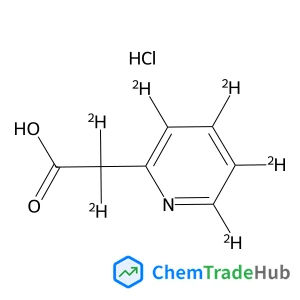
2,2-dideuterio-2-(3,4,5,6-tetradeuterio-2-pyridyl)acetic acid;hydrochloride
CAS番号:
1329799-67-8
分子式:
C7H2ClD6NO2

おすすめサプライヤー






免責事項
このページに表示される学術雑誌情報は、参考および研究目的のみを目的としています。当社は雑誌出版社とは提携しておらず、投稿の取り扱いも行っておりません。出版に関するお問い合わせは、各雑誌出版社に直接ご連絡ください。
表示されている情報に誤りがある場合は、support@chemtradehub.com までご連絡ください。迅速に確認し、対応いたします。