












Effect of epoxy monomer structure on the curing process and thermo-mechanical characteristics of tri-functional epoxy/amine systems: a methodology combining atomistic molecular simulation with experimental analyses
文献情報
出版日
2017-02-10
DOI
10.1039/C7PY00063D
インパクトファクター
5.582
著者
Liang Gao, Qingjie Zhang, Hao Li, Siruo Yu, Weihong Zhong, Gang Sui, Xiaoping Yang
原文を見る
要旨
The curing kinetics and thermo-mechanical characteristics of two kinds of high-performance amine cured tri-functional epoxy resin compounds, including diglycidyl-4,5-epoxycyclohexane-1,2-dicarboxylate and N,N-diglycidyl-4-glycidyloxyaniline, were systematically studied herein. Different to the simple bi-functional epoxy resins studied before, the increase in epoxy functionality and resultant asymmetric monomer structure made the whole curing behaviour more difficult to analyse. Nevertheless, there is an urgent demand to provide a thorough understanding of the tri-functional epoxy resin/amine system in order to obtain the desired macro-performance. In this paper, a methodology, which combines atomistic molecular simulation with experimental research, was established to expound the effect of the asymmetric epoxy monomer structure on the reaction kinetics and ultimate performance of the tri-functional epoxy/amine system. It can be utilized to efficiently analyse the cross-linking procedure and the microstructure–property relationships of epoxy resin with poly-functionality and asymmetric monomer structures, thereby serving as guidance to design high-performance polymer matrices for advanced composites.
おすすめジャーナル
関連文献
H/D solvent isotope effects on the photoracemization reaction of enantiomeric the tris(2,2′-bipyridine)ruthenium(ii) complex and its analogues
Masahiro Asahara, Haruhiko Kurimoto, Masato Nakamizu, Shingo Hattori, Kazuteru Shinozaki
2020-03-02
Paper
DOI: 10.1039/C9CP06758B
When is the Bell–Evans–Polanyi principle fulfilled in Diels–Alder reactions of fullerenes?
Paula Pla, Yang Wang
2020-03-27
Paper
DOI: 10.1039/C9CP06977A
Achieving long carrier lifetime and high optical gain in all-inorganic CsPbBr3 perovskite films via top and bottom surface modification
Li Jiang, Zhishan Fang, Haoran Lou, Chen Lin, Zhanhang Chen, Jing Li, Haiping He, Zhizhen Ye
2019-09-07
Paper
DOI: 10.1039/C9CP04033A
Detailed mechanism and kinetics of the reaction of Criegee intermediate CH2OO with HCOOH investigated via infrared identification of conformers of hydroperoxymethyl formate and formic acid anhydride
Chen-An Chung, Jou Wei Su
2019-09-09
Paper
DOI: 10.1039/C9CP04168K
Optimizing the orbital occupation in the multiple minima problem of magnetic materials from the metaheuristic firefly algorithm
Adam Payne, Guillermo Avedaño-Franco, Xu He, Eric Bousquet, Aldo H. Romero
2019-09-17
Paper
DOI: 10.1039/C9CP03618K
New insights into HER catalysis: the effect of nano-silica support on catalysis by silver nanoparticles
Gifty Sara Rolly, Guy Yardeni, Ronen Bar-Ziv, Tomer Zidki
2020-03-02
Paper
DOI: 10.1039/C9CP06820A
Implications of the fractional charge of hydroxide at the electrochemical interface
Leanne D. Chen, Michal Bajdich, Karen Chan
2020-03-03
Paper
DOI: 10.1039/C9CP05952K
A unique pentagonal network structure of the NiS2 monolayer with high stability and a tunable bandgap
2020-03-07
Paper
DOI: 10.1039/D0CP00434K
Metallic FeSe monolayer as an anode material for Li and non-Li ion batteries: a DFT study
Xiaodong Lv, Fengyu Li, Jian Gong, Jinxing Gu, Shiru Lin, Zhongfang Chen
2020-03-20
Paper
DOI: 10.1039/D0CP00967A
こちらもおすすめ
28770-01-62-(2-Isopropyl-1,3-o...
化合物よくある質問
「邻羟基阿托伐他汀内酯标准品」に適用される法規ガイドelinesは何ですか?
CAS番号163217-74-1の「邻羟基阿托伐他汀内酯标准品」は、GHS分類では危険物に分類されず、主にREACH規則とFDA/EPAの管理対象となります。R...
163217-74-1ortho-Hydroxy Atorva...
化合物よくある質問
メチル(3R)-3-アミノ-2,3-ジヒドロ-1-ベンゾファンラニン-5-カルボイル酸塩塩酸塩の主な用途は何ですか?
メチル(3R)-3-アミノ-2,3-ジヒドロ-1-ベンゾファンラニン-5-カルボイル酸塩塩酸塩は、医薬品や合成化学の研究に広く用いられます。また、特定の薬物の前...
2241594-15-8Methyl (3R)-3-amino-...
化合物よくある質問
トランス-4-メチルピロリジン-3-オール塩酸塩はどのように合成されますか?
トランス-4-メチルピロリジン-3-オール塩酸塩は、4-メチルピロリジンの塩酸塩化によって合成されます。一般的な合成方法では、4-メチルピロリジンを塩酸に加えて...
265108-42-7trans-4-Methylpyrrol...
化合物よくある質問
硫雜環丁烷-1,1-二氧化物は安全ですか?
硫雜環丁烷-1,1-二氧化物は安全ではありません。毒性は報告されていませんが、高温下で分解し、可燃性があるため、高圧ガスは注意が必要です。密閉した容器で保管し、...
5687-92-3Thietane 1,1-dioxide
6054-10-02H, 8H-Benzo[1,2-b
化合物よくある質問
9-ヒドロキシエリプチシネ塩酸塩はどのように合成されますか?
9-ヒドロキシエリプチシネ塩酸塩は、エリプチシネから塩酸を添加することで合成されます。選択性は高いですが、収率は約70%です。
52238-35-49-Hydroxyellipticine...
化合物よくある質問
5-塩素-2-(メチルアミノ)フェニル-(2-塩素フェニル)メタン酮の物理化学的性質は何ですか?
5-塩素-2-(メチルアミノ)フェニル-(2-塩素フェニル)メタン酮のCAS番号は5621-86-3です。この化合物は白色の結晶性粉末で、分子量は415.03で...
5621-86-3[5-Chloro-2-(methyla...
化合物よくある質問
1-[2-(4-甲氧基-苯氧基)-乙基]-哌嗪はどのように保存すればよいですか?
1-[2-(4-甲氧基-苯氧基)-乙基]-哌嗪は、直射日光を避けて暗所に、室温(15-25℃)で保管し、密閉容器に入れることで安定性を保つことができます。
117132-44-21-[2-(4-Methoxy-phen...
化合物よくある質問
2-[3-(4-甲氧基フェニル)プロピル]-4,4,5,5-四メチル-1,3,2-ドイボロロールアンの主な用途は何ですか?
2-[3-(4-甲氧基フェニル)プロピル]-4,4,5,5-四メチル-1,3,2-ドイボロロールアンは、医薬品の合成、有機合成化学、および新材料の研究で使用され...
1073371-72-82-[3-(4-Methoxypheny...
掲載誌
Polymer Chemistry

CiteScore:
8.6
自己引用率:
7.3%
年間論文数:
457
Polymer Chemistry welcomes submissions in all areas of polymer science that have a strong focus on macromolecular chemistry. Manuscripts may cover a broad range of fields, yet no direct application focus is required.
おすすめ化合物
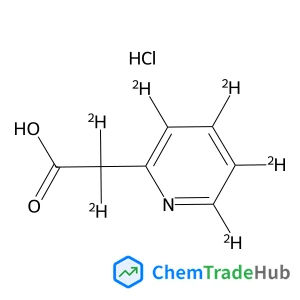
2,2-dideuterio-2-(3,4,5,6-tetradeuterio-2-pyridyl)acetic acid;hydrochloride
CAS番号:
1329799-67-8
分子式:
C7H2ClD6NO2
おすすめサプライヤー







免責事項
このページに表示される学術雑誌情報は、参考および研究目的のみを目的としています。当社は雑誌出版社とは提携しておらず、投稿の取り扱いも行っておりません。出版に関するお問い合わせは、各雑誌出版社に直接ご連絡ください。
表示されている情報に誤りがある場合は、support@chemtradehub.com までご連絡ください。迅速に確認し、対応いたします。