


Polymerization kinetics of a multi-functional silica precursor studied using a novel Monte Carlo simulation technique
文献情報
出版日
2017-12-20
DOI
10.1039/C7CP07737H
インパクトファクター
3.676
著者
Inderdip Shere, Ateeque Malani
原文を見る
要旨
Silica polymerization has been extensively used to synthesize various fascinating materials for industrial and technological applications. The polymerization protocol is modified by altering several parameters (such as the concentration of the precursor, temperature, pH) heuristically to obtain the desired end product. To properly understand the effect of such parameters, knowledge of molecular events occurring during the process of polymerization is essential. In this work, we developed algorithms to capture molecular events such as translation, rotation, and reactions using the reaction ensemble Monte Carlo (REMC) technique. Our algorithms simulate molecular events in accordance with physical time by correctly scaling the movements of a cluster with the monomer, thereby capturing the kinetics of the process. We studied the polymerization of the four coordinated silica (f4) precursor using our algorithm and observed excellent agreement between simulation results and experimental data. The algorithm was also used to study the polymerization of the three coordinated silica (f3) precursor and it was found that our simulations capture experimental kinetics well, thereby confirming that the developed algorithms are robust. We studied the effect of the functionality of the precursor on polymerization kinetics and the resulting structure by simulating silica systems having a mixture of two, three and four functional (f2, f3, and f4) silica precursors. We observed that network formation and cluster size decrease with the increase in the concentration of the f2 precursor. The radius of gyration (Rg) of the system initially increases due to network formation and decreases later due to the collapse of a large cluster. The Rg is directly correlated with the total number of primitive rings present in the system. The molecular level understanding obtained will be useful in the design of tailored silica nanoparticles.
おすすめジャーナル

Journal of Natural Medicines

Drug Discovery Today

Russian Chemical Bulletin

Chemical Communications

Journal of Peptide Science

Current Opinion in Solid State & Materials Science

Chemistry Education Research and Practice

Russian Journal of Organic Chemistry

Journal of Saudi Chemical Society

Russian Journal of Coordination Chemistry
関連文献
Raman structural study of thymine and its 2′-deoxy-ribosyl derivatives in solid state, aqueous solution and when adsorbed on silver nanoparticles
Laura Rivas, Santiago Sánchez-Cortés, José V. García-Ramos
2002-04-16
Paper
DOI: 10.1039/B110564G
Comment on “Application of Gibbs ensemble methods to reaction kinetics in non-ideal systems”, by D. G. Hall, J. Chem. Soc., Faraday Trans. 2, 1986, 82, 1305
2002-04-17
Comment
DOI: 10.1039/B107802J
The effect of surface texture on total reflection of neutrons and X-rays from modified interfaces
Arach Goldar, Steve Roser, Arwel Hughes, Karen Edler, Michael C. Gerstenberg
2002-05-02
Paper
DOI: 10.1039/B200410K
Towards the determination of partition coefficients of cosurfactants at surfactant bilayer interfaces by muon spin resonance spectroscopy
Robert Scheuermann, Ian M. Tucker, Andrew M. Creeth, Herbert Dilger, Bettina Beck, Emil Roduner
2002-03-25
Communication
DOI: 10.1039/B201531P
On product state distributions in triatomic unimolecular reactions Part II. Processes governed by non-linear bending forces
P. Larrégaray, L. Bonnet, J. C. Rayez
2002-03-25
Paper
DOI: 10.1039/B109739N
A non-rotatory isomerization path in ethene derivatives? Investigation of a stilbenophane and protonated azobenzenophanes (“pseudo-stilbenophanes”)‡
2002-04-17
Paper
DOI: 10.1039/B111483M
OH-initiated oxidation of benzene Part I. Phenol formation under atmospheric conditions
Ian Barnes, Takashi Imamura, Klaus Wirtz, Nobuaki Washida, Karl Heinz Becker, Ulrich Platt
2002-03-21
Paper
DOI: 10.1039/B108747A
Correlation functions of singly and multiply scattered light analysed by the 3-D cross-correlation technique
2002-04-18
Paper
DOI: 10.1039/B109479C
Aggregation of azamethine dyes on hydrated glass surfaces: An evanescent wave-induced fluorescence study
Chetan K. Parmar, Garry Rumbles, Christopher J. Winscom
2002-04-08
Paper
DOI: 10.1039/B108865C
こちらもおすすめ
化合物よくある質問
4-アミノフェノール酸ナトリウム水和物とは何ですか?
4-アミノフェノール酸ナトリウム水和物は、CAS番号206557-08-6の化合物で、4-アミノフェノールとナトリウムが結合した塩と水和物です。この化合物は、白...
206557-08-64-Aminobenzoic acid ...
化合物よくある質問
Methyl 3-methyl-N-{[(2-methyl-2-propanyl)oxy]carbonyl}-L-histidinateの代替品はありますか?
この化合物は特定の合成プロセスに使用される可能性がありますが、代替品として、他の类似的な化合物、例えばMethyl 3-methyl-N-{[(2-methyl...
72212-51-2Methyl 3-methyl-N-{[...
化合物よくある質問
4-Boc-2-哌嗪甲酸の市場動向や研究トレンドはどうですか?
4-Boc-2-哌嗪甲酸は、薬品開発や合成化学分野で広く使用されており、その需要は継続的に推移しています。特に、新薬開発における合成化学分野での需要が高まってい...
192330-11-3(2R)-4-[(tert-butoxy...
化合物よくある質問
4,4'-二羟甲基联苯の物理化学的性質は何ですか?
4,4'-二羟甲基联苯のCAS番号は1667-12-5です。この化合物は白色の結晶粉末で、分子量は154.20です。水にわずかに溶けますが、アルコールや有機溶媒...
1667-12-54,4'-Biphenyldiyldim...
化合物よくある質問
5-甲硫基戊腈はどの業界で使用されていますか?
5-甲硫基戊腈は医薬品産業で使用される可能性があります。また、ポリマー合成の触媒として、センサー製造の一部として、半導体製造のプロセス改善に使用される可能性があ...
59121-25-45-(Methylsulfanyl)pe...
化合物よくある質問
CAS番号1311961-50-8の化合物はどのように合成されますか?
この化合物は、1-abieta-8,11,13-trien-19-イルと6'-メトキシシンコナナン-9-基を含有する窒素含有化合物から合成されます。一般的な合成...
1311961-50-81-Abieta-8,11,13-tri...
化合物よくある質問
6-ブロモベンジジミダゾール-2-カルビルデオキシドはどのように保存すればよいですか?
6-ブロモベンジジミダゾール-2-カルビルデオキシドは、避光・乾燥した容器(密閉容器)で-20℃~4℃の低温で保存してください。高温や直射日光、湿気は避けてくだ...
885280-26-25-Bromo-1H-benzimida...
化合物よくある質問
Boc-N-甲基氨甲环酸とは何ですか?
621-65-8のCAS番号を持つBoc-N-甲基氨甲环酸は、化学式C7H13NO5を有する化合物です。この化合物は白色の結晶性粉末で、吸湿性があります。
621-65-83-Hydroxy-1,2-propan...
化合物よくある質問
乙基三氟硼酸钾はどのように合成されますか?
乙基三氟硼酸钾は、トリフLUオール酸カリウムとエチルブロミドを反応させて合成されます。この反応は高い選択性と収率を持ち、触媒を用いることで効率的に進行します。
882871-21-8Potassium ethyltrifl...
化合物よくある質問
2-フロウロ-5-クロロ-4-アミノフェノールはどのように保存すればよいですか?
2-フロウロ-5-クロロ-4-アミノフェノールは、直射日光を避けて冷却された暗所で保存し、密閉容器に保管してください。温度は常温か低温が適しています。
847872-10-04-Amino-5-chloro-2-f...
掲載誌
Physical Chemistry Chemical Physics

CiteScore:
5.5
自己引用率:
10.3%
年間論文数:
3036
Physical Chemistry Chemical Physics (PCCP) is an international journal co-owned by 19 physical chemistry and physics societies from around the world. This journal publishes original, cutting-edge research in physical chemistry, chemical physics and biophysical chemistry. To be suitable for publication in PCCP, articles must include significant innovation and/or insight into physical chemistry; this is the most important criterion that reviewers and Editors will judge against when evaluating submissions. The journal has a broad scope and welcomes contributions spanning experiment, theory, computation and data science. Topical coverage includes spectroscopy, dynamics, kinetics, statistical mechanics, thermodynamics, electrochemistry, catalysis, surface science, quantum mechanics, quantum computing and machine learning. Interdisciplinary research areas such as polymers and soft matter, materials, nanoscience, energy, surfaces/interfaces, and biophysical chemistry are welcomed if they demonstrate significant innovation and/or insight into physical chemistry. Joined experimental/theoretical studies are particularly appreciated when complementary and based on up-to-date approaches.
おすすめ化合物
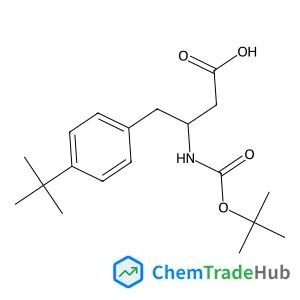
(S)-3-((tert-Butoxycarbonyl)amino)-4-(4-(tert-butyl)phenyl)butanoic acid
CAS番号:
403661-85-8
分子式:
C19H29NO4
おすすめサプライヤー




免責事項
このページに表示される学術雑誌情報は、参考および研究目的のみを目的としています。当社は雑誌出版社とは提携しておらず、投稿の取り扱いも行っておりません。出版に関するお問い合わせは、各雑誌出版社に直接ご連絡ください。
表示されている情報に誤りがある場合は、support@chemtradehub.com までご連絡ください。迅速に確認し、対応いたします。