



Influence of vibration in the reactive scattering of D + MuH: the effect of dynamical bonding
文献情報
出版日
2016-04-15
DOI
10.1039/C6CP01305H
インパクトファクター
3.676
著者
V. Sáez-Rábanos, J. E. Verdasco, F. J. Aoiz, V. J. Herrero
原文を見る
要旨
The dynamics of the D + MuH(v = 1) reaction has been investigated using time-independent quantum mechanical calculations. The total reaction cross sections and rate coefficients have been calculated for the two exit channels of the reaction leading, respectively, to DMu + H and DH + Mu. Over the 100–1000 K temperature range investigated the rate coefficients for the DMu + H channel are of the order of 10−10 cm3 s−1 and those for the DH + Mu channel vary between 1 × 10⁻¹² and 8 × 10⁻¹¹ cm3 s−1. These results point to a virtually barrierless reaction for the DMu + H channel and to the presence of a comparatively small barrier for the DH + Mu channel and are consistent with the profiles of their respective collinear vibrationally adiabatic potentials (VAPs). The effective barrier in the VAP of the DH + Mu channel is located in the reactant valley and, consequently, translation is found to be more efficient than vibration for the promotion of the reaction over a large energy interval in the post threshold region. Below this barrier, the DH + Mu channel can be accessible through an indirect mechanism implying crossing from the DMu + H pathway. The most salient feature found in the present study is revealed in the total reaction cross section for the DMu + H channel, which shows a sharp resonance caused by the presence of a deep well in the vibrationally adiabatic potential. This well has a dynamical origin, reminiscent of that found recently in the vibrationally bonded BrMuBr complex [Fleming, et al., Angew. Chem., Int. Ed., 2014, 53, 1], and is due to the stabilizing effect of the light Mu atom oscillating between the heavier H and D isotopes and to the bond softening associated with vibrational excitation of MuH.
おすすめジャーナル

Organic Process Research & Development

New Journal of Chemistry

Chemistry Education Research and Practice

Journal of Saudi Chemical Society

Russian Journal of General Chemistry

Saudi Pharmaceutical Journal

Journal of Peptide Science

Russian Journal of Organic Chemistry

Current Opinion in Solid State & Materials Science

Nature Medicine
関連文献
Stability of dye loaded faujasites against organic solvents: effect of SiCl4 treatment
Wolfgang F. Hölderich, Nadja Röhrlich, Peter Bartl, Laurent Chassot
2000-08-04
Paper
DOI: 10.1039/B003425H
Single crystal Raman microscopic study of the asbestos mineral chrysotile
Paper
DOI: 10.1039/A809238I
The structure of the water–hydrogen peroxide complex. A matrix isolation study
Anders Engdahl, Bengt Nelander
2000-08-29
Paper
DOI: 10.1039/B005861K
Polytriphenylamine derivatives as materials for hole transporting layers in electroluminescent devices
Paper
DOI: 10.1039/A808613C
Excited state proton and electron transfer reactions of acridinedione dyes with amines
Paper
DOI: 10.1039/A809070J
Electron transfer at a distance induced by site-selective photoionization of 2-aminopurine in oligonucleotides and investigated by transient absorption techniques
Vladimir Shafirovich, Alexander Dourandin, Weidong Huang, Natalia P. Luneva, Nicholas E. Geacintov
2000-09-15
Paper
DOI: 10.1039/B004896H
Ni–Ar complex studied by laser spectroscopy
Yasunobu Kawamoto, Kenji Honma
2000-08-21
Paper
DOI: 10.1039/B004714G
こちらもおすすめ
28770-01-62-(2-Isopropyl-1,3-o...
化合物よくある質問
「邻羟基阿托伐他汀内酯标准品」に適用される法規ガイドelinesは何ですか?
CAS番号163217-74-1の「邻羟基阿托伐他汀内酯标准品」は、GHS分類では危険物に分類されず、主にREACH規則とFDA/EPAの管理対象となります。R...
163217-74-1ortho-Hydroxy Atorva...
化合物よくある質問
メチル(3R)-3-アミノ-2,3-ジヒドロ-1-ベンゾファンラニン-5-カルボイル酸塩塩酸塩の主な用途は何ですか?
メチル(3R)-3-アミノ-2,3-ジヒドロ-1-ベンゾファンラニン-5-カルボイル酸塩塩酸塩は、医薬品や合成化学の研究に広く用いられます。また、特定の薬物の前...
2241594-15-8Methyl (3R)-3-amino-...
化合物よくある質問
トランス-4-メチルピロリジン-3-オール塩酸塩はどのように合成されますか?
トランス-4-メチルピロリジン-3-オール塩酸塩は、4-メチルピロリジンの塩酸塩化によって合成されます。一般的な合成方法では、4-メチルピロリジンを塩酸に加えて...
265108-42-7trans-4-Methylpyrrol...
化合物よくある質問
硫雜環丁烷-1,1-二氧化物は安全ですか?
硫雜環丁烷-1,1-二氧化物は安全ではありません。毒性は報告されていませんが、高温下で分解し、可燃性があるため、高圧ガスは注意が必要です。密閉した容器で保管し、...
5687-92-3Thietane 1,1-dioxide
6054-10-02H, 8H-Benzo[1,2-b
化合物よくある質問
9-ヒドロキシエリプチシネ塩酸塩はどのように合成されますか?
9-ヒドロキシエリプチシネ塩酸塩は、エリプチシネから塩酸を添加することで合成されます。選択性は高いですが、収率は約70%です。
52238-35-49-Hydroxyellipticine...
化合物よくある質問
5-塩素-2-(メチルアミノ)フェニル-(2-塩素フェニル)メタン酮の物理化学的性質は何ですか?
5-塩素-2-(メチルアミノ)フェニル-(2-塩素フェニル)メタン酮のCAS番号は5621-86-3です。この化合物は白色の結晶性粉末で、分子量は415.03で...
5621-86-3[5-Chloro-2-(methyla...
化合物よくある質問
1-[2-(4-甲氧基-苯氧基)-乙基]-哌嗪はどのように保存すればよいですか?
1-[2-(4-甲氧基-苯氧基)-乙基]-哌嗪は、直射日光を避けて暗所に、室温(15-25℃)で保管し、密閉容器に入れることで安定性を保つことができます。
117132-44-21-[2-(4-Methoxy-phen...
化合物よくある質問
2-[3-(4-甲氧基フェニル)プロピル]-4,4,5,5-四メチル-1,3,2-ドイボロロールアンの主な用途は何ですか?
2-[3-(4-甲氧基フェニル)プロピル]-4,4,5,5-四メチル-1,3,2-ドイボロロールアンは、医薬品の合成、有機合成化学、および新材料の研究で使用され...
1073371-72-82-[3-(4-Methoxypheny...
掲載誌
Physical Chemistry Chemical Physics

CiteScore:
5.5
自己引用率:
10.3%
年間論文数:
3036
Physical Chemistry Chemical Physics (PCCP) is an international journal co-owned by 19 physical chemistry and physics societies from around the world. This journal publishes original, cutting-edge research in physical chemistry, chemical physics and biophysical chemistry. To be suitable for publication in PCCP, articles must include significant innovation and/or insight into physical chemistry; this is the most important criterion that reviewers and Editors will judge against when evaluating submissions. The journal has a broad scope and welcomes contributions spanning experiment, theory, computation and data science. Topical coverage includes spectroscopy, dynamics, kinetics, statistical mechanics, thermodynamics, electrochemistry, catalysis, surface science, quantum mechanics, quantum computing and machine learning. Interdisciplinary research areas such as polymers and soft matter, materials, nanoscience, energy, surfaces/interfaces, and biophysical chemistry are welcomed if they demonstrate significant innovation and/or insight into physical chemistry. Joined experimental/theoretical studies are particularly appreciated when complementary and based on up-to-date approaches.
おすすめ化合物

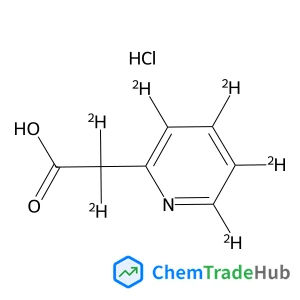
2,2-dideuterio-2-(3,4,5,6-tetradeuterio-2-pyridyl)acetic acid;hydrochloride
CAS番号:
1329799-67-8
分子式:
C7H2ClD6NO2
おすすめサプライヤー


免責事項
このページに表示される学術雑誌情報は、参考および研究目的のみを目的としています。当社は雑誌出版社とは提携しておらず、投稿の取り扱いも行っておりません。出版に関するお問い合わせは、各雑誌出版社に直接ご連絡ください。
表示されている情報に誤りがある場合は、support@chemtradehub.com までご連絡ください。迅速に確認し、対応いたします。