


Enhancement of two photon absorption properties and intersystem crossing by charge transfer in pentaaryl boron-dipyrromethene (BODIPY) derivatives
文献情報
出版日
2016-04-19
DOI
10.1039/C6CP01266C
インパクトファクター
3.676
著者
B. Küçüköz, G. Sevinç, E. Yildiz, A. Karatay, F. Zhong, H. Yılmaz, Y. Tutel, M. Hayvalı, J. Zhao, H. G. Yaglioglu
原文を見る
要旨
Novel BODIPY derivatives containing N,N-diphenylamine, 4-methoxyphenyl, 2,4-dimethoxyphenyl, triphenylamine, and 1-pyrene moieties were designed and synthesized for the first time by employing the palladium-catalyzed Suzuki–Miyaura coupling on pentaaryl boron dipyrromethene compounds. The effect of various moieties and charge transfer on linear and nonlinear optical absorption was investigated. It was found that moieties with strong electron donor properties and long conjugation lengths increase charge transfer and enhance intersystem crossing in the investigated compounds. Besides, the investigated compounds showed strong two photon absorption properties at near infrared wavelengths (800 nm and 900 nm), which is required for two photon photodynamic therapy. Two photon absorption cross section values were found to be 83, 454, 331, 472 and 413 GM for B1, B2, B3, B4 and B5 compounds at 800 nm wavelength, respectively. The highest two-photon absorption cross-section value was obtained for the B4 compound containing a triphenylamine moiety due to its more efficient charge transfer characteristics. Strong two-photon absorption properties in the near infrared region, efficient intersystem crossing and heavy atom free nature of the investigated compounds make them good candidates for two photon photodynamic therapy applications. We believe that this work will be one of the leading studies for two-photon photodynamic therapy applications of pentaaryl BODIPY derivatives.
おすすめジャーナル

Current Opinion in Solid State & Materials Science

Russian Journal of General Chemistry

Russian Chemical Bulletin

Acta Materialia

Crystallography Reports

Journal of Natural Medicines

New Journal of Chemistry

Chemistry Education Research and Practice

Journal of Peptide Science

Russian Journal of Coordination Chemistry
関連文献
Effect of hindered internal rotation treatments on predicting the thermodynamic properties of alkanes
Tanjin He
2019-01-03
Paper
DOI: 10.1039/C8CP07308B
Origin band of the first photoionizing transition of hydrogen isocyanide
Bérenger Gans, Gustavo A. Garcia, Séverine Boyé-Péronne, Stephen T. Pratt, Jean-Claude Guillemin, Alfredo Aguado, Octavio Roncero, Jean-Christophe Loison
2019-01-10
Paper
DOI: 10.1039/C8CP07737A
Which types of clay minerals fix cesium ions effectively? the “cavity-charge matching effect”
Takahiro Yamamoto, Tomoaki Takigawa, Takuya Fujimura, Tetsuya Shimada, Tamao Ishida, Haruo Inoue, Shinsuke Takagi
2019-04-01
Paper
DOI: 10.1039/C9CP00457B
Role of direct and inverted undoped spiro-OMeTAD–perovskite architectures in determining solar cells performances: an investigation via electrical impedance spectroscopy
Marianna Ambrico, Paolo F. Ambrico, Luisa De Marco, Rosabianca Iacobellis, Arianna D’Abramo, Teresa Ligonzo
2019-02-22
Paper
DOI: 10.1039/C9CP00564A
Photophysical properties of structural isomers of homoleptic Ir-complexes derived from xylenyl-substituted N-heterocyclic carbene ligands
Bo-Sun Yun, Jin-Hyoung Kim, So-Yoen Kim, Ho-Jin Son, Sang Ook Kang
2019-03-06
Paper
DOI: 10.1039/C9CP00553F
Far-IR and UV spectral signatures of controlled complexation and microhydration of the polycyclic aromatic hydrocarbon acenaphthene
Jens Antony, Stefan Grimme, Anouk M. Rijs
2018-10-11
Paper
DOI: 10.1039/C8CP04480E
Controllable design of double metal oxide (NiCo2O4)-modified CdS for efficient photocatalytic hydrogen production
2019-01-23
Paper
DOI: 10.1039/C8CP07275B
Suppressing depolarization by tail substitution in an organic supramolecular ferroelectric
Indre Urbanaviciute, Subham Bhattacharjee, Michal Biler, Jody A. M. Lugger, Tim D. Cornelissen, Patrick Norman, Rint P. Sijbesma, Martijn Kemerink
2019-01-02
Paper
DOI: 10.1039/C8CP06315J
Intrinsic effects of strain on low-index surfaces of platinum: roles of the five 5d orbitals
Xingqun Zheng, Li Li, Jing Li, Zidong Wei
2019-01-18
Paper
DOI: 10.1039/C8CP07556E
Piezo-phototronic effect-modulated carrier transport behavior in different regions of a Si/CdS heterojunction photodetector under a Vis–NIR waveband
Zhi-Hao Zhao, Yejing Dai
2019-04-10
Paper
DOI: 10.1039/C9CP00415G
こちらもおすすめ
28770-01-62-(2-Isopropyl-1,3-o...
化合物よくある質問
「邻羟基阿托伐他汀内酯标准品」に適用される法規ガイドelinesは何ですか?
CAS番号163217-74-1の「邻羟基阿托伐他汀内酯标准品」は、GHS分類では危険物に分類されず、主にREACH規則とFDA/EPAの管理対象となります。R...
163217-74-1ortho-Hydroxy Atorva...
化合物よくある質問
メチル(3R)-3-アミノ-2,3-ジヒドロ-1-ベンゾファンラニン-5-カルボイル酸塩塩酸塩の主な用途は何ですか?
メチル(3R)-3-アミノ-2,3-ジヒドロ-1-ベンゾファンラニン-5-カルボイル酸塩塩酸塩は、医薬品や合成化学の研究に広く用いられます。また、特定の薬物の前...
2241594-15-8Methyl (3R)-3-amino-...
化合物よくある質問
トランス-4-メチルピロリジン-3-オール塩酸塩はどのように合成されますか?
トランス-4-メチルピロリジン-3-オール塩酸塩は、4-メチルピロリジンの塩酸塩化によって合成されます。一般的な合成方法では、4-メチルピロリジンを塩酸に加えて...
265108-42-7trans-4-Methylpyrrol...
化合物よくある質問
硫雜環丁烷-1,1-二氧化物は安全ですか?
硫雜環丁烷-1,1-二氧化物は安全ではありません。毒性は報告されていませんが、高温下で分解し、可燃性があるため、高圧ガスは注意が必要です。密閉した容器で保管し、...
5687-92-3Thietane 1,1-dioxide
6054-10-02H, 8H-Benzo[1,2-b
化合物よくある質問
9-ヒドロキシエリプチシネ塩酸塩はどのように合成されますか?
9-ヒドロキシエリプチシネ塩酸塩は、エリプチシネから塩酸を添加することで合成されます。選択性は高いですが、収率は約70%です。
52238-35-49-Hydroxyellipticine...
化合物よくある質問
5-塩素-2-(メチルアミノ)フェニル-(2-塩素フェニル)メタン酮の物理化学的性質は何ですか?
5-塩素-2-(メチルアミノ)フェニル-(2-塩素フェニル)メタン酮のCAS番号は5621-86-3です。この化合物は白色の結晶性粉末で、分子量は415.03で...
5621-86-3[5-Chloro-2-(methyla...
化合物よくある質問
1-[2-(4-甲氧基-苯氧基)-乙基]-哌嗪はどのように保存すればよいですか?
1-[2-(4-甲氧基-苯氧基)-乙基]-哌嗪は、直射日光を避けて暗所に、室温(15-25℃)で保管し、密閉容器に入れることで安定性を保つことができます。
117132-44-21-[2-(4-Methoxy-phen...
化合物よくある質問
2-[3-(4-甲氧基フェニル)プロピル]-4,4,5,5-四メチル-1,3,2-ドイボロロールアンの主な用途は何ですか?
2-[3-(4-甲氧基フェニル)プロピル]-4,4,5,5-四メチル-1,3,2-ドイボロロールアンは、医薬品の合成、有機合成化学、および新材料の研究で使用され...
1073371-72-82-[3-(4-Methoxypheny...
掲載誌
Physical Chemistry Chemical Physics

CiteScore:
5.5
自己引用率:
10.3%
年間論文数:
3036
Physical Chemistry Chemical Physics (PCCP) is an international journal co-owned by 19 physical chemistry and physics societies from around the world. This journal publishes original, cutting-edge research in physical chemistry, chemical physics and biophysical chemistry. To be suitable for publication in PCCP, articles must include significant innovation and/or insight into physical chemistry; this is the most important criterion that reviewers and Editors will judge against when evaluating submissions. The journal has a broad scope and welcomes contributions spanning experiment, theory, computation and data science. Topical coverage includes spectroscopy, dynamics, kinetics, statistical mechanics, thermodynamics, electrochemistry, catalysis, surface science, quantum mechanics, quantum computing and machine learning. Interdisciplinary research areas such as polymers and soft matter, materials, nanoscience, energy, surfaces/interfaces, and biophysical chemistry are welcomed if they demonstrate significant innovation and/or insight into physical chemistry. Joined experimental/theoretical studies are particularly appreciated when complementary and based on up-to-date approaches.
おすすめ化合物
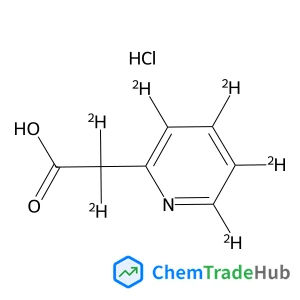
2,2-dideuterio-2-(3,4,5,6-tetradeuterio-2-pyridyl)acetic acid;hydrochloride
CAS番号:
1329799-67-8
分子式:
C7H2ClD6NO2
おすすめサプライヤー





免責事項
このページに表示される学術雑誌情報は、参考および研究目的のみを目的としています。当社は雑誌出版社とは提携しておらず、投稿の取り扱いも行っておりません。出版に関するお問い合わせは、各雑誌出版社に直接ご連絡ください。
表示されている情報に誤りがある場合は、support@chemtradehub.com までご連絡ください。迅速に確認し、対応いたします。