


![[(1S,2S,3R,4S,7R,9S,10S,12R,15S)-4,12-Diacetyloxy-15-[(2R,3S)-3-benzamido-3-phenyl-2-(2,2,2-trichloroethoxycarbonyloxy)propanoyl]oxy-1,9-dihydroxy-10,14,17,17-tetramethyl-11-oxo-6-oxatetracyclo[11.3.1.03,10.04,7]heptadec-13-en-2-yl] benzoate structure](https://static.chemtradehub.com/structs/100/100431-55-8-7104.webp "[(1S,2S,3R,4S,7R,9S,10S,12R,15S)-4,12-Diacetyloxy-15-[(2R,3S)-3-benzamido-3-phenyl-2-(2,2,2-trichloroethoxycarbonyloxy)propanoyl]oxy-1,9-dihydroxy-10,14,17,17-tetramethyl-11-oxo-6-oxatetracyclo[11.3.1.03,10.04,7]heptadec-13-en-2-yl] benzoate structure")
Analysis of constant tension-induced rupture of lipid membranes using activation energy
文献情報
出版日
2016-04-15
DOI
10.1039/C6CP01184E
インパクトファクター
3.676
著者
Mohammad Abu Sayem Karal, Victor Levadnyy
原文を見る
要旨
The stretching of biomembranes and lipid membranes plays important roles in various physiological and physicochemical phenomena. Here we analyzed the rate constant kp of constant tension-induced rupture of giant unilamellar vesicles (GUVs) as a function of tension σ using their activation energy Ua. To determine the values of kp, we applied constant tension to a GUV membrane using the micropipette aspiration method and observed the rupture of GUVs, and then analyzed these data statistically. First, we investigated the temperature dependence of kp for GUVs of charged lipid membranes composed of negatively charged dioleoylphosphatidylglycerol (DOPG) and electrically neutral dioleoylphosphatidylcholine (DOPC). By analyzing this result, the values of Ua of tension-induced rupture of DOPG/DOPC-GUVs were obtained. Ua decreased with an increase in σ, supporting the classical theory of tension-induced pore formation. The analysis of the relationship between Ua and σ using the theory on the electrostatic interaction effects on the tension-induced rupture of GUVs provided the equation of Ua including electrostatic interaction effects, which well fits the experimental data of the tension dependence of Ua. A constant which does not depend on tension, U0, was also found to contribute significantly to Ua. The Arrhenius equations for kp using the equation of Ua and the parameters determined by the above analysis fit well to the experimental data of the tension dependence of kp for DOPG/DOPC-GUVs as well as for DOPC-GUVs. On the basis of these results, we discussed the possible elementary processes underlying the tension-induced rupture of GUVs of lipid membranes. These results indicate that the Arrhenius equation using the experimentally determined Ua is useful in the analysis of tension-induced rupture of GUVs.
おすすめジャーナル

Russian Journal of Coordination Chemistry

New Journal of Chemistry

Chemistry Education Research and Practice

Russian Journal of Bioorganic Chemistry

Journal of Natural Medicines

Crystallography Reports

Current Opinion in Colloid & Interface Science

Russian Journal of Organic Chemistry

Russian Journal of General Chemistry

Chemical Communications
関連文献
Theoretical study of methane adsorption on Zn(II) zeolites
Luis A. M. M. Barbosa, Georgii M. Zhidomirov, Rutger A. van Santen
2000-08-15
Paper
DOI: 10.1039/B004090H
Effect of 1-alkanols on the native conformation of Lysozyme
Vania Calandrini, Giuseppe Onori, Aldo Santucci
2000-08-25
Paper
DOI: 10.1039/B003746J
Chloroform encapsulated in p-tert-butylcalix[4]arene: Structure and dynamics
2000-08-25
Paper
DOI: 10.1039/B004924G
Polytriphenylamine derivatives as materials for hole transporting layers in electroluminescent devices
Paper
DOI: 10.1039/A808613C
Self-healing hydrophobic POSS-functionalized fluorinated copolymers via RAFT polymerization and dynamic Diels–Alder reaction
Prantik Mondal, Thomas Becker, Richard Hoogenboom, Andrew B. Lowe, Nikhil K. Singha
2020-12-28
Paper
DOI: 10.1039/D0PY01522A
Stability of dye loaded faujasites against organic solvents: effect of SiCl4 treatment
Wolfgang F. Hölderich, Nadja Röhrlich, Peter Bartl, Laurent Chassot
2000-08-04
Paper
DOI: 10.1039/B003425H
An inelastic neutron scattering spectroscopic investigation of the adsorption of ethene and propene on carbon
David Lennon, John McNamara, Jon R. Phillips, Richard M. Ibberson, Stewart F. Parker
2000-09-06
Paper
DOI: 10.1039/B005144F
Experimental characterization of aircraft combustor soot: Microstructure, surface area, porosity and water adsorption
O. B. Popovitcheva, N. M. Persiantseva, M. E. Trukhin, G. B. Rulev, N. K. Shonija, Yu. Ya. Buriko, A. M. Starik, B. Demirdjian, D. Ferry, J. Suzanne
2000-09-15
Paper
DOI: 10.1039/B004345L
こちらもおすすめ
28770-01-62-(2-Isopropyl-1,3-o...
化合物よくある質問
「邻羟基阿托伐他汀内酯标准品」に適用される法規ガイドelinesは何ですか?
CAS番号163217-74-1の「邻羟基阿托伐他汀内酯标准品」は、GHS分類では危険物に分類されず、主にREACH規則とFDA/EPAの管理対象となります。R...
163217-74-1ortho-Hydroxy Atorva...
化合物よくある質問
メチル(3R)-3-アミノ-2,3-ジヒドロ-1-ベンゾファンラニン-5-カルボイル酸塩塩酸塩の主な用途は何ですか?
メチル(3R)-3-アミノ-2,3-ジヒドロ-1-ベンゾファンラニン-5-カルボイル酸塩塩酸塩は、医薬品や合成化学の研究に広く用いられます。また、特定の薬物の前...
2241594-15-8Methyl (3R)-3-amino-...
化合物よくある質問
トランス-4-メチルピロリジン-3-オール塩酸塩はどのように合成されますか?
トランス-4-メチルピロリジン-3-オール塩酸塩は、4-メチルピロリジンの塩酸塩化によって合成されます。一般的な合成方法では、4-メチルピロリジンを塩酸に加えて...
265108-42-7trans-4-Methylpyrrol...
化合物よくある質問
硫雜環丁烷-1,1-二氧化物は安全ですか?
硫雜環丁烷-1,1-二氧化物は安全ではありません。毒性は報告されていませんが、高温下で分解し、可燃性があるため、高圧ガスは注意が必要です。密閉した容器で保管し、...
5687-92-3Thietane 1,1-dioxide
6054-10-02H, 8H-Benzo[1,2-b
化合物よくある質問
9-ヒドロキシエリプチシネ塩酸塩はどのように合成されますか?
9-ヒドロキシエリプチシネ塩酸塩は、エリプチシネから塩酸を添加することで合成されます。選択性は高いですが、収率は約70%です。
52238-35-49-Hydroxyellipticine...
化合物よくある質問
5-塩素-2-(メチルアミノ)フェニル-(2-塩素フェニル)メタン酮の物理化学的性質は何ですか?
5-塩素-2-(メチルアミノ)フェニル-(2-塩素フェニル)メタン酮のCAS番号は5621-86-3です。この化合物は白色の結晶性粉末で、分子量は415.03で...
5621-86-3[5-Chloro-2-(methyla...
化合物よくある質問
1-[2-(4-甲氧基-苯氧基)-乙基]-哌嗪はどのように保存すればよいですか?
1-[2-(4-甲氧基-苯氧基)-乙基]-哌嗪は、直射日光を避けて暗所に、室温(15-25℃)で保管し、密閉容器に入れることで安定性を保つことができます。
117132-44-21-[2-(4-Methoxy-phen...
化合物よくある質問
2-[3-(4-甲氧基フェニル)プロピル]-4,4,5,5-四メチル-1,3,2-ドイボロロールアンの主な用途は何ですか?
2-[3-(4-甲氧基フェニル)プロピル]-4,4,5,5-四メチル-1,3,2-ドイボロロールアンは、医薬品の合成、有機合成化学、および新材料の研究で使用され...
1073371-72-82-[3-(4-Methoxypheny...
掲載誌
Physical Chemistry Chemical Physics

CiteScore:
5.5
自己引用率:
10.3%
年間論文数:
3036
Physical Chemistry Chemical Physics (PCCP) is an international journal co-owned by 19 physical chemistry and physics societies from around the world. This journal publishes original, cutting-edge research in physical chemistry, chemical physics and biophysical chemistry. To be suitable for publication in PCCP, articles must include significant innovation and/or insight into physical chemistry; this is the most important criterion that reviewers and Editors will judge against when evaluating submissions. The journal has a broad scope and welcomes contributions spanning experiment, theory, computation and data science. Topical coverage includes spectroscopy, dynamics, kinetics, statistical mechanics, thermodynamics, electrochemistry, catalysis, surface science, quantum mechanics, quantum computing and machine learning. Interdisciplinary research areas such as polymers and soft matter, materials, nanoscience, energy, surfaces/interfaces, and biophysical chemistry are welcomed if they demonstrate significant innovation and/or insight into physical chemistry. Joined experimental/theoretical studies are particularly appreciated when complementary and based on up-to-date approaches.
おすすめ化合物
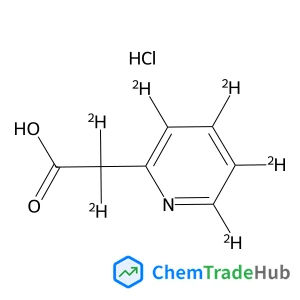
2,2-dideuterio-2-(3,4,5,6-tetradeuterio-2-pyridyl)acetic acid;hydrochloride
CAS番号:
1329799-67-8
分子式:
C7H2ClD6NO2

おすすめサプライヤー





免責事項
このページに表示される学術雑誌情報は、参考および研究目的のみを目的としています。当社は雑誌出版社とは提携しておらず、投稿の取り扱いも行っておりません。出版に関するお問い合わせは、各雑誌出版社に直接ご連絡ください。
表示されている情報に誤りがある場合は、support@chemtradehub.com までご連絡ください。迅速に確認し、対応いたします。