



A closer examination of the coupling between ionic hydrogen bond (IHB) stretching and flanking group motions in (CH3OH)2H+: the strong isotope effects
文献情報
出版日
2016-04-28
DOI
10.1039/C6CP00309E
インパクトファクター
3.676
著者
原文を見る
要旨
The intermode coupling between shared proton (O–H+–O) fundamental stretching and flanking modes in (CH3OH)2H+ was revisited in the following contexts: (1) evaluation of Hamiltonian matrix elements represented in a “pure state” (PS) basis and (2) tuning of coupling strengths using H/D isotopic substitution. We considered four experimentally accessible isotopologues for this study. These are: (CH3OH)2H+, (CD3OH)2H+, (CH3OD)2D+, and (CD3OD)2D+. Potential energy surfaces (PESs), as well as dipole moment surfaces (DMSs), were constructed at the MP2/aug-cc-pVDZ level. Multidimensional vibrational calculations were conducted by solving a reduced dimensional Schrödinger equation using a discrete variable representation (DVR). We found that vibrational states in (CH3OH)2H+ and (CD3OH)2H+ are much more heavily mixed than those in (CH3OD)2D+ and (CD3OD)2D+. Furthermore, each isotopologue chooses to strongly couple between out-of-phase in-plane CH3 rocking and its out-of-plane counterpart. Lastly, the interaction between O–O stretching and O–H+–O stretching was explored. We found that between the first overtone of O–O stretching and its combination tone with O–H+–O fundamental stretching, only the second couples with O–H+–O fundamental stretching. We hope that our isotopologue calculations would motivate experimentalists to measure them in the future.
おすすめジャーナル

Organic Process Research & Development

Drug Discovery Today

Current Opinion in Solid State & Materials Science

Russian Journal of Applied Chemistry

Journal of Natural Medicines

Russian Journal of Coordination Chemistry

Russian Journal of Bioorganic Chemistry

Nature Medicine

Current Opinion in Colloid & Interface Science

Chemical Communications
関連文献
Adsorption of CO2 on FSM-type mesoporous silicas
Masahiro Katoh, Keiichi Sakamoto, Mituo Kamiyamane, Tahei Tomida
2000-09-05
Paper
DOI: 10.1039/B004505P
Modelling flow-distributed oscillations in the CDIMA reaction
Serafim Kalliadasis, John H. Merkin
2000-09-04
Paper
DOI: 10.1039/B004552G
Effect of 1-alkanols on the native conformation of Lysozyme
Vania Calandrini, Giuseppe Onori, Aldo Santucci
2000-08-25
Paper
DOI: 10.1039/B003746J
Evaluation of vibrational partition functions for polyatomic systems: quantum ersus classical methods for H2O and Ar···CN
Antonio Riganelli, Frederico V. Prudente, António J. C. Varandas
2000-05-18
Paper
DOI: 10.1039/B001746I
RAIRS of small alkynes on Pd(100)
John P. Camplin, Jemimah K. Eve, Elaine M. McCash
2000-09-06
Paper
DOI: 10.1039/B004344N
CeO2–La2O3 catalytic system Part I. Preparation and characterisation of catalysts
G. Colón, J. A. Navío, R. Monaci, I. Ferino
2000-09-15
Paper
DOI: 10.1039/B002815K
The role of onium salts in the oxidation of hydrocarbons by O2 catalysed by cationic phase-transfer reagents
László J. Csányi, Károly Jáky, István Pálinkó, Antal Rockenbauer, László Korecz
2000-08-04
Paper
DOI: 10.1039/B002558P
こちらもおすすめ
28770-01-62-(2-Isopropyl-1,3-o...
化合物よくある質問
「邻羟基阿托伐他汀内酯标准品」に適用される法規ガイドelinesは何ですか?
CAS番号163217-74-1の「邻羟基阿托伐他汀内酯标准品」は、GHS分類では危険物に分類されず、主にREACH規則とFDA/EPAの管理対象となります。R...
163217-74-1ortho-Hydroxy Atorva...
化合物よくある質問
メチル(3R)-3-アミノ-2,3-ジヒドロ-1-ベンゾファンラニン-5-カルボイル酸塩塩酸塩の主な用途は何ですか?
メチル(3R)-3-アミノ-2,3-ジヒドロ-1-ベンゾファンラニン-5-カルボイル酸塩塩酸塩は、医薬品や合成化学の研究に広く用いられます。また、特定の薬物の前...
2241594-15-8Methyl (3R)-3-amino-...
化合物よくある質問
トランス-4-メチルピロリジン-3-オール塩酸塩はどのように合成されますか?
トランス-4-メチルピロリジン-3-オール塩酸塩は、4-メチルピロリジンの塩酸塩化によって合成されます。一般的な合成方法では、4-メチルピロリジンを塩酸に加えて...
265108-42-7trans-4-Methylpyrrol...
化合物よくある質問
硫雜環丁烷-1,1-二氧化物は安全ですか?
硫雜環丁烷-1,1-二氧化物は安全ではありません。毒性は報告されていませんが、高温下で分解し、可燃性があるため、高圧ガスは注意が必要です。密閉した容器で保管し、...
5687-92-3Thietane 1,1-dioxide
6054-10-02H, 8H-Benzo[1,2-b
化合物よくある質問
9-ヒドロキシエリプチシネ塩酸塩はどのように合成されますか?
9-ヒドロキシエリプチシネ塩酸塩は、エリプチシネから塩酸を添加することで合成されます。選択性は高いですが、収率は約70%です。
52238-35-49-Hydroxyellipticine...
化合物よくある質問
5-塩素-2-(メチルアミノ)フェニル-(2-塩素フェニル)メタン酮の物理化学的性質は何ですか?
5-塩素-2-(メチルアミノ)フェニル-(2-塩素フェニル)メタン酮のCAS番号は5621-86-3です。この化合物は白色の結晶性粉末で、分子量は415.03で...
5621-86-3[5-Chloro-2-(methyla...
化合物よくある質問
1-[2-(4-甲氧基-苯氧基)-乙基]-哌嗪はどのように保存すればよいですか?
1-[2-(4-甲氧基-苯氧基)-乙基]-哌嗪は、直射日光を避けて暗所に、室温(15-25℃)で保管し、密閉容器に入れることで安定性を保つことができます。
117132-44-21-[2-(4-Methoxy-phen...
化合物よくある質問
2-[3-(4-甲氧基フェニル)プロピル]-4,4,5,5-四メチル-1,3,2-ドイボロロールアンの主な用途は何ですか?
2-[3-(4-甲氧基フェニル)プロピル]-4,4,5,5-四メチル-1,3,2-ドイボロロールアンは、医薬品の合成、有機合成化学、および新材料の研究で使用され...
1073371-72-82-[3-(4-Methoxypheny...
掲載誌
Physical Chemistry Chemical Physics

CiteScore:
5.5
自己引用率:
10.3%
年間論文数:
3036
Physical Chemistry Chemical Physics (PCCP) is an international journal co-owned by 19 physical chemistry and physics societies from around the world. This journal publishes original, cutting-edge research in physical chemistry, chemical physics and biophysical chemistry. To be suitable for publication in PCCP, articles must include significant innovation and/or insight into physical chemistry; this is the most important criterion that reviewers and Editors will judge against when evaluating submissions. The journal has a broad scope and welcomes contributions spanning experiment, theory, computation and data science. Topical coverage includes spectroscopy, dynamics, kinetics, statistical mechanics, thermodynamics, electrochemistry, catalysis, surface science, quantum mechanics, quantum computing and machine learning. Interdisciplinary research areas such as polymers and soft matter, materials, nanoscience, energy, surfaces/interfaces, and biophysical chemistry are welcomed if they demonstrate significant innovation and/or insight into physical chemistry. Joined experimental/theoretical studies are particularly appreciated when complementary and based on up-to-date approaches.
おすすめ化合物
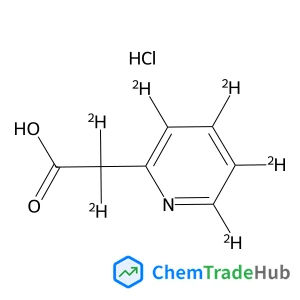
2,2-dideuterio-2-(3,4,5,6-tetradeuterio-2-pyridyl)acetic acid;hydrochloride
CAS番号:
1329799-67-8
分子式:
C7H2ClD6NO2

おすすめサプライヤー





免責事項
このページに表示される学術雑誌情報は、参考および研究目的のみを目的としています。当社は雑誌出版社とは提携しておらず、投稿の取り扱いも行っておりません。出版に関するお問い合わせは、各雑誌出版社に直接ご連絡ください。
表示されている情報に誤りがある場合は、support@chemtradehub.com までご連絡ください。迅速に確認し、対応いたします。