












![2,4-Dichloro-6-isopropyl-5H-pyrrolo[3,4-d]pyrimidin-7(6H)-one structure](https://static.chemtradehub.com/structs/107/1079649-94-7-ad4a.webp "2,4-Dichloro-6-isopropyl-5H-pyrrolo[3,4-d]pyrimidin-7(6H)-one structure")
Surfactant-free synthesis of three-dimensional nitrogen-doped hierarchically porous carbon and its application as an electrode modification material for simultaneous sensing of ascorbic acid, dopamine and uric acid
文献情報
出版日
2017-01-05
DOI
10.1039/C6AN02584F
インパクトファクター
4.616
著者
Suping Li, Pan Hui, Zhongyuan Liu, Guobao Xu
原文を見る
要旨
Three-dimensional N-doped hierarchically porous carbon (3D NHPC) was synthesized successfully without using any surfactant or etching agent. This simple and effective synthesis method was accomplished by solvothermal synthesis followed by pyrolysis. The physical morphology and chemical composition of 3D NHPC were verified by scanning electron microscopy, nitrogen adsorption–desorption, and X-ray photoelectron spectroscopy. Its structural studies reveal that it exhibits a micro–mesoporous hierarchical structure and contains C, O and N atoms forming different functional groups. The characterization also reveals that 3D NHPC has a Brunauer–Emmett–Teller (BET) surface area of 594.774 m2 g−1 and the micropore volume was calculated to be 0.192 cm3 g−1 using the t-plot method. Its catalytic activity was investigated by studying its application for simultaneous determination of ascorbic acid (AA), dopamine (DA) and uric acid (UA) by cyclic voltammetry and square-wave voltammetry at physiological pH. A 3D NHPC-modified glassy carbon electrode exhibits linear ranges from 0.05 to 14.50 μM, 1.0 to 120.0 μM, and 2.0 to 30.0 μM for DA, AA and UA, respectively. It also exhibits low detection limits (0.02, 0.10, and 0.14 μM for DA, AA, and UA, respectively), good reproducibility and stability. The urine sample analysis results show good recoveries ranging between 96.30% and 105.40%.
関連文献
Effect of water nanoconfinement on the dynamic properties of paramagnetic colloidal complexes
Luca Bergamasco, Matteo Morciano, Matteo Fasano
2021-08-02
Paper
DOI: 10.1039/D1CP00708D
Modeling the impedance response and steady state behaviour of porous CGO-based MIEC anodes
Philip Marmet, Lorenz Holzer, Jan G. Grolig, Holger Bausinger, Andreas Mai, Joseph M. Brader, Thomas Hocker
2021-10-06
Paper
DOI: 10.1039/D1CP01962G
Generation, contraction, and polarisation of Gaussian basis sets for atomic and molecular calculations using the generator coordinate method with polynomial discretisation: atoms from Na through Cl
Amanda R. Guimarães, Rugles C. Barbosa, Ana Cristina Mora Tello, Aldineia P. da Silva, Júlia M. A. Alves, Milena Palhares Maringolo, Albérico B. F. da Silva
2021-07-23
Paper
DOI: 10.1039/D1CP01879E
Single sheets of graphene for fabrication of fibers with enhanced mechanical properties
Muhammad G. Salim, Luke A. Thimons, Min A. Kim, Brennan Carr, Michelle Montgomery, Nathan Tolman, Tevis D. B. Jacobs, Haitao Liu
2021-09-20
Paper
DOI: 10.1039/D1CP03238K
Robustness and accuracy improvement of data processing with 2D neural networks for transient absorption dynamics
Ruixuan Zhao, Daxin Wu, Jiao Wen, Qi Zhang, Guanglei Zhang, Jiebo Li
2021-07-16
Paper
DOI: 10.1039/D1CP02521J
Effects of substituent position on aminobenzoate relaxation pathways in solution
Jack M. Woolley, Konstantina M. Krokidi, Maria A. Tesa-Serrate, Nicholas D. M. Hine, Vasilios G. Stavros
2021-10-06
Paper
DOI: 10.1039/D1CP03759E
Active Brownian particle in homogeneous media of different viscosities: numerical simulations
E. A. Lisin, O. S. Vaulina, I. I. Lisina, O. F. Petrov
2021-07-26
Paper
DOI: 10.1039/D1CP02511B
Self-standing, conducting and capacitive biomimetic hybrid nanomembranes for selective molecular ion separation
Catherine Michaux, Eric A. Perpète, David Zanuy
2021-07-05
Paper
DOI: 10.1039/D1CP01840J
Regression and clustering algorithms for AgCu nanoalloys: from mixing energy predictions to structure recognition
Cesare Roncaglia, Daniele Rapetti, Riccardo Ferrando
2021-10-11
Paper
DOI: 10.1039/D1CP02143E
Formation of dimethyl carbonate via direct esterification of CO2 with methanol on reduced or stoichiometric CeO2(111) and (110) surfaces
Jian Jiang, Chris M. Marin, Avinash Kumar Both, Chin Li Cheung, Lei Li, Xiao Cheng Zeng
2021-07-19
Paper
DOI: 10.1039/D1CP02152D
こちらもおすすめ
化合物よくある質問
4-アミノフェノール酸ナトリウム水和物とは何ですか?
4-アミノフェノール酸ナトリウム水和物は、CAS番号206557-08-6の化合物で、4-アミノフェノールとナトリウムが結合した塩と水和物です。この化合物は、白...
206557-08-64-Aminobenzoic acid ...
化合物よくある質問
Methyl 3-methyl-N-{[(2-methyl-2-propanyl)oxy]carbonyl}-L-histidinateの代替品はありますか?
この化合物は特定の合成プロセスに使用される可能性がありますが、代替品として、他の类似的な化合物、例えばMethyl 3-methyl-N-{[(2-methyl...
72212-51-2Methyl 3-methyl-N-{[...
化合物よくある質問
4-Boc-2-哌嗪甲酸の市場動向や研究トレンドはどうですか?
4-Boc-2-哌嗪甲酸は、薬品開発や合成化学分野で広く使用されており、その需要は継続的に推移しています。特に、新薬開発における合成化学分野での需要が高まってい...
192330-11-3(2R)-4-[(tert-butoxy...
化合物よくある質問
4,4'-二羟甲基联苯の物理化学的性質は何ですか?
4,4'-二羟甲基联苯のCAS番号は1667-12-5です。この化合物は白色の結晶粉末で、分子量は154.20です。水にわずかに溶けますが、アルコールや有機溶媒...
1667-12-54,4'-Biphenyldiyldim...
化合物よくある質問
5-甲硫基戊腈はどの業界で使用されていますか?
5-甲硫基戊腈は医薬品産業で使用される可能性があります。また、ポリマー合成の触媒として、センサー製造の一部として、半導体製造のプロセス改善に使用される可能性があ...
59121-25-45-(Methylsulfanyl)pe...
化合物よくある質問
CAS番号1311961-50-8の化合物はどのように合成されますか?
この化合物は、1-abieta-8,11,13-trien-19-イルと6'-メトキシシンコナナン-9-基を含有する窒素含有化合物から合成されます。一般的な合成...
1311961-50-81-Abieta-8,11,13-tri...
化合物よくある質問
6-ブロモベンジジミダゾール-2-カルビルデオキシドはどのように保存すればよいですか?
6-ブロモベンジジミダゾール-2-カルビルデオキシドは、避光・乾燥した容器(密閉容器)で-20℃~4℃の低温で保存してください。高温や直射日光、湿気は避けてくだ...
885280-26-25-Bromo-1H-benzimida...
化合物よくある質問
Boc-N-甲基氨甲环酸とは何ですか?
621-65-8のCAS番号を持つBoc-N-甲基氨甲环酸は、化学式C7H13NO5を有する化合物です。この化合物は白色の結晶性粉末で、吸湿性があります。
621-65-83-Hydroxy-1,2-propan...
化合物よくある質問
乙基三氟硼酸钾はどのように合成されますか?
乙基三氟硼酸钾は、トリフLUオール酸カリウムとエチルブロミドを反応させて合成されます。この反応は高い選択性と収率を持ち、触媒を用いることで効率的に進行します。
882871-21-8Potassium ethyltrifl...
化合物よくある質問
2-フロウロ-5-クロロ-4-アミノフェノールはどのように保存すればよいですか?
2-フロウロ-5-クロロ-4-アミノフェノールは、直射日光を避けて冷却された暗所で保存し、密閉容器に保管してください。温度は常温か低温が適しています。
847872-10-04-Amino-5-chloro-2-f...
掲載誌
Analyst

CiteScore:
7.8
自己引用率:
5.6%
年間論文数:
653
Analyst publishes analytical and bioanalytical research that reports premier fundamental discoveries and inventions, and the applications of those discoveries, unconfined by traditional discipline barriers.
おすすめ化合物
![[3-(2,6-Dichlorophenyl)-5-isopropyl-1,2-oxazol-4-yl]methanol structure](https://static.chemtradehub.com/structs/278/278597-30-1-5c79.webp "[3-(2,6-Dichlorophenyl)-5-isopropyl-1,2-oxazol-4-yl]methanol structure")
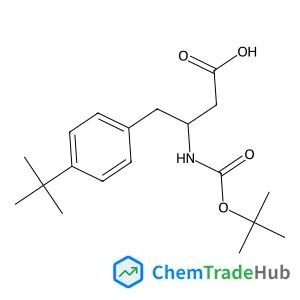
(S)-3-((tert-Butoxycarbonyl)amino)-4-(4-(tert-butyl)phenyl)butanoic acid
CAS番号:
403661-85-8
分子式:
C19H29NO4
おすすめサプライヤー




免責事項
このページに表示される学術雑誌情報は、参考および研究目的のみを目的としています。当社は雑誌出版社とは提携しておらず、投稿の取り扱いも行っておりません。出版に関するお問い合わせは、各雑誌出版社に直接ご連絡ください。
表示されている情報に誤りがある場合は、support@chemtradehub.com までご連絡ください。迅速に確認し、対応いたします。