












An isothermal electrochemical biosensor for the sensitive detection of microRNA based on a catalytic hairpin assembly and supersandwich amplification
文献情報
出版日
2016-12-12
DOI
10.1039/C6AN02390H
インパクトファクター
4.616
著者
Hua Zhang, Qing Wang, Xiaohai Yang, Kemin Wang, Qing Li, Zhiping Li, Lei Gao, Wenyan Nie, Yan Zheng
原文を見る
要旨
A novel isothermal electrochemical biosensor was proposed for the sensitive detection of microRNA (miRNA) based on the ingenious combination of the target-catalyzed hairpin assembly (CHA) and supersandwich amplification strategies. Since miRNA-221 has been reported to be overexpressed in cancers and has been a potentially useful biomarker for the diagnosis of the related diseases, miRNA-221 was chosen as a model target miRNA. The target miRNA-221 triggered a toehold strand displacement assembly of the two hairpin substrates, which led to the cyclicality of the target miRNA and the CHA products. Subsequently, the CHA products hybridized with a capture probe on the electrode and the exposed stem of the CHA products was further used to propagate the supersandwich. After this, the signal probe was modified with horseradish peroxidase (HRP) to form a supersandwich multiplex HRP–DNA label, which could achieve an amplified electrochemical signal. Using the isothermal dual signal amplification strategies, miRNA-221 as low as 0.6 pM (3σ) could be detected. In addition, this biosensor showed high selectivity and could discriminate miRNA-221 from the homologous miRNAs. Note that human miRNA from cancer cells could also be detected and the results were in excellent agreement with those obtained using qRT-PCR. Given that the biosensor avoided the introduction of nanoparticles, the limitation of using the nanoparticles was overcome. The proposed biosensor has great potential for broad applications in the field of clinical analysis.
関連文献
Local structure and NO adsorption/desorption property of Pd2+ cations at different paired Al sites in CHA zeolite
Shunsaku Yasumura, Taihei Ueda, Hajime Ide, Katsumasa Otsubo, Chong Liu, Nao Tsunoji, Zen Maeno
2021-08-12
Paper
DOI: 10.1039/D1CP02668B
Phase analysis of tungsten and phonon behavior of beryllium layers in W/Be periodic multilayers
Niranjan Kumar, Roman S. Pleshkov, Aleksey V. Nezhdanov, Vladimir N. Polkovnikov, Nikolay I. Chkhalo, Aleksandr I. Mashin
2021-09-21
Paper
DOI: 10.1039/D1CP02815D
Effects of substituent position on aminobenzoate relaxation pathways in solution
Jack M. Woolley, Konstantina M. Krokidi, Maria A. Tesa-Serrate, Nicholas D. M. Hine, Vasilios G. Stavros
2021-10-06
Paper
DOI: 10.1039/D1CP03759E
Regression and clustering algorithms for AgCu nanoalloys: from mixing energy predictions to structure recognition
Cesare Roncaglia, Daniele Rapetti, Riccardo Ferrando
2021-10-11
Paper
DOI: 10.1039/D1CP02143E
Core-softened water–alcohol mixtures: the solute-size effects
Murilo S. Marques, Vinicius F. Hernandes, José Rafael Bordin
2021-07-05
Paper
DOI: 10.1039/D1CP00751C
Understanding charge storage in Nb2CTx MXene as an anode material for lithium ion batteries
Tao Hu, Zuohua Wang, Weizhen Wang, Yan Liang, Chao Zhang, Cuiyu Li, Hailong Wang, Hongxia Lu, Zhiqing Yang, Hongwang Zhang, Xiaohui Wang
2021-09-16
Paper
DOI: 10.1039/D1CP03070A
Self-standing, conducting and capacitive biomimetic hybrid nanomembranes for selective molecular ion separation
Catherine Michaux, Eric A. Perpète, David Zanuy
2021-07-05
Paper
DOI: 10.1039/D1CP01840J
Single sheets of graphene for fabrication of fibers with enhanced mechanical properties
Muhammad G. Salim, Luke A. Thimons, Min A. Kim, Brennan Carr, Michelle Montgomery, Nathan Tolman, Tevis D. B. Jacobs, Haitao Liu
2021-09-20
Paper
DOI: 10.1039/D1CP03238K
Reactive force fields for aqueous and interfacial magnesium carbonate formation
Siavash Zare, Mohammad Javad Abdolhosseini Qomi
2021-10-01
Paper
DOI: 10.1039/D1CP02627E
Attosecond charge migration following oxygen K-shell ionization in DNA bases and base pairs
Fatemeh Khalili, Mohsen Vafaee
2021-10-06
Paper
DOI: 10.1039/D1CP02920G
こちらもおすすめ
化合物よくある質問
4-アミノフェノール酸ナトリウム水和物とは何ですか?
4-アミノフェノール酸ナトリウム水和物は、CAS番号206557-08-6の化合物で、4-アミノフェノールとナトリウムが結合した塩と水和物です。この化合物は、白...
206557-08-64-Aminobenzoic acid ...
化合物よくある質問
Methyl 3-methyl-N-{[(2-methyl-2-propanyl)oxy]carbonyl}-L-histidinateの代替品はありますか?
この化合物は特定の合成プロセスに使用される可能性がありますが、代替品として、他の类似的な化合物、例えばMethyl 3-methyl-N-{[(2-methyl...
72212-51-2Methyl 3-methyl-N-{[...
化合物よくある質問
4-Boc-2-哌嗪甲酸の市場動向や研究トレンドはどうですか?
4-Boc-2-哌嗪甲酸は、薬品開発や合成化学分野で広く使用されており、その需要は継続的に推移しています。特に、新薬開発における合成化学分野での需要が高まってい...
192330-11-3(2R)-4-[(tert-butoxy...
化合物よくある質問
4,4'-二羟甲基联苯の物理化学的性質は何ですか?
4,4'-二羟甲基联苯のCAS番号は1667-12-5です。この化合物は白色の結晶粉末で、分子量は154.20です。水にわずかに溶けますが、アルコールや有機溶媒...
1667-12-54,4'-Biphenyldiyldim...
化合物よくある質問
5-甲硫基戊腈はどの業界で使用されていますか?
5-甲硫基戊腈は医薬品産業で使用される可能性があります。また、ポリマー合成の触媒として、センサー製造の一部として、半導体製造のプロセス改善に使用される可能性があ...
59121-25-45-(Methylsulfanyl)pe...
化合物よくある質問
CAS番号1311961-50-8の化合物はどのように合成されますか?
この化合物は、1-abieta-8,11,13-trien-19-イルと6'-メトキシシンコナナン-9-基を含有する窒素含有化合物から合成されます。一般的な合成...
1311961-50-81-Abieta-8,11,13-tri...
化合物よくある質問
6-ブロモベンジジミダゾール-2-カルビルデオキシドはどのように保存すればよいですか?
6-ブロモベンジジミダゾール-2-カルビルデオキシドは、避光・乾燥した容器(密閉容器)で-20℃~4℃の低温で保存してください。高温や直射日光、湿気は避けてくだ...
885280-26-25-Bromo-1H-benzimida...
化合物よくある質問
Boc-N-甲基氨甲环酸とは何ですか?
621-65-8のCAS番号を持つBoc-N-甲基氨甲环酸は、化学式C7H13NO5を有する化合物です。この化合物は白色の結晶性粉末で、吸湿性があります。
621-65-83-Hydroxy-1,2-propan...
化合物よくある質問
乙基三氟硼酸钾はどのように合成されますか?
乙基三氟硼酸钾は、トリフLUオール酸カリウムとエチルブロミドを反応させて合成されます。この反応は高い選択性と収率を持ち、触媒を用いることで効率的に進行します。
882871-21-8Potassium ethyltrifl...
化合物よくある質問
2-フロウロ-5-クロロ-4-アミノフェノールはどのように保存すればよいですか?
2-フロウロ-5-クロロ-4-アミノフェノールは、直射日光を避けて冷却された暗所で保存し、密閉容器に保管してください。温度は常温か低温が適しています。
847872-10-04-Amino-5-chloro-2-f...
掲載誌
Analyst

CiteScore:
7.8
自己引用率:
5.6%
年間論文数:
653
Analyst publishes analytical and bioanalytical research that reports premier fundamental discoveries and inventions, and the applications of those discoveries, unconfined by traditional discipline barriers.
おすすめ化合物
![6-Bromo-3-ethyl-3H-imidazo[4,5-b]pyridine structure](https://static.chemtradehub.com/structs/103/1033202-59-3-2a8f.webp "6-Bromo-3-ethyl-3H-imidazo[4,5-b]pyridine structure")
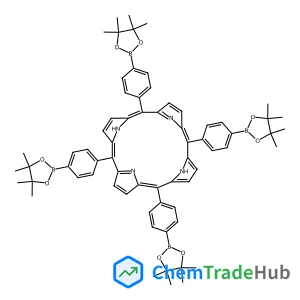
5,10,15,20-tetrakis(4-boronic acid pinacol ester phenyl) porphyrin
CAS番号:
1332748-00-1
分子式:
C68H74B4N4O8
おすすめサプライヤー





免責事項
このページに表示される学術雑誌情報は、参考および研究目的のみを目的としています。当社は雑誌出版社とは提携しておらず、投稿の取り扱いも行っておりません。出版に関するお問い合わせは、各雑誌出版社に直接ご連絡ください。
表示されている情報に誤りがある場合は、support@chemtradehub.com までご連絡ください。迅速に確認し、対応いたします。