












![6-Bromo-3-ethyl-3H-imidazo[4,5-b]pyridine structure](https://static.chemtradehub.com/structs/103/1033202-59-3-2a8f.webp "6-Bromo-3-ethyl-3H-imidazo[4,5-b]pyridine structure")
Correlative SEM SERS for quantitative analysis of dimer nanoparticles
文献情報
出版日
2016-10-19
DOI
10.1039/C6AN01648K
インパクトファクター
4.616
著者
F. J. Timmermans, A. T. M. Lenferink, H. A. G. M. van Wolferen, C. Otto
原文を見る
要旨
A Raman microscope integrated with a scanning electron microscope was used to investigate plasmonic structures by correlative SEM-SERS analysis. The integrated Raman-SEM microscope combines high-resolution electron microscopy information with SERS signal enhancement from selected nanostructures with adsorbed Raman reporter molecules. Correlative analysis is performed for dimers of two gold nanospheres. Dimers were selected on the basis of SEM images from multi aggregate samples. The effect of the orientation of the dimer with respect to the polarization state of the laser light and the effect of the particle gap size on the Raman signal intensity is observed. Additionally, calculations are performed to simulate the electric near field enhancement. These simulations are based on the morphologies observed by electron microscopy. In this way the experiments are compared with the enhancement factor calculated with near field simulations and are subsequently used to quantify the SERS enhancement factor. Large differences between experimentally observed and calculated enhancement factors are regularly detected, a phenomenon caused by nanoscale differences between the real and ‘simplified’ simulated structures. Quantitative SERS experiments reveal the structure induced enhancement factor, ranging from ∼200 to ∼20 000, averaged over the full nanostructure surface. The results demonstrate correlative Raman-SEM microscopy for the quantitative analysis of plasmonic particles and structures, thus enabling a new analytical method in the field of SERS and plasmonics.
関連文献
Experimental studies on combined production of CH4 and safe long-term storage of CO2 in the form of solid hydrate in sediment
Navid Saeidi, Bjørn Kvamme, Yu-Chien Chien
2021-10-11
Paper
DOI: 10.1039/D1CP03239A
Theoretical characterization of zeolite encapsulated platinum clusters in the presence of water molecules
2021-10-07
Paper
DOI: 10.1039/D1CP03766H
Kinetic and thermodynamic stability comparison for the fibrillar form of small amyloid-β(1–42) oligomers using scaled molecular dynamics
Debasis Saha, Biman Jana
2021-07-06
Paper
DOI: 10.1039/D1CP01866C
Large Rashba splitting, carrier mobility, and valley polarization in a 1T-SnS2/MoTe2 heterostructure
Sukai Teng, Jia Li, Xiujuan Mao, Fuli He, Ze Liu, Jiaxi Wang, Yafan Wang
2021-07-07
Paper
DOI: 10.1039/D1CP02039K
Self-standing, conducting and capacitive biomimetic hybrid nanomembranes for selective molecular ion separation
Catherine Michaux, Eric A. Perpète, David Zanuy
2021-07-05
Paper
DOI: 10.1039/D1CP01840J
The Fermi level as an energy reference in liquid jet X-ray photoelectron spectroscopy studies of aqueous solutions
Lucía Pérez Ramírez, Anthony Boucly, Florent Saudrais, Emmanuel Maisonhaute, Aleksandar R. Milosavljević, Christophe Nicolas, François Rochet
2021-07-05
Paper
DOI: 10.1039/D1CP01511G
Modeling the impedance response and steady state behaviour of porous CGO-based MIEC anodes
Philip Marmet, Lorenz Holzer, Jan G. Grolig, Holger Bausinger, Andreas Mai, Joseph M. Brader, Thomas Hocker
2021-10-06
Paper
DOI: 10.1039/D1CP01962G
Dissolution kinetics of a sodium borosilicate glass in Tris buffer solutions: impact of Tris concentration and acid (HCl/HNO3) identity
Nicholas Stone-Weiss, Nicholas J. Smith, Randall E. Youngman, Eric M. Pierce, Ashutosh Goel
2021-07-08
Paper
DOI: 10.1039/D0CP06425D
Unravelling the nature of a toluene–fumaronitrile complex
Andrzej J. Kałka, Mateusz Z. Brela, Andrzej M. Turek
2021-07-03
Paper
DOI: 10.1039/D1CP01895G
An augmented (multi-descriptor) grouping algorithm to optimize chemical ordering in nanoalloys
Davide Fioravanti, Giovanni Barcaro, Alessandro Fortunelli
2021-09-21
Paper
DOI: 10.1039/D1CP03583E
こちらもおすすめ
化合物よくある質問
4-アミノフェノール酸ナトリウム水和物とは何ですか?
4-アミノフェノール酸ナトリウム水和物は、CAS番号206557-08-6の化合物で、4-アミノフェノールとナトリウムが結合した塩と水和物です。この化合物は、白...
206557-08-64-Aminobenzoic acid ...
化合物よくある質問
Methyl 3-methyl-N-{[(2-methyl-2-propanyl)oxy]carbonyl}-L-histidinateの代替品はありますか?
この化合物は特定の合成プロセスに使用される可能性がありますが、代替品として、他の类似的な化合物、例えばMethyl 3-methyl-N-{[(2-methyl...
72212-51-2Methyl 3-methyl-N-{[...
化合物よくある質問
4-Boc-2-哌嗪甲酸の市場動向や研究トレンドはどうですか?
4-Boc-2-哌嗪甲酸は、薬品開発や合成化学分野で広く使用されており、その需要は継続的に推移しています。特に、新薬開発における合成化学分野での需要が高まってい...
192330-11-3(2R)-4-[(tert-butoxy...
化合物よくある質問
4,4'-二羟甲基联苯の物理化学的性質は何ですか?
4,4'-二羟甲基联苯のCAS番号は1667-12-5です。この化合物は白色の結晶粉末で、分子量は154.20です。水にわずかに溶けますが、アルコールや有機溶媒...
1667-12-54,4'-Biphenyldiyldim...
化合物よくある質問
5-甲硫基戊腈はどの業界で使用されていますか?
5-甲硫基戊腈は医薬品産業で使用される可能性があります。また、ポリマー合成の触媒として、センサー製造の一部として、半導体製造のプロセス改善に使用される可能性があ...
59121-25-45-(Methylsulfanyl)pe...
化合物よくある質問
CAS番号1311961-50-8の化合物はどのように合成されますか?
この化合物は、1-abieta-8,11,13-trien-19-イルと6'-メトキシシンコナナン-9-基を含有する窒素含有化合物から合成されます。一般的な合成...
1311961-50-81-Abieta-8,11,13-tri...
化合物よくある質問
6-ブロモベンジジミダゾール-2-カルビルデオキシドはどのように保存すればよいですか?
6-ブロモベンジジミダゾール-2-カルビルデオキシドは、避光・乾燥した容器(密閉容器)で-20℃~4℃の低温で保存してください。高温や直射日光、湿気は避けてくだ...
885280-26-25-Bromo-1H-benzimida...
化合物よくある質問
Boc-N-甲基氨甲环酸とは何ですか?
621-65-8のCAS番号を持つBoc-N-甲基氨甲环酸は、化学式C7H13NO5を有する化合物です。この化合物は白色の結晶性粉末で、吸湿性があります。
621-65-83-Hydroxy-1,2-propan...
化合物よくある質問
乙基三氟硼酸钾はどのように合成されますか?
乙基三氟硼酸钾は、トリフLUオール酸カリウムとエチルブロミドを反応させて合成されます。この反応は高い選択性と収率を持ち、触媒を用いることで効率的に進行します。
882871-21-8Potassium ethyltrifl...
化合物よくある質問
2-フロウロ-5-クロロ-4-アミノフェノールはどのように保存すればよいですか?
2-フロウロ-5-クロロ-4-アミノフェノールは、直射日光を避けて冷却された暗所で保存し、密閉容器に保管してください。温度は常温か低温が適しています。
847872-10-04-Amino-5-chloro-2-f...
掲載誌
Analyst

CiteScore:
7.8
自己引用率:
5.6%
年間論文数:
653
Analyst publishes analytical and bioanalytical research that reports premier fundamental discoveries and inventions, and the applications of those discoveries, unconfined by traditional discipline barriers.
おすすめ化合物
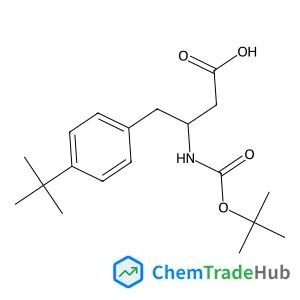
(S)-3-((tert-Butoxycarbonyl)amino)-4-(4-(tert-butyl)phenyl)butanoic acid
CAS番号:
403661-85-8
分子式:
C19H29NO4
おすすめサプライヤー





免責事項
このページに表示される学術雑誌情報は、参考および研究目的のみを目的としています。当社は雑誌出版社とは提携しておらず、投稿の取り扱いも行っておりません。出版に関するお問い合わせは、各雑誌出版社に直接ご連絡ください。
表示されている情報に誤りがある場合は、support@chemtradehub.com までご連絡ください。迅速に確認し、対応いたします。