












![[3-(2,6-Dichlorophenyl)-5-isopropyl-1,2-oxazol-4-yl]methanol structure](https://static.chemtradehub.com/structs/278/278597-30-1-5c79.webp "[3-(2,6-Dichlorophenyl)-5-isopropyl-1,2-oxazol-4-yl]methanol structure")
Continuous and simultaneous measurement of the biophysical properties of blood in a microfluidic environment
文献情報
出版日
2016-11-04
DOI
10.1039/C6AN01593J
インパクトファクター
4.616
著者
原文を見る
要旨
The biophysical properties of blood have been considered as promising indices for effectively screening the cardiovascular diseases. In this study, a method for the continuous and simultaneous measurement of the biophysical properties of blood, including viscosity, viscoelasticity, and RBC (red blood cell) aggregation is suggested, using a microfluidic device. The microfluidic device has two inlets (A, B), two outlets (A, B), two identical side channels, and one bridge channel. To sequentially induce steady and transient flows of blood samples, a blood sample is carefully delivered into the inlet (A) at a pulsatile flow rate (Q) (Qmax = 1 mL h−1, Qmin = 0 mL h−1, T = 240 s). By operating a pinch valve connected to the outlet (A), the blood flow is stopped or passed in the left-lower side channel. Three biophysical properties of the blood sample are quantified by analyzing the flow rate in the left-upper side channel (QμPIV), the image intensity in the left-lower side channel (〈I〉Blood), and the blood-filled width in the right-lower side channel (αBlood). First, based on the modified parallel flow method, the blood viscosity (μBlood) is measured by analyzing the variation in αBlood. Second, using a discrete fluidic circuit model, the time constant (λ) is evaluated by analyzing temporal variations in QμPIV and 1/(1 − αBlood). Then, the blood elasticity (GBlood) is calculated by assuming the linear Maxwell model (i.e., λ = μBlood/GBlood). Third, the RBC aggregation is quantified in terms of three parameters (〈I〉Slope, ARatio, and AUpp) obtained by analyzing temporal variations in the image intensity. From the experimental demonstrations using various blood samples, it is concluded that the proposed method has the ability to measure the biophysical properties of blood with consistency, as compared with the previous methods. In the near future, the proposed method will be employed for evaluating variations in the biophysical properties of blood, circulating in the extracorporeal rat bypass loop.
関連文献
The role of halogen bonding in metal free phosphors
Ramin Ansari, Daniel Hashemi, John Kieffer
2021-10-09
Paper
DOI: 10.1039/D1CP01325D
Decomposition of nitrous oxide in hydrated cobalt(i) clusters: a theoretical insight into the mechanistic roles of ligand-binding modes
Ephrem G. Demissie, Wing Ka Lam, Wai Kit Tang, Chi-Kit Siu
2021-07-06
Paper
DOI: 10.1039/D1CP01820E
Robustness and accuracy improvement of data processing with 2D neural networks for transient absorption dynamics
Ruixuan Zhao, Daxin Wu, Jiao Wen, Qi Zhang, Guanglei Zhang, Jiebo Li
2021-07-16
Paper
DOI: 10.1039/D1CP02521J
Theoretical investigation of the SN2 mechanism of X− [X = SH, PH2] + CH3Y [Y = F, Cl, Br, I] reactions in water
Chen Li, Xin Xin, Dunyou Wang
2021-09-29
Paper
DOI: 10.1039/D1CP03048E
The effect of interface angle on the thermal conductivity of Si/Ge superlattices
Aleksandr Chernatynskiy, Xiao-Feng Zhao
2021-10-08
Paper
DOI: 10.1039/D1CP03544D
Molecular dynamics study on the inhibition mechanisms of ReACp53 peptide for p53–R175H mutant aggregation
Jiangtao Lei, Mengqiang Cai, Yun Shen, Dongdong Lin, Xiaohua Deng
2021-09-22
Paper
DOI: 10.1039/D1CP03094A
Phase analysis of tungsten and phonon behavior of beryllium layers in W/Be periodic multilayers
Niranjan Kumar, Roman S. Pleshkov, Aleksey V. Nezhdanov, Vladimir N. Polkovnikov, Nikolay I. Chkhalo, Aleksandr I. Mashin
2021-09-21
Paper
DOI: 10.1039/D1CP02815D
Proton transport mechanism and pathways in the superprotonic phase of M3H(AO4)2 solid acids from ab initio molecular dynamics simulations
Boris V. Merinov, Sergey I. Morozov
2021-07-28
Paper
DOI: 10.1039/D1CP00757B
Deformation mechanism of a metal–organic framework glass under indentation
Theany To, Malwina Stepniewska, Haizheng Tao, Laurent Calvez, Xianghua Zhang, Morten M. Smedskjaer, Yuanzheng Yue
2021-07-26
Paper
DOI: 10.1039/D1CP02213J
Generation, contraction, and polarisation of Gaussian basis sets for atomic and molecular calculations using the generator coordinate method with polynomial discretisation: atoms from Na through Cl
Amanda R. Guimarães, Rugles C. Barbosa, Ana Cristina Mora Tello, Aldineia P. da Silva, Júlia M. A. Alves, Milena Palhares Maringolo, Albérico B. F. da Silva
2021-07-23
Paper
DOI: 10.1039/D1CP01879E
こちらもおすすめ
化合物よくある質問
4-アミノフェノール酸ナトリウム水和物とは何ですか?
4-アミノフェノール酸ナトリウム水和物は、CAS番号206557-08-6の化合物で、4-アミノフェノールとナトリウムが結合した塩と水和物です。この化合物は、白...
206557-08-64-Aminobenzoic acid ...
化合物よくある質問
Methyl 3-methyl-N-{[(2-methyl-2-propanyl)oxy]carbonyl}-L-histidinateの代替品はありますか?
この化合物は特定の合成プロセスに使用される可能性がありますが、代替品として、他の类似的な化合物、例えばMethyl 3-methyl-N-{[(2-methyl...
72212-51-2Methyl 3-methyl-N-{[...
化合物よくある質問
4-Boc-2-哌嗪甲酸の市場動向や研究トレンドはどうですか?
4-Boc-2-哌嗪甲酸は、薬品開発や合成化学分野で広く使用されており、その需要は継続的に推移しています。特に、新薬開発における合成化学分野での需要が高まってい...
192330-11-3(2R)-4-[(tert-butoxy...
化合物よくある質問
4,4'-二羟甲基联苯の物理化学的性質は何ですか?
4,4'-二羟甲基联苯のCAS番号は1667-12-5です。この化合物は白色の結晶粉末で、分子量は154.20です。水にわずかに溶けますが、アルコールや有機溶媒...
1667-12-54,4'-Biphenyldiyldim...
化合物よくある質問
5-甲硫基戊腈はどの業界で使用されていますか?
5-甲硫基戊腈は医薬品産業で使用される可能性があります。また、ポリマー合成の触媒として、センサー製造の一部として、半導体製造のプロセス改善に使用される可能性があ...
59121-25-45-(Methylsulfanyl)pe...
化合物よくある質問
CAS番号1311961-50-8の化合物はどのように合成されますか?
この化合物は、1-abieta-8,11,13-trien-19-イルと6'-メトキシシンコナナン-9-基を含有する窒素含有化合物から合成されます。一般的な合成...
1311961-50-81-Abieta-8,11,13-tri...
化合物よくある質問
6-ブロモベンジジミダゾール-2-カルビルデオキシドはどのように保存すればよいですか?
6-ブロモベンジジミダゾール-2-カルビルデオキシドは、避光・乾燥した容器(密閉容器)で-20℃~4℃の低温で保存してください。高温や直射日光、湿気は避けてくだ...
885280-26-25-Bromo-1H-benzimida...
化合物よくある質問
Boc-N-甲基氨甲环酸とは何ですか?
621-65-8のCAS番号を持つBoc-N-甲基氨甲环酸は、化学式C7H13NO5を有する化合物です。この化合物は白色の結晶性粉末で、吸湿性があります。
621-65-83-Hydroxy-1,2-propan...
化合物よくある質問
乙基三氟硼酸钾はどのように合成されますか?
乙基三氟硼酸钾は、トリフLUオール酸カリウムとエチルブロミドを反応させて合成されます。この反応は高い選択性と収率を持ち、触媒を用いることで効率的に進行します。
882871-21-8Potassium ethyltrifl...
化合物よくある質問
2-フロウロ-5-クロロ-4-アミノフェノールはどのように保存すればよいですか?
2-フロウロ-5-クロロ-4-アミノフェノールは、直射日光を避けて冷却された暗所で保存し、密閉容器に保管してください。温度は常温か低温が適しています。
847872-10-04-Amino-5-chloro-2-f...
掲載誌
Analyst

CiteScore:
7.8
自己引用率:
5.6%
年間論文数:
653
Analyst publishes analytical and bioanalytical research that reports premier fundamental discoveries and inventions, and the applications of those discoveries, unconfined by traditional discipline barriers.
おすすめ化合物
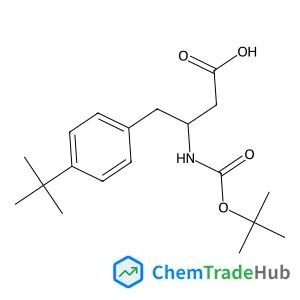
(S)-3-((tert-Butoxycarbonyl)amino)-4-(4-(tert-butyl)phenyl)butanoic acid
CAS番号:
403661-85-8
分子式:
C19H29NO4
![N-{3-[Benzyl(methyl)amino]propyl}-9-chloro-5,6,7,8-tetrahydro-2-acridinecarboxamide structure](https://static.chemtradehub.com/structs/142/1426944-49-1-1e4c.webp "N-{3-[Benzyl(methyl)amino]propyl}-9-chloro-5,6,7,8-tetrahydro-2-acridinecarboxamide structure")
おすすめサプライヤー





免責事項
このページに表示される学術雑誌情報は、参考および研究目的のみを目的としています。当社は雑誌出版社とは提携しておらず、投稿の取り扱いも行っておりません。出版に関するお問い合わせは、各雑誌出版社に直接ご連絡ください。
表示されている情報に誤りがある場合は、support@chemtradehub.com までご連絡ください。迅速に確認し、対応いたします。