












Feature driven classification of Raman spectra for real-time spectral brain tumour diagnosis using sound
文献情報
出版日
2016-10-12
DOI
10.1039/C6AN01583B
インパクトファクター
4.616
著者
Ryan Stables, Holly J. Butler, Katherine M. Ashton, Andrew Brodbelt, Timothy P. Dawson, Leanne M. Fullwood, Michael D. Jenkinson, Matthew J. Baker
原文を見る
要旨
Spectroscopic diagnostics have been shown to be an effective tool for the analysis and discrimination of disease states from human tissue. Furthermore, Raman spectroscopic probes are of particular interest as they allow for in vivo spectroscopic diagnostics, for tasks such as the identification of tumour margins during surgery. In this study, we investigate a feature-driven approach to the classification of metastatic brain cancer, glioblastoma (GB) and non-cancer from tissue samples, and we provide a real-time feedback method for endoscopic diagnostics using sound. To do this, we first evaluate the sensitivity and specificity of three classifiers (SVM, KNN and LDA), when trained with both sub-band spectral features and principal components taken directly from Raman spectra. We demonstrate that the feature extraction approach provides an increase in classification accuracy of 26.25% for SVM and 25% for KNN. We then discuss the molecular assignment of the most salient sub-bands in the dataset. The most salient sub-band features are mapped to parameters of a frequency modulation (FM) synthesizer in order to generate audio clips from each tissue sample. Based on the properties of the sub-band features, the synthesizer was able to maintain similar sound timbres within the disease classes and provide different timbres between disease classes. This was reinforced via listening tests, in which participants were able to discriminate between classes with mean classification accuracy of 71.1%. Providing intuitive feedback via sound frees the surgeons’ visual attention to remain on the patient, allowing for greater control over diagnostic and surgical tools during surgery, and thus promoting clinical translation of spectroscopic diagnostics.
関連文献
Mechanical properties and thermal conductivity of newly introduced graphene-like borophanes: a reactive molecular dynamics study
2021-08-02
Paper
DOI: 10.1039/D1CP01831K
The Fermi level as an energy reference in liquid jet X-ray photoelectron spectroscopy studies of aqueous solutions
Lucía Pérez Ramírez, Anthony Boucly, Florent Saudrais, Emmanuel Maisonhaute, Aleksandar R. Milosavljević, Christophe Nicolas, François Rochet
2021-07-05
Paper
DOI: 10.1039/D1CP01511G
Revisiting the glass transition temperature of water–glycerol mixtures in the bulk and confined in mesoporous silica
Ivette Angarita, Ma. Florencia Mazzobre
2021-07-10
Paper
DOI: 10.1039/D1CP02153B
Self-standing, conducting and capacitive biomimetic hybrid nanomembranes for selective molecular ion separation
Catherine Michaux, Eric A. Perpète, David Zanuy
2021-07-05
Paper
DOI: 10.1039/D1CP01840J
Local structure and NO adsorption/desorption property of Pd2+ cations at different paired Al sites in CHA zeolite
Shunsaku Yasumura, Taihei Ueda, Hajime Ide, Katsumasa Otsubo, Chong Liu, Nao Tsunoji, Zen Maeno
2021-08-12
Paper
DOI: 10.1039/D1CP02668B
Electrically tunable band gap in strained h-BN/silicene van der Waals heterostructures
Douglas D. de Vargas, Rogério J. Baierle
2021-08-03
Paper
DOI: 10.1039/D1CP02012A
The effect of interface angle on the thermal conductivity of Si/Ge superlattices
Aleksandr Chernatynskiy, Xiao-Feng Zhao
2021-10-08
Paper
DOI: 10.1039/D1CP03544D
The disparate effect of strain on thermal conductivity of 2-D materials
K. V. S. Dheeraj, Sarith P. Sathian
2021-09-14
Paper
DOI: 10.1039/D1CP02771A
A theoretical approach to evaluate and understand the electrical properties of the electrode materials of batteries
Hatef Yousefi-Mashhour, Mohammad Mahdi Kalantarian
2021-07-06
Paper
DOI: 10.1039/D1CP01796A
こちらもおすすめ
化合物よくある質問
4-アミノフェノール酸ナトリウム水和物とは何ですか?
4-アミノフェノール酸ナトリウム水和物は、CAS番号206557-08-6の化合物で、4-アミノフェノールとナトリウムが結合した塩と水和物です。この化合物は、白...
206557-08-64-Aminobenzoic acid ...
化合物よくある質問
Methyl 3-methyl-N-{[(2-methyl-2-propanyl)oxy]carbonyl}-L-histidinateの代替品はありますか?
この化合物は特定の合成プロセスに使用される可能性がありますが、代替品として、他の类似的な化合物、例えばMethyl 3-methyl-N-{[(2-methyl...
72212-51-2Methyl 3-methyl-N-{[...
化合物よくある質問
4-Boc-2-哌嗪甲酸の市場動向や研究トレンドはどうですか?
4-Boc-2-哌嗪甲酸は、薬品開発や合成化学分野で広く使用されており、その需要は継続的に推移しています。特に、新薬開発における合成化学分野での需要が高まってい...
192330-11-3(2R)-4-[(tert-butoxy...
化合物よくある質問
4,4'-二羟甲基联苯の物理化学的性質は何ですか?
4,4'-二羟甲基联苯のCAS番号は1667-12-5です。この化合物は白色の結晶粉末で、分子量は154.20です。水にわずかに溶けますが、アルコールや有機溶媒...
1667-12-54,4'-Biphenyldiyldim...
化合物よくある質問
5-甲硫基戊腈はどの業界で使用されていますか?
5-甲硫基戊腈は医薬品産業で使用される可能性があります。また、ポリマー合成の触媒として、センサー製造の一部として、半導体製造のプロセス改善に使用される可能性があ...
59121-25-45-(Methylsulfanyl)pe...
化合物よくある質問
CAS番号1311961-50-8の化合物はどのように合成されますか?
この化合物は、1-abieta-8,11,13-trien-19-イルと6'-メトキシシンコナナン-9-基を含有する窒素含有化合物から合成されます。一般的な合成...
1311961-50-81-Abieta-8,11,13-tri...
化合物よくある質問
6-ブロモベンジジミダゾール-2-カルビルデオキシドはどのように保存すればよいですか?
6-ブロモベンジジミダゾール-2-カルビルデオキシドは、避光・乾燥した容器(密閉容器)で-20℃~4℃の低温で保存してください。高温や直射日光、湿気は避けてくだ...
885280-26-25-Bromo-1H-benzimida...
化合物よくある質問
Boc-N-甲基氨甲环酸とは何ですか?
621-65-8のCAS番号を持つBoc-N-甲基氨甲环酸は、化学式C7H13NO5を有する化合物です。この化合物は白色の結晶性粉末で、吸湿性があります。
621-65-83-Hydroxy-1,2-propan...
化合物よくある質問
乙基三氟硼酸钾はどのように合成されますか?
乙基三氟硼酸钾は、トリフLUオール酸カリウムとエチルブロミドを反応させて合成されます。この反応は高い選択性と収率を持ち、触媒を用いることで効率的に進行します。
882871-21-8Potassium ethyltrifl...
化合物よくある質問
2-フロウロ-5-クロロ-4-アミノフェノールはどのように保存すればよいですか?
2-フロウロ-5-クロロ-4-アミノフェノールは、直射日光を避けて冷却された暗所で保存し、密閉容器に保管してください。温度は常温か低温が適しています。
847872-10-04-Amino-5-chloro-2-f...
掲載誌
Analyst

CiteScore:
7.8
自己引用率:
5.6%
年間論文数:
653
Analyst publishes analytical and bioanalytical research that reports premier fundamental discoveries and inventions, and the applications of those discoveries, unconfined by traditional discipline barriers.
おすすめ化合物
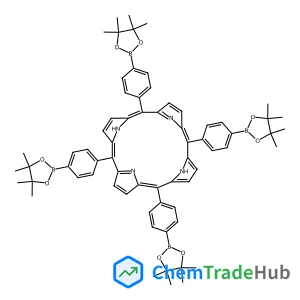
5,10,15,20-tetrakis(4-boronic acid pinacol ester phenyl) porphyrin
CAS番号:
1332748-00-1
分子式:
C68H74B4N4O8
おすすめサプライヤー



免責事項
このページに表示される学術雑誌情報は、参考および研究目的のみを目的としています。当社は雑誌出版社とは提携しておらず、投稿の取り扱いも行っておりません。出版に関するお問い合わせは、各雑誌出版社に直接ご連絡ください。
表示されている情報に誤りがある場合は、support@chemtradehub.com までご連絡ください。迅速に確認し、対応いたします。