


Synthesis of thermally cleavable multisegmented polystyrene by an atom transfer nitroxide radical polymerization (ATNRP) mechanism
文献情報
出版日
2015-09-28
DOI
10.1039/C5PY01493J
インパクトファクター
5.582
著者
Wenguang Song, Jian Huang, Cheng Hang, Chenyan Liu, Xuepu Wang, Guowei Wang
原文を見る
要旨
Based on the common features of well-defined nitroxide radical coupling (NRC) reaction, atom transfer radical polymerization (ATRP) and nitroxide mediated radical polymerization (NMRP) mechanisms, an atom transfer nitroxide radical polymerization (ATNRP) mechanism was presented by integrating these three mechanisms into one polymerization system simultaneously, and further used to construct multisegmented polystyrene (PSm) embedded with multiple alkoxyamine linkages. The initiator 1-oxyl-2,2,6,6-tetramethylpiperidinyl-4-yl 2-bromo-2-methylpropanoate (Br-TEMPO) containing one bromoisobutyryl group and one stable nitroxide radical was firstly designed and synthesized. Then, the ATNRP mechanism was systematically investigated by optimizing factors such as polymerization temperature, solvent, catalyst, time and operation technology. The results showed that the NRC reaction, ATRP and NMRP mechanisms can synergistically proceed in ATNRP due to the thermally reversible dissociation–combination behavior of the formed alkoxyamine linkages, and the polymerization temperature and solvent were the key factors. Finally, the thermal behaviour of the formed PSm was monitored by TGA and DSC analyses. The result showed that the alkoxyamine linkages can undergo a thermal cleavage at an elevated temperature of 110 °C and the PSm can be cleaved in the presence of excess stable nitroxide radicals. The PSm embedded with multiple alkoxyamine linkages and the cleaved PS possessing one nitroxide radical have the same thermal stability, however the Tg of PSm gradually approached that of the cleaved PS when several heating–cooling (40–150 °C) cycles were performed. Due to the versatile functions of the as-prepared PSm and cleaved PS, this ATNRP mechanism will hopefully find more potential applications in polymer chemistry.
おすすめジャーナル

Russian Chemical Bulletin

Current Opinion in Colloid & Interface Science

Saudi Pharmaceutical Journal

Crystallography Reports

Journal of Saudi Chemical Society

Chemical Communications

New Journal of Chemistry

Current Opinion in Solid State & Materials Science

Organic Process Research & Development

Russian Journal of Organic Chemistry
関連文献
Impact of pore size, interconnections, and dynamic conductivity on the electrochemistry of vanadium pentoxide in well defined porous structures
Nam Kim, Emily Sahadeo, Chanyuan Liu, Olivia Rose
2018-11-21
Paper
DOI: 10.1039/C8CP04706E
Visualizing the coordination-spheres of photoexcited transition metal complexes with ultrafast hard X-rays
D. Khakhulin, L. M. Lawson Daku, D. Leshchev, G. E. Newby, C. Bressler, M. Wulff
2019-04-04
Paper
DOI: 10.1039/C9CP01263J
Vibrationally induced metallisation of the energetic azide α-NaN3
Svemir Rudić, Carole A. Morrison
2018-11-05
Paper
DOI: 10.1039/C8CP06161K
Role of the vibrational contribution in Coulomb explosion of dicationic neon gas clusters: a parallel tempering based study
Sankar Ghorai, Pulak Naskar, Pinaki Chaudhury
2018-08-13
Paper
DOI: 10.1039/C8CP03779E
Self-adaptive multiscaling algorithm for efficient simulations of many-protein systems in crowded conditions
2018-10-29
Paper
DOI: 10.1039/C8CP05517C
Structural analysis of the initial lithiation of NiO thin film electrodes
Guennadi Evmenenko, Timothy T. Fister, Fernando C. Castro, Byeongdu Lee, D. Bruce Buchholz, Vinayak P. Dravid, Paul Fenter
2019-04-05
Paper
DOI: 10.1039/C9CP01527B
A comparative study of the structure, stability and energetic performance of 5,5′-bitetrazole-1,1′-diolate based energetic ionic salts: future high energy density materials
B. Moses Abraham, Vikas D. Ghule
2018-11-09
Paper
DOI: 10.1039/C8CP06635C
Reply to the ‘Comment on “Negative effective Li transference numbers in Li salt/ionic liquid mixtures: does Li drift in the “Wrong” direction?”’ by K. R. Harris, Phys. Chem. Chem. Phys., 2018, 20, DOI: 10.1039/C8CP02595A
Monika Schönhoff, Cornelia Cramer, Florian Schmidt
2018-11-21
Comment
DOI: 10.1039/C8CP06075D
Effects of hydrogen bonding on the gas-phase reactivity of didehydroisoquinolinium cation isomers
Nelson R. Vinueza, Bartłomiej J. Jankiewicz, Vanessa A. Gallardo, John J. Nash, Hilkka I. Kenttämaa
2018-08-02
Paper
DOI: 10.1039/C8CP03350A
こちらもおすすめ
28770-01-62-(2-Isopropyl-1,3-o...
化合物よくある質問
「邻羟基阿托伐他汀内酯标准品」に適用される法規ガイドelinesは何ですか?
CAS番号163217-74-1の「邻羟基阿托伐他汀内酯标准品」は、GHS分類では危険物に分類されず、主にREACH規則とFDA/EPAの管理対象となります。R...
163217-74-1ortho-Hydroxy Atorva...
化合物よくある質問
メチル(3R)-3-アミノ-2,3-ジヒドロ-1-ベンゾファンラニン-5-カルボイル酸塩塩酸塩の主な用途は何ですか?
メチル(3R)-3-アミノ-2,3-ジヒドロ-1-ベンゾファンラニン-5-カルボイル酸塩塩酸塩は、医薬品や合成化学の研究に広く用いられます。また、特定の薬物の前...
2241594-15-8Methyl (3R)-3-amino-...
化合物よくある質問
トランス-4-メチルピロリジン-3-オール塩酸塩はどのように合成されますか?
トランス-4-メチルピロリジン-3-オール塩酸塩は、4-メチルピロリジンの塩酸塩化によって合成されます。一般的な合成方法では、4-メチルピロリジンを塩酸に加えて...
265108-42-7trans-4-Methylpyrrol...
化合物よくある質問
硫雜環丁烷-1,1-二氧化物は安全ですか?
硫雜環丁烷-1,1-二氧化物は安全ではありません。毒性は報告されていませんが、高温下で分解し、可燃性があるため、高圧ガスは注意が必要です。密閉した容器で保管し、...
5687-92-3Thietane 1,1-dioxide
6054-10-02H, 8H-Benzo[1,2-b
化合物よくある質問
9-ヒドロキシエリプチシネ塩酸塩はどのように合成されますか?
9-ヒドロキシエリプチシネ塩酸塩は、エリプチシネから塩酸を添加することで合成されます。選択性は高いですが、収率は約70%です。
52238-35-49-Hydroxyellipticine...
化合物よくある質問
5-塩素-2-(メチルアミノ)フェニル-(2-塩素フェニル)メタン酮の物理化学的性質は何ですか?
5-塩素-2-(メチルアミノ)フェニル-(2-塩素フェニル)メタン酮のCAS番号は5621-86-3です。この化合物は白色の結晶性粉末で、分子量は415.03で...
5621-86-3[5-Chloro-2-(methyla...
化合物よくある質問
1-[2-(4-甲氧基-苯氧基)-乙基]-哌嗪はどのように保存すればよいですか?
1-[2-(4-甲氧基-苯氧基)-乙基]-哌嗪は、直射日光を避けて暗所に、室温(15-25℃)で保管し、密閉容器に入れることで安定性を保つことができます。
117132-44-21-[2-(4-Methoxy-phen...
化合物よくある質問
2-[3-(4-甲氧基フェニル)プロピル]-4,4,5,5-四メチル-1,3,2-ドイボロロールアンの主な用途は何ですか?
2-[3-(4-甲氧基フェニル)プロピル]-4,4,5,5-四メチル-1,3,2-ドイボロロールアンは、医薬品の合成、有機合成化学、および新材料の研究で使用され...
1073371-72-82-[3-(4-Methoxypheny...
掲載誌
Polymer Chemistry

CiteScore:
8.6
自己引用率:
7.3%
年間論文数:
457
Polymer Chemistry welcomes submissions in all areas of polymer science that have a strong focus on macromolecular chemistry. Manuscripts may cover a broad range of fields, yet no direct application focus is required.
おすすめ化合物
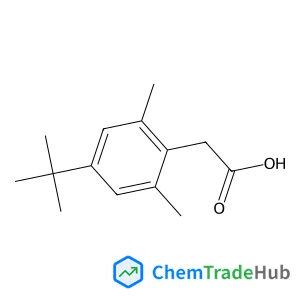
phosphoryl}methyl 4-methylbenzenesulfonate structure](https://static.chemtradehub.com/structs/864/864068-45-1-ba7c.webp "{[3-(Hexadecyloxy)propoxy](hydroxy)phosphoryl}methyl 4-methylbenzenesulfonate structure")
{[3-(Hexadecyloxy)propoxy](hydroxy)phosphoryl}methyl 4-methylbenzenesulfonate
CAS番号:
864068-45-1
分子式:
C27H49O7PS
![1-[(4-Methylphenyl)sulfonyl]-3-(4,4,5,5-tetramethyl-1,3,2-dioxaborolan-2-yl)-1H-pyrrolo[2,3-b]pyridine-5-carbonitrile structure](https://static.chemtradehub.com/structs/143/1434747-57-5-fc0d.webp "1-[(4-Methylphenyl)sulfonyl]-3-(4,4,5,5-tetramethyl-1,3,2-dioxaborolan-2-yl)-1H-pyrrolo[2,3-b]pyridine-5-carbonitrile structure")
おすすめサプライヤー






免責事項
このページに表示される学術雑誌情報は、参考および研究目的のみを目的としています。当社は雑誌出版社とは提携しておらず、投稿の取り扱いも行っておりません。出版に関するお問い合わせは、各雑誌出版社に直接ご連絡ください。
表示されている情報に誤りがある場合は、support@chemtradehub.com までご連絡ください。迅速に確認し、対応いたします。