













Di(naphthalen-2-yl)-1,2-diphenylethene-based conjugated polymers: aggregation-enhanced emission and explosive detection
文献情報
出版日
2015-10-08
DOI
10.1039/C5PY01458A
インパクトファクター
5.582
著者
Mengxia Gao, Yue Wu, Bin Chen, Bairong He, Han Nie, Tingyan Li, Fupeng Wu, Wenjun Zhou, Jian Zhou, Zujin Zhao
原文を見る
要旨
Fluorescent conjugated polymers based on a new AIE building block, di(naphthalen-2-yl)-1,2-diphenylethene, are synthesized and characterized. These polymers show interesting aggregation-enhanced emission and function well in explosive detection in aqueous media.
関連文献
Visualizing the coordination-spheres of photoexcited transition metal complexes with ultrafast hard X-rays
D. Khakhulin, L. M. Lawson Daku, D. Leshchev, G. E. Newby, C. Bressler, M. Wulff
2019-04-04
Paper
DOI: 10.1039/C9CP01263J
Hydrogen bond induced enhancement of Fermi resonances in N–H⋯N hydrogen bonded complexes of anilines
Saurabh Mishra, Jer-Lai Kuo, G. Naresh Patwari
2018-07-20
Paper
DOI: 10.1039/C8CP02448K
Adsorption, surface relaxation and electrolyte structure at Pt(111) electrodes in non-aqueous and aqueous acetonitrile electrolytes
Gary S. Harlow, Iain M. Aldous, Yvonne Gründer, Laurence J. Hardwick, Christopher A. Lucas
2019-02-21
Paper
DOI: 10.1039/C9CP00499H
Nonadiabatic fragmentation of H2O+ and isotopomers. Wave packet propagation using ab initio wavefunctions
Jaime Suárez, L. Méndez, I. Rabadán
2018-11-12
Paper
DOI: 10.1039/C8CP03725F
Factors governing when a metal-bound water is deprotonated in proteins
Cédric Grauffel
2018-11-05
Paper
DOI: 10.1039/C8CP04776F
Excited interatomic potential energy surfaces of Rb + He that correlate with Rb terms 52S through 72S
Amit R. Sharma, David E. Weeks
2018-11-09
Paper
DOI: 10.1039/C8CP05550E
Interband transitions in closed-shell vacancy containing graphene quantum dots complexed with heavy metals
Rositsa Yakimova
2018-08-01
Paper
DOI: 10.1039/C8CP03306D
Role of the carbon source in the transformation of amorphous carbon to graphene during rapid thermal processing
Yong Zhou, Xiaowei Xu, Aiying Wang, Kwang-Ryeol Lee
2019-04-08
Paper
DOI: 10.1039/C9CP01305A
Defect generation in TiO2 nanotube anodes via heat treatment in various atmospheres for lithium-ion batteries
Andreas I. Savva, Kassiopeia A. Smith, Matthew Lawson, Sterling R. Croft, Ariel E. Weltner, Chris D. Jones, Hailey Bull, Paul J. Simmonds, Lan Li, Hui Xiong
2018-08-16
Paper
DOI: 10.1039/C8CP04368J
こちらもおすすめ
28770-01-62-(2-Isopropyl-1,3-o...
化合物よくある質問
「邻羟基阿托伐他汀内酯标准品」に適用される法規ガイドelinesは何ですか?
CAS番号163217-74-1の「邻羟基阿托伐他汀内酯标准品」は、GHS分類では危険物に分類されず、主にREACH規則とFDA/EPAの管理対象となります。R...
163217-74-1ortho-Hydroxy Atorva...
化合物よくある質問
メチル(3R)-3-アミノ-2,3-ジヒドロ-1-ベンゾファンラニン-5-カルボイル酸塩塩酸塩の主な用途は何ですか?
メチル(3R)-3-アミノ-2,3-ジヒドロ-1-ベンゾファンラニン-5-カルボイル酸塩塩酸塩は、医薬品や合成化学の研究に広く用いられます。また、特定の薬物の前...
2241594-15-8Methyl (3R)-3-amino-...
化合物よくある質問
トランス-4-メチルピロリジン-3-オール塩酸塩はどのように合成されますか?
トランス-4-メチルピロリジン-3-オール塩酸塩は、4-メチルピロリジンの塩酸塩化によって合成されます。一般的な合成方法では、4-メチルピロリジンを塩酸に加えて...
265108-42-7trans-4-Methylpyrrol...
化合物よくある質問
硫雜環丁烷-1,1-二氧化物は安全ですか?
硫雜環丁烷-1,1-二氧化物は安全ではありません。毒性は報告されていませんが、高温下で分解し、可燃性があるため、高圧ガスは注意が必要です。密閉した容器で保管し、...
5687-92-3Thietane 1,1-dioxide
6054-10-02H, 8H-Benzo[1,2-b
化合物よくある質問
9-ヒドロキシエリプチシネ塩酸塩はどのように合成されますか?
9-ヒドロキシエリプチシネ塩酸塩は、エリプチシネから塩酸を添加することで合成されます。選択性は高いですが、収率は約70%です。
52238-35-49-Hydroxyellipticine...
化合物よくある質問
5-塩素-2-(メチルアミノ)フェニル-(2-塩素フェニル)メタン酮の物理化学的性質は何ですか?
5-塩素-2-(メチルアミノ)フェニル-(2-塩素フェニル)メタン酮のCAS番号は5621-86-3です。この化合物は白色の結晶性粉末で、分子量は415.03で...
5621-86-3[5-Chloro-2-(methyla...
化合物よくある質問
1-[2-(4-甲氧基-苯氧基)-乙基]-哌嗪はどのように保存すればよいですか?
1-[2-(4-甲氧基-苯氧基)-乙基]-哌嗪は、直射日光を避けて暗所に、室温(15-25℃)で保管し、密閉容器に入れることで安定性を保つことができます。
117132-44-21-[2-(4-Methoxy-phen...
化合物よくある質問
2-[3-(4-甲氧基フェニル)プロピル]-4,4,5,5-四メチル-1,3,2-ドイボロロールアンの主な用途は何ですか?
2-[3-(4-甲氧基フェニル)プロピル]-4,4,5,5-四メチル-1,3,2-ドイボロロールアンは、医薬品の合成、有機合成化学、および新材料の研究で使用され...
1073371-72-82-[3-(4-Methoxypheny...
掲載誌
Polymer Chemistry

CiteScore:
8.6
自己引用率:
7.3%
年間論文数:
457
Polymer Chemistry welcomes submissions in all areas of polymer science that have a strong focus on macromolecular chemistry. Manuscripts may cover a broad range of fields, yet no direct application focus is required.
おすすめ化合物


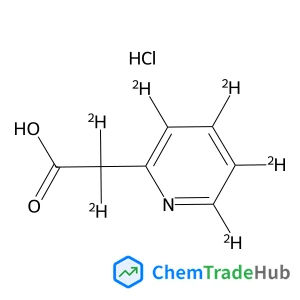
2,2-dideuterio-2-(3,4,5,6-tetradeuterio-2-pyridyl)acetic acid;hydrochloride
CAS番号:
1329799-67-8
分子式:
C7H2ClD6NO2
おすすめサプライヤー



免責事項
このページに表示される学術雑誌情報は、参考および研究目的のみを目的としています。当社は雑誌出版社とは提携しておらず、投稿の取り扱いも行っておりません。出版に関するお問い合わせは、各雑誌出版社に直接ご連絡ください。
表示されている情報に誤りがある場合は、support@chemtradehub.com までご連絡ください。迅速に確認し、対応いたします。