


A robust procedure for large scale synthesis of a high molar mass, unsubstituted poly(m,p-phenylene)
文献情報
出版日
2015-09-15
DOI
10.1039/C5PY01317H
インパクトファクター
5.582
著者
Bernd Deffner, A. Dieter Schlüter
原文を見る
要旨
Due to the absence of functional groups and the relative inertness of phenylene units, polyphenylenes are an interesting research target for materials such as films and fibers, combining some π–π conjugation with chemical (e.g. hydrolytic) and thermal robustness. However, unsubstituted polyphenylenes practically cannot be obtained at high molar masses due to their already poor solubility at an early stage of growth. Herein, we report a synthetic route which nevertheless provides such polymers in a two-step process recently promoted by Sakamoto et al. First, a soluble precursor poly(m,p-phenylene) is obtained by AA/BB-type Suzuki polycondensation (SPC) which is then subjected to a virtually quantitative removal of its solubilizing side chains. SPC was carried out on a multigram scale using highly pure monomers which resulted in a fully reproducible and scalable route that provided up to 14 g of a substituted poly(m,p-phenylene) with a molar mass of 150 kg mol−1 (300 kg mol−1 after the removal of the common cyclic side products). This molar mass is amongst the highest ever reported in the open literature for SPC. The precursor polymer was compression moulded into films which were then subjected to side chain cleaving conditions by simple immersion into acidic solutions. Gratifyingly, the side chains could almost completely be removed with preservation of the overall film shape. We consider this work a step towards novel stiff and strong fluorescing films and fibers resistant to hydrolytic conditions.
おすすめジャーナル

Nature Medicine

Current Opinion in Solid State & Materials Science

Journal of Saudi Chemical Society

Current Opinion in Colloid & Interface Science

Drug Discovery Today

Russian Journal of Bioorganic Chemistry

Organic Process Research & Development

Russian Journal of General Chemistry

Acta Materialia

Saudi Pharmaceutical Journal
関連文献
Extreme electron transport suppression in siloxane ring-based molecular devices
Jie Li, Yunrui Duan, Tao Li, Hui Li
2018-08-21
Paper
DOI: 10.1039/C8CP03616K
Bulk phase behavior of lithium imide–metal nitride ammonia decomposition catalysts‡
Thomas J. Wood, Ronald I. Smith, Claire A. Murray
2018-08-23
Paper
DOI: 10.1039/C8CP02824A
Ion speciation of lithium hexafluorophosphate in dimethyl carbonate solutions: an infrared spectroscopy study
Kristen D. Fulfer, Daniel G. Kuroda
2018-08-13
Paper
DOI: 10.1039/C8CP03315C
Factors governing when a metal-bound water is deprotonated in proteins
Cédric Grauffel
2018-11-05
Paper
DOI: 10.1039/C8CP04776F
Pulse-shaped two-photon excitation of a fluorescent base analogue approaches single-molecule sensitivity
Rachel S. Fisher, David Nobis, Anders F. Füchtbauer, Mattias Bood, Morten Grøtli, L. Marcus Wilhelmsson, Anita C. Jones, Steven W. Magennis
2018-10-30
Paper
DOI: 10.1039/C8CP05496G
Visualizing the coordination-spheres of photoexcited transition metal complexes with ultrafast hard X-rays
D. Khakhulin, L. M. Lawson Daku, D. Leshchev, G. E. Newby, C. Bressler, M. Wulff
2019-04-04
Paper
DOI: 10.1039/C9CP01263J
Atomistic reverse nonequilibrium molecular dynamics simulation of the viscosity of ionic liquid 1-n-butyl 3-methylimidazolium bis(trifluoromethylsulfonyl)imide [bmim][Tf2N]
Rouhollah Safinejad, Nargess Mehdipour, Hossein Eslami
2018-08-02
Paper
DOI: 10.1039/C8CP02393J
Total electron scattering cross sections from para-benzoquinone in the energy range 1–200 eV
A. I. Lozano, J. C. Oller, D. B. Jones, M. T. do N. Varella, M. H. F. Bettega, F. Ferreira da Silva, P. Limão-Vieira, M. A. P. Lima, R. D. White, M. J. Brunger, F. Blanco, A. Muñoz, G. García
2018-08-13
Paper
DOI: 10.1039/C8CP03297A
Distribution of water in the pores of periodic mesoporous organosilicates – a proton solid state MAS NMR study
V. S. Veena, Kavya Illath, Anish Lazar, C. P. Vinod, T. G. Ajithkumar, S. Jayanthi
2018-11-01
Paper
DOI: 10.1039/C8CP04902E
こちらもおすすめ
28770-01-62-(2-Isopropyl-1,3-o...
化合物よくある質問
「邻羟基阿托伐他汀内酯标准品」に適用される法規ガイドelinesは何ですか?
CAS番号163217-74-1の「邻羟基阿托伐他汀内酯标准品」は、GHS分類では危険物に分類されず、主にREACH規則とFDA/EPAの管理対象となります。R...
163217-74-1ortho-Hydroxy Atorva...
化合物よくある質問
メチル(3R)-3-アミノ-2,3-ジヒドロ-1-ベンゾファンラニン-5-カルボイル酸塩塩酸塩の主な用途は何ですか?
メチル(3R)-3-アミノ-2,3-ジヒドロ-1-ベンゾファンラニン-5-カルボイル酸塩塩酸塩は、医薬品や合成化学の研究に広く用いられます。また、特定の薬物の前...
2241594-15-8Methyl (3R)-3-amino-...
化合物よくある質問
トランス-4-メチルピロリジン-3-オール塩酸塩はどのように合成されますか?
トランス-4-メチルピロリジン-3-オール塩酸塩は、4-メチルピロリジンの塩酸塩化によって合成されます。一般的な合成方法では、4-メチルピロリジンを塩酸に加えて...
265108-42-7trans-4-Methylpyrrol...
化合物よくある質問
硫雜環丁烷-1,1-二氧化物は安全ですか?
硫雜環丁烷-1,1-二氧化物は安全ではありません。毒性は報告されていませんが、高温下で分解し、可燃性があるため、高圧ガスは注意が必要です。密閉した容器で保管し、...
5687-92-3Thietane 1,1-dioxide
6054-10-02H, 8H-Benzo[1,2-b
化合物よくある質問
9-ヒドロキシエリプチシネ塩酸塩はどのように合成されますか?
9-ヒドロキシエリプチシネ塩酸塩は、エリプチシネから塩酸を添加することで合成されます。選択性は高いですが、収率は約70%です。
52238-35-49-Hydroxyellipticine...
化合物よくある質問
5-塩素-2-(メチルアミノ)フェニル-(2-塩素フェニル)メタン酮の物理化学的性質は何ですか?
5-塩素-2-(メチルアミノ)フェニル-(2-塩素フェニル)メタン酮のCAS番号は5621-86-3です。この化合物は白色の結晶性粉末で、分子量は415.03で...
5621-86-3[5-Chloro-2-(methyla...
化合物よくある質問
1-[2-(4-甲氧基-苯氧基)-乙基]-哌嗪はどのように保存すればよいですか?
1-[2-(4-甲氧基-苯氧基)-乙基]-哌嗪は、直射日光を避けて暗所に、室温(15-25℃)で保管し、密閉容器に入れることで安定性を保つことができます。
117132-44-21-[2-(4-Methoxy-phen...
化合物よくある質問
2-[3-(4-甲氧基フェニル)プロピル]-4,4,5,5-四メチル-1,3,2-ドイボロロールアンの主な用途は何ですか?
2-[3-(4-甲氧基フェニル)プロピル]-4,4,5,5-四メチル-1,3,2-ドイボロロールアンは、医薬品の合成、有機合成化学、および新材料の研究で使用され...
1073371-72-82-[3-(4-Methoxypheny...
掲載誌
Polymer Chemistry

CiteScore:
8.6
自己引用率:
7.3%
年間論文数:
457
Polymer Chemistry welcomes submissions in all areas of polymer science that have a strong focus on macromolecular chemistry. Manuscripts may cover a broad range of fields, yet no direct application focus is required.
おすすめ化合物
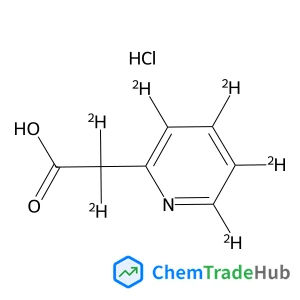
2,2-dideuterio-2-(3,4,5,6-tetradeuterio-2-pyridyl)acetic acid;hydrochloride
CAS番号:
1329799-67-8
分子式:
C7H2ClD6NO2
おすすめサプライヤー





免責事項
このページに表示される学術雑誌情報は、参考および研究目的のみを目的としています。当社は雑誌出版社とは提携しておらず、投稿の取り扱いも行っておりません。出版に関するお問い合わせは、各雑誌出版社に直接ご連絡ください。
表示されている情報に誤りがある場合は、support@chemtradehub.com までご連絡ください。迅速に確認し、対応いたします。