












Synthesis of catechol and zwitterion-bifunctionalized poly(ethylene glycol) for the construction of antifouling surfaces
文献情報
出版日
2015-11-11
DOI
10.1039/C5PY01234A
インパクトファクター
5.582
著者
Li Qun Xu, Dicky Pranantyo, Koon-Gee Neoh, En-Tang Kang, Serena Lay-Ming Teo, Guo Dong Fu
原文を見る
要旨
The synthesis of catechol-containing small molecules and macromolecules always requires multiple reaction steps, coupling agents, or enzymes. In this study, a simple and scalable strategy for the preparation of catechol-containing poly(ethylene glycol) (CaPEG) by epoxide–amine polymerization of PEG diglycidyl ether with dopamine is described. The as-formed tertiary amine groups in the backbone of CaPEG can be converted into sulfobetaine structures in an alkylsulfonation step, leading to the formation of catechol and zwitterion-bifunctionalized PEG (SBCaPEG). The resulting catechol-containing CaPEG and SBCaPEG can be anchored on various substrate surfaces, including stainless steel (SS), titanium and silicon wafer, under mild conditions. Since SS is susceptible to fouling by a variety of microorganisms, the antifouling properties of the polymer-coated SS surfaces are studied in detail. The CaPEG- and SBCaPEG-coated SS surfaces effectively reduced the adsorption of protein (albumin–fluorescein isothiocyanate conjugate and bovine plasma fibrinogen), as well as the adhesion of bacteria (Pseudomonas sp. and Escherichia coli) and microalgae (Amphora coffeaeformis), as compared to that of the pristine SS surface. In comparison with the CaPEG-coated SS surfaces, the zwitterionic SBCaPEG-coated SS surfaces exhibited even better antifouling efficiencies.
関連文献
Effects of double-atom vacancies on the electronic properties of graphyne: a DFT investigation
Si Wu, Yuan Yuan, Hongqi Ai, Baotao Kang
2018-08-10
Paper
DOI: 10.1039/C8CP03359E
Charge polarization in partially lithiated single-walled carbon nanotubes
A. A. Makarova
2018-07-23
Paper
DOI: 10.1039/C8CP01510D
van der Waals interaction-induced photoluminescence weakening and multilayer growth in epitaxially aligned WS2
Hyun Goo Ji, Mina Maruyama, Adha Sukma Aji, Susumu Okada, Kazunari Matsuda
2018-11-07
Paper
DOI: 10.1039/C8CP04418J
Reply to the ‘Comment on “Negative effective Li transference numbers in Li salt/ionic liquid mixtures: does Li drift in the “Wrong” direction?”’ by K. R. Harris, Phys. Chem. Chem. Phys., 2018, 20, DOI: 10.1039/C8CP02595A
Monika Schönhoff, Cornelia Cramer, Florian Schmidt
2018-11-21
Comment
DOI: 10.1039/C8CP06075D
Optical properties and charge distribution in rod-shape DNA–silver cluster emitters
Matías Berdakin
2018-08-15
Paper
DOI: 10.1039/C8CP03895C
Silicene-supported TiO2 nanostructures: a theoretical study of electronic and optical properties
Yesukhei Jagvaral, Qing Guo, Haiying He, Ravindra Pandey
2019-04-04
Paper
DOI: 10.1039/C9CP00894B
Vibrationally induced metallisation of the energetic azide α-NaN3
Svemir Rudić, Carole A. Morrison
2018-11-05
Paper
DOI: 10.1039/C8CP06161K
Solvation of 2-(hydroxymethyl)-2,5,7,8-tetramethyl-chroman-6-ol revealed by circular dichroism: a case of chromane helicity rule breaking
Joanna E. Rode, Marcin Górecki, Stanisław Witkowski, Jadwiga Frelek
2018-08-15
Paper
DOI: 10.1039/C8CP02491J
こちらもおすすめ
28770-01-62-(2-Isopropyl-1,3-o...
化合物よくある質問
「邻羟基阿托伐他汀内酯标准品」に適用される法規ガイドelinesは何ですか?
CAS番号163217-74-1の「邻羟基阿托伐他汀内酯标准品」は、GHS分類では危険物に分類されず、主にREACH規則とFDA/EPAの管理対象となります。R...
163217-74-1ortho-Hydroxy Atorva...
化合物よくある質問
メチル(3R)-3-アミノ-2,3-ジヒドロ-1-ベンゾファンラニン-5-カルボイル酸塩塩酸塩の主な用途は何ですか?
メチル(3R)-3-アミノ-2,3-ジヒドロ-1-ベンゾファンラニン-5-カルボイル酸塩塩酸塩は、医薬品や合成化学の研究に広く用いられます。また、特定の薬物の前...
2241594-15-8Methyl (3R)-3-amino-...
化合物よくある質問
トランス-4-メチルピロリジン-3-オール塩酸塩はどのように合成されますか?
トランス-4-メチルピロリジン-3-オール塩酸塩は、4-メチルピロリジンの塩酸塩化によって合成されます。一般的な合成方法では、4-メチルピロリジンを塩酸に加えて...
265108-42-7trans-4-Methylpyrrol...
化合物よくある質問
硫雜環丁烷-1,1-二氧化物は安全ですか?
硫雜環丁烷-1,1-二氧化物は安全ではありません。毒性は報告されていませんが、高温下で分解し、可燃性があるため、高圧ガスは注意が必要です。密閉した容器で保管し、...
5687-92-3Thietane 1,1-dioxide
6054-10-02H, 8H-Benzo[1,2-b
化合物よくある質問
9-ヒドロキシエリプチシネ塩酸塩はどのように合成されますか?
9-ヒドロキシエリプチシネ塩酸塩は、エリプチシネから塩酸を添加することで合成されます。選択性は高いですが、収率は約70%です。
52238-35-49-Hydroxyellipticine...
化合物よくある質問
5-塩素-2-(メチルアミノ)フェニル-(2-塩素フェニル)メタン酮の物理化学的性質は何ですか?
5-塩素-2-(メチルアミノ)フェニル-(2-塩素フェニル)メタン酮のCAS番号は5621-86-3です。この化合物は白色の結晶性粉末で、分子量は415.03で...
5621-86-3[5-Chloro-2-(methyla...
化合物よくある質問
1-[2-(4-甲氧基-苯氧基)-乙基]-哌嗪はどのように保存すればよいですか?
1-[2-(4-甲氧基-苯氧基)-乙基]-哌嗪は、直射日光を避けて暗所に、室温(15-25℃)で保管し、密閉容器に入れることで安定性を保つことができます。
117132-44-21-[2-(4-Methoxy-phen...
化合物よくある質問
2-[3-(4-甲氧基フェニル)プロピル]-4,4,5,5-四メチル-1,3,2-ドイボロロールアンの主な用途は何ですか?
2-[3-(4-甲氧基フェニル)プロピル]-4,4,5,5-四メチル-1,3,2-ドイボロロールアンは、医薬品の合成、有機合成化学、および新材料の研究で使用され...
1073371-72-82-[3-(4-Methoxypheny...
掲載誌
Polymer Chemistry

CiteScore:
8.6
自己引用率:
7.3%
年間論文数:
457
Polymer Chemistry welcomes submissions in all areas of polymer science that have a strong focus on macromolecular chemistry. Manuscripts may cover a broad range of fields, yet no direct application focus is required.
おすすめ化合物

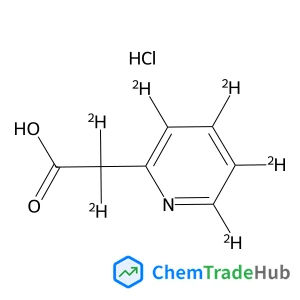
2,2-dideuterio-2-(3,4,5,6-tetradeuterio-2-pyridyl)acetic acid;hydrochloride
CAS番号:
1329799-67-8
分子式:
C7H2ClD6NO2
おすすめサプライヤー






免責事項
このページに表示される学術雑誌情報は、参考および研究目的のみを目的としています。当社は雑誌出版社とは提携しておらず、投稿の取り扱いも行っておりません。出版に関するお問い合わせは、各雑誌出版社に直接ご連絡ください。
表示されている情報に誤りがある場合は、support@chemtradehub.com までご連絡ください。迅速に確認し、対応いたします。