













Macro-RAFT agent mediated dispersion polymerization: the monomer concentration effect on the morphology of the in situ synthesized block copolymer nano-objects
文献情報
出版日
2015-09-25
DOI
10.1039/C5PY01202C
インパクトファクター
5.582
著者
Zhonglin Ding, Chengqiang Gao, Shuang Wang, Hui Liu, Wangqing Zhang
原文を見る
要旨
The monomer concentration affecting the morphology of the in situ synthesized block copolymer nano-objects during the macro-RAFT agent mediated dispersion polymerization is investigated. It is found that the monomer concentration exerts a great influence on both the polymerization kinetics of the poly(ethylene glycol) trithiocarbonate macro-RAFT agent mediated dispersion polymerization and the morphology of the in situ synthesized nano-objects of the poly(ethylene glycol)-block-polystyrene (PEG-b-PS) diblock copolymer. The poly(ethylene glycol) trithiocarbonate macro-RAFT agent mediated dispersion polymerization of styrene in an alcoholic solvent at 50% high monomer concentration follows similar kinetic behaviour to homogeneous RAFT polymerization as indicated by the linear ln([M]0/[M])–time plot, and good control both on the molecular weight of the PEG-b-PS diblock copolymer and the molecular weight distribution is achieved. With the extension of the PS block, the morphology of the in situ synthesized PEG-b-PS nano-objects changes from the porous nanospheres to the bicontinuous nanospheres and finally to the entrapped vesicles, which is much different from the dispersion RAFT polymerization at low monomer concentrations. Our results demonstrate that the monomer concentration is an important parameter affecting the morphology of the in situ synthesized block copolymer nano-objects.
おすすめジャーナル
関連文献
A proton transfer network that generates deprotonated tyrosine is a key to producing reactive oxygen species in phototoxic KillerRed protein
Wook Lee, Inkoo Kim, Young Min Rhee
2018-08-03
Paper
DOI: 10.1039/C8CP02939C
Atomistic reverse nonequilibrium molecular dynamics simulation of the viscosity of ionic liquid 1-n-butyl 3-methylimidazolium bis(trifluoromethylsulfonyl)imide [bmim][Tf2N]
Rouhollah Safinejad, Nargess Mehdipour, Hossein Eslami
2018-08-02
Paper
DOI: 10.1039/C8CP02393J
Total electron scattering cross sections from para-benzoquinone in the energy range 1–200 eV
A. I. Lozano, J. C. Oller, D. B. Jones, M. T. do N. Varella, M. H. F. Bettega, F. Ferreira da Silva, P. Limão-Vieira, M. A. P. Lima, R. D. White, M. J. Brunger, F. Blanco, A. Muñoz, G. García
2018-08-13
Paper
DOI: 10.1039/C8CP03297A
Electron-withdrawing effects on the molecular structure of 2- and 3-nitrobenzonitrile revealed by broadband rotational spectroscopy and their comparison with 4-nitrobenzonitrile
William C. Bailey
2018-08-03
Paper
DOI: 10.1039/C8CP01539B
Infrared spectroscopy of gas phase alpha hydroxy carboxylic acid homo and hetero dimers
Yong Xia, Sifeng Chen, Peifeng Su, Zhijun Yang, Carl O. Trindle, J. L. Knee
2018-10-08
Paper
DOI: 10.1039/C8CP05979A
Electronic structures and transport properties of SnS–SnSe nanoribbon lateral heterostructures
Zhuang Luo, Yandong Guo, Dewei Rao
2019-03-27
Paper
DOI: 10.1039/C9CP00427K
Microscopic origin of the scattering pre-peak in aqueous propylamine mixtures: X-ray and neutron experiments versus simulations
Alexander I. Kuklin, Martina Požar, Anthony Baptista, Aurélien Perera
2019-04-04
Paper
DOI: 10.1039/C9CP01137D
Understanding the influence of disorder on the exciton dynamics and energy transfer in Zn-phthalocyanine H-aggregates
Nicolò Azzaroli, Justin R. Caram, Timothy S. Sinclair, Lorenzo Cupellini, Sandro Jurinovich, Benedetta Mennucci, Gloria Zanotti, Anna Maria Paoletti, Giovanna Pennesi
2018-08-03
Paper
DOI: 10.1039/C8CP02172D
Photoelectron spectroscopy of solvated dicarboxylate and alkali metal ion clusters, M+[O2C(CH2)2CO2]2− [H2O]n (M = Na, K; n = 1–6)
Shihu H. M. Deng, Gao-Lei Hou, Marat Valiev, Xue-Bin Wang
2018-11-02
Paper
DOI: 10.1039/C8CP03896A
Theoretical prediction of LiScO2 nanosheets as a cathode material for Li–O2 batteries
Zhixiao Liu, Shiguo Zhang, Wangyu Hu
2018-08-11
Paper
DOI: 10.1039/C8CP01756E
こちらもおすすめ
28770-01-62-(2-Isopropyl-1,3-o...
化合物よくある質問
「邻羟基阿托伐他汀内酯标准品」に適用される法規ガイドelinesは何ですか?
CAS番号163217-74-1の「邻羟基阿托伐他汀内酯标准品」は、GHS分類では危険物に分類されず、主にREACH規則とFDA/EPAの管理対象となります。R...
163217-74-1ortho-Hydroxy Atorva...
化合物よくある質問
メチル(3R)-3-アミノ-2,3-ジヒドロ-1-ベンゾファンラニン-5-カルボイル酸塩塩酸塩の主な用途は何ですか?
メチル(3R)-3-アミノ-2,3-ジヒドロ-1-ベンゾファンラニン-5-カルボイル酸塩塩酸塩は、医薬品や合成化学の研究に広く用いられます。また、特定の薬物の前...
2241594-15-8Methyl (3R)-3-amino-...
化合物よくある質問
トランス-4-メチルピロリジン-3-オール塩酸塩はどのように合成されますか?
トランス-4-メチルピロリジン-3-オール塩酸塩は、4-メチルピロリジンの塩酸塩化によって合成されます。一般的な合成方法では、4-メチルピロリジンを塩酸に加えて...
265108-42-7trans-4-Methylpyrrol...
化合物よくある質問
硫雜環丁烷-1,1-二氧化物は安全ですか?
硫雜環丁烷-1,1-二氧化物は安全ではありません。毒性は報告されていませんが、高温下で分解し、可燃性があるため、高圧ガスは注意が必要です。密閉した容器で保管し、...
5687-92-3Thietane 1,1-dioxide
6054-10-02H, 8H-Benzo[1,2-b
化合物よくある質問
9-ヒドロキシエリプチシネ塩酸塩はどのように合成されますか?
9-ヒドロキシエリプチシネ塩酸塩は、エリプチシネから塩酸を添加することで合成されます。選択性は高いですが、収率は約70%です。
52238-35-49-Hydroxyellipticine...
化合物よくある質問
5-塩素-2-(メチルアミノ)フェニル-(2-塩素フェニル)メタン酮の物理化学的性質は何ですか?
5-塩素-2-(メチルアミノ)フェニル-(2-塩素フェニル)メタン酮のCAS番号は5621-86-3です。この化合物は白色の結晶性粉末で、分子量は415.03で...
5621-86-3[5-Chloro-2-(methyla...
化合物よくある質問
1-[2-(4-甲氧基-苯氧基)-乙基]-哌嗪はどのように保存すればよいですか?
1-[2-(4-甲氧基-苯氧基)-乙基]-哌嗪は、直射日光を避けて暗所に、室温(15-25℃)で保管し、密閉容器に入れることで安定性を保つことができます。
117132-44-21-[2-(4-Methoxy-phen...
化合物よくある質問
2-[3-(4-甲氧基フェニル)プロピル]-4,4,5,5-四メチル-1,3,2-ドイボロロールアンの主な用途は何ですか?
2-[3-(4-甲氧基フェニル)プロピル]-4,4,5,5-四メチル-1,3,2-ドイボロロールアンは、医薬品の合成、有機合成化学、および新材料の研究で使用され...
1073371-72-82-[3-(4-Methoxypheny...
掲載誌
Polymer Chemistry

CiteScore:
8.6
自己引用率:
7.3%
年間論文数:
457
Polymer Chemistry welcomes submissions in all areas of polymer science that have a strong focus on macromolecular chemistry. Manuscripts may cover a broad range of fields, yet no direct application focus is required.
おすすめ化合物
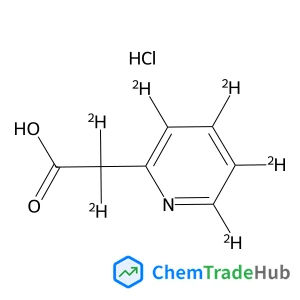
2,2-dideuterio-2-(3,4,5,6-tetradeuterio-2-pyridyl)acetic acid;hydrochloride
CAS番号:
1329799-67-8
分子式:
C7H2ClD6NO2

おすすめサプライヤー




免責事項
このページに表示される学術雑誌情報は、参考および研究目的のみを目的としています。当社は雑誌出版社とは提携しておらず、投稿の取り扱いも行っておりません。出版に関するお問い合わせは、各雑誌出版社に直接ご連絡ください。
表示されている情報に誤りがある場合は、support@chemtradehub.com までご連絡ください。迅速に確認し、対応いたします。